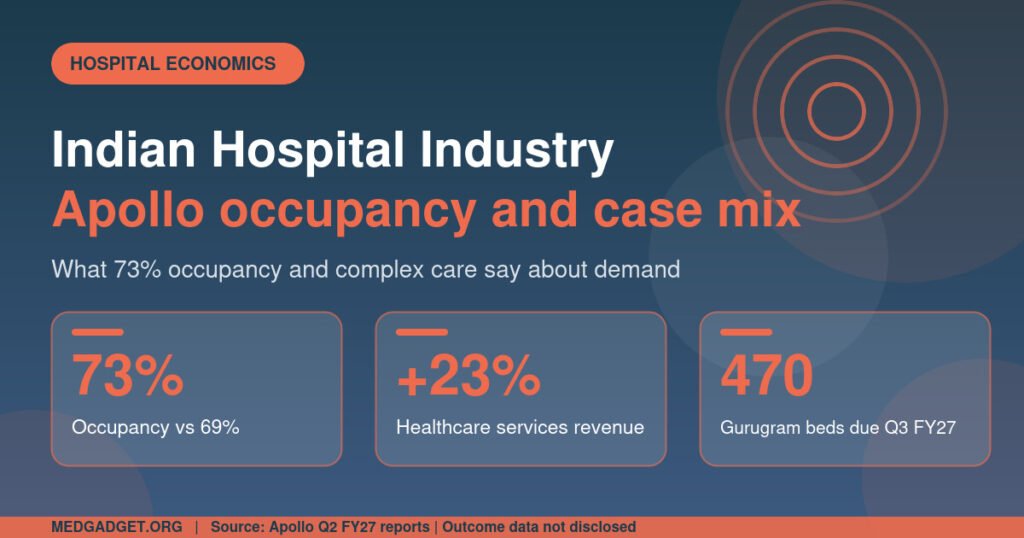

The Indian hospital industry offers a useful lens on how clinical demand turns into financial results, and Apollo Hospitals’ Q2 FY27 numbers, published on 4 November 2026, give a recent example. Occupancy rose to 73% from 69%, more patients came for complex procedures, and revenue from operations grew 23% to ₹7,615 crore while net profit rose 32% to ₹630 crore. This article looks at the clinical and operational side of those figures, what they can and cannot tell us, and which evidence is missing.
Key takeaways on the Indian hospital industry from Apollo’s quarter
- Occupancy of 73% against 69% a year earlier, linked by Apollo to a richer case mix.
- Healthcare services revenue rose about 23%, with demand for oncology and urology and a jump in international patients cited in one report.
- Net profit grew faster than revenue, which is consistent with operating leverage.
- Apollo plans to add 5,800 beds over five years; a 470-bed Gurugram hospital is scheduled for Q3 FY27.
- No data on clinical outcomes, infection rates or patient experience accompanied the financial reports.
What a richer case mix means clinically
Hospitals treat very different cases. A short admission for a simple problem consumes few resources, while a complex cancer operation, a cardiac procedure or an organ transplant demands specialist teams, intensive care capacity and expensive equipment. A richer case mix means the proportion of complex care is rising. Financially that raises revenue per bed. Clinically, it raises the importance of outcomes, because complex procedures carry higher risks and depend on volume and team experience.
The financial reports do not describe outcomes. Readers who want to judge whether growth in complex care is accompanied by good results should look for published data on survival after surgery, readmission rates and hospital-acquired infections, which were not part of the announcement.
Oncology and urology demand
One press report said healthcare services revenue was lifted by strong demand in oncology and urology. Both fields rely on diagnostics, surgery and, in oncology, drug therapy and radiotherapy, so growth can be driven by earlier detection, ageing populations and better access. We note that diagnostics research, such as the NHS blood test trial we report on in this series, is part of the wider effort to detect cancers earlier, but nothing in Apollo’s figures links its oncology volumes to any specific cause.
Occupancy: a clinical and operational balance
Occupancy has an optimum. Very low occupancy wastes capacity, but very high occupancy can strain staff, delay admissions and reduce the buffer needed for emergencies. At 73%, Apollo’s reported figure sits in a range that many hospital managers consider healthy, though no single benchmark applies to every hospital. The sources did not report bed turnover or length of stay.
The numbers
| Measure | Q2 FY27 | Year-on-year |
|---|---|---|
| Revenue from operations | ₹7,615 crore | Up 23% |
| Net profit (most reports) | ₹630 crore | Up 32% |
| Occupancy | 73% | From 69% |
| Planned bed additions | 5,800 over five years | Not applicable |
One report gives net profit as ₹660 crore, up 33.6%. Our calculation suggests that both figures fit different prior-year bases (about ₹477 crore and ₹494 crore), which points to different profit definitions, though the reports do not say so.
The expansion and quality
Rapid expansion poses a quality question. New hospitals must recruit and train clinical staff, establish protocols and build referral networks. The sources did not discuss how Apollo plans to maintain quality standards across 5,800 additional beds. Accreditation and public reporting of outcomes are common ways for hospitals to demonstrate quality, and details of such measures would help readers assess the plan.
Timeline
- 30 September 2026: end of the reported quarter.
- 4 November 2026: results published.
- Q3 FY27: Gurugram hospital with 470 beds scheduled to begin operations.
- Over five years: addition of 5,800 beds planned.
Market context: medical tourism
Acumen Research And Consulting has no hospital-sector report for India, so we cite its Medical Tourism Market report as an adjacent source for the international patient theme. It gives USD 11,395 million in 2021 and USD 88,595 million by 2030, with a 27.4% compound annual growth rate for 2022 to 2030, and names cancer treatment as the largest segment in 2021.
The page is dated August 2022, and its growth rate does not reconcile with its endpoints, which imply about 25.6% a year by our calculation. It gives no India-specific share. We use it only as background.
Our analysis
In our assessment, the Apollo results show strong demand for complex hospital care but say little about the quality of that care, which is the question that matters most to patients. Higher occupancy and richer case mix are positive signs for the business and indicate that patients are choosing the hospitals. They are not evidence of better outcomes. For the wider Indian hospital industry, the next phase of competition is likely to include transparency on outcomes as well as capacity.
What is not disclosed
- Clinical outcomes, infection rates and patient experience.
- Revenue per occupied bed, length of stay and specialty split.
- The share of international patients in revenue.
- Staffing plans for the new capacity.
Risks and caveats
- Financial results do not measure care quality.
- New hospitals can take time to reach target occupancy.
- Some details come from press reports and not company filings.
- This is not medical or investment advice.
What to watch next
- Disclosure of outcomes or accreditation for new hospitals.
- Regulatory changes on procedure pricing.
- Occupancy at newly opened hospitals.
- Workforce plans for expansion.
General background
Company information is at Apollo Hospitals. Related coverage: the Supreme Court drug-pricing scrutiny that hit Indian hospital stocks. Exchange filings are available at the NSE and BSE websites. More in our Healthcare Services category.
Questions readers are asking about the Indian hospital industry
Does higher occupancy mean better care?
Not necessarily. It shows demand, not quality.
What is case mix?
The mix of simple and complex patients a hospital treats.
Why does expansion matter for quality?
New hospitals must build teams and protocols, and outcomes depend on experience and volume.
FAQ
How much did Apollo’s revenue grow?
About 23% to ₹7,615 crore.
What was occupancy?
73%, up from 69%.
Are outcome data published?
Not in the sources we reviewed.
How we reported this: details come from press reports of Apollo Hospitals’ Q2 FY27 results published on 4 November 2026; we did not review the filing. Market figures are attributed to Acumen Research And Consulting. Last updated 4 November 2026. This is news reporting and not medical or investment advice.