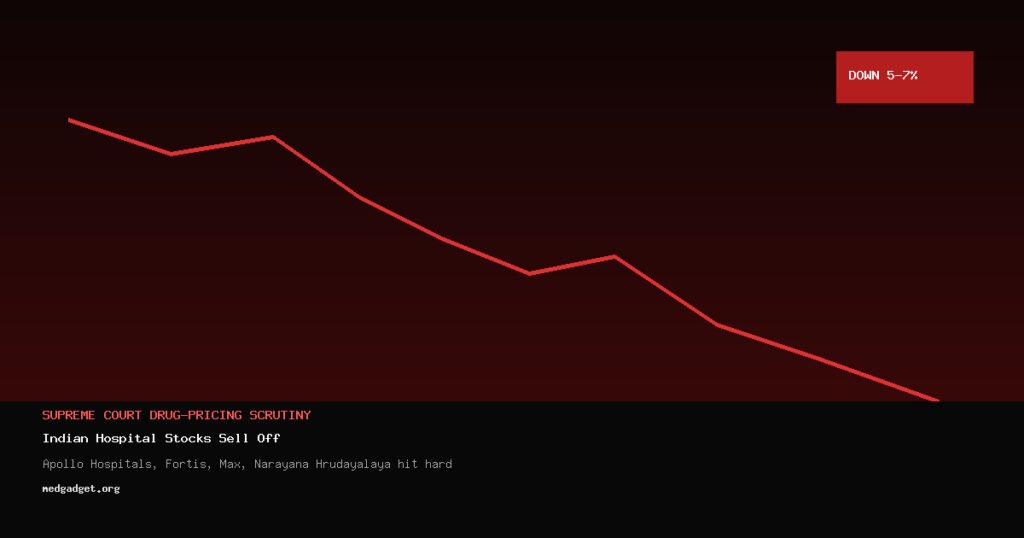

Shares of major Indian hospital operators fell sharply on September 30, 2026, as investors reacted to the Supreme Court of India’s renewed scrutiny of medicine mark-ups at private hospitals. Apollo Hospitals Enterprise, Fortis Healthcare, Max Healthcare Institute, and Narayana Hrudayalaya each declined between five and seven percent on the Bombay Stock Exchange and National Stock Exchange, representing one of the steepest single-day drops for the sector in recent memory.
What the Supreme Court Said
The sell-off was triggered by statements from the Supreme Court bench during a hearing related to alleged overcharging for medicines and consumables at private hospitals. The court expressed strong concern over the practice of private facilities marking up drug prices significantly above their procurement cost or the maximum retail price, a practice that consumer advocates and patient rights groups have long criticized as exploitative, particularly for patients receiving treatment for serious or chronic conditions.
The bench questioned why patients admitted to private hospitals should pay prices substantially higher than what the same drugs cost at a retail pharmacy, and indicated that the court was considering whether to issue broader directions on medicine pricing in the private healthcare sector. The court did not issue an immediate binding order, but the direction of its inquiry was clear enough to prompt a swift market reaction.
Why Markets Reacted So Sharply
The medicine mark-up model is a significant revenue contributor for private Indian hospitals. Industry analysts have noted for years that margins on pharmacy and consumable sales within hospital facilities can run well ahead of margins on clinical services themselves. Any regulatory or judicial action that compresses those mark-ups would have a direct and material impact on the revenue and profitability of listed hospital chains.
Investors appear to have concluded that even the court’s stated scrutiny, short of a formal order, signals elevated regulatory risk for the sector. The sell-off reflected concern that a binding ruling or government action following from the court’s observations could force changes to pricing practices that hospitals have relied upon for years as part of their operating model.
The Stocks That Fell Hardest
Apollo Hospitals, the country’s largest listed hospital chain by market capitalization and the operator of a large pharmacy retail network, was among the most affected. The dual exposure, both as a hospital operator collecting in-facility drug margins and as a pharmacy retailer, placed it at the intersection of the court’s concerns. Fortis Healthcare and Max Healthcare, which together operate a substantial share of Delhi NCR’s private hospital capacity, also saw steep declines. Narayana Hrudayalaya, known for its high-volume, lower-cost model, was not immune despite its positioning as a more accessible provider.
Smaller and mid-cap hospital operators listed on Indian exchanges saw similar pressure, with the broader healthcare index underperforming the market significantly on the day.
The Underlying Policy Debate
Medicine pricing in private Indian hospitals sits at the intersection of several long-running policy tensions. The National Pharmaceutical Pricing Authority regulates the prices of essential medicines under the Drugs (Prices Control) Order, but private hospitals frequently argue that procurement logistics, storage, dispensing infrastructure, and the cost of maintaining 24-hour pharmacy access within a hospital facility justify prices above what a standalone retail chemist charges.
Patient advocacy organizations counter that for a patient already paying room charges, procedure fees, and consultation fees, a substantial additional mark-up on medicines they have no ability to source elsewhere during a hospital stay amounts to a captive pricing situation. The Supreme Court’s interest in the matter reflects how politically and socially charged the issue has become, particularly in the context of rising out-of-pocket healthcare costs in India.
The government has considered various regulatory approaches over the years, including price caps on in-hospital drug sales and requirements that hospitals allow patients to source medicines from outside pharmacies. Implementation has been inconsistent across states.
What Comes Next
The Supreme Court was expected to continue hearing the matter in subsequent sessions. A formal direction or ruling, if it emerges, could take the form of a cap on mark-ups relative to procurement price or MRP, a requirement for price transparency at point of dispensing, or a referral to the government to formulate a regulatory framework within a specified time. Any of these outcomes would have significant implications for hospital sector earnings.
Analysts at several domestic brokerage houses noted that while the near-term market reaction may have been exaggerated, the longer-term uncertainty around medicine pricing regulation in the private hospital sector is a genuine overhang that investors will need to price in. Hospital stocks had seen a strong multi-year run on the back of expanding capacity, rising insurance penetration, and improving margins, and this development introduces a structural risk to that earnings narrative.
The sector will be watching closely for any government response to the court’s observations, and for whether the Ministry of Health and Family Welfare or the National Pharmaceutical Pricing Authority is directed to take any specific action.
Medical Disclaimer: This article covers financial and regulatory developments affecting healthcare companies and is for informational purposes only. It does not constitute investment advice. Readers should consult a registered financial advisor before making any investment decisions.