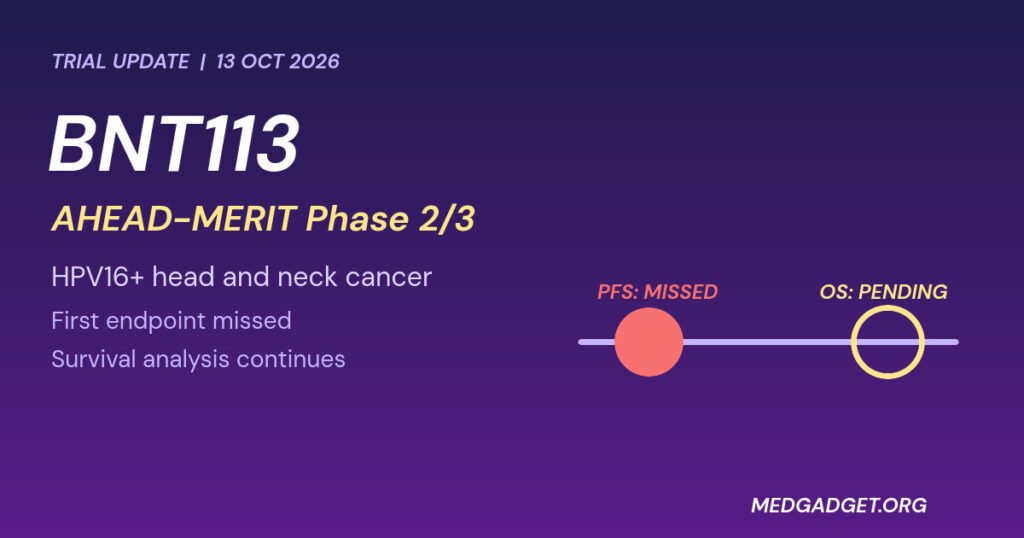

The BNT113 clinical trial has missed its first main goal, but it is not over. In a statement dated 13 October 2026, BioNTech said that the Phase 2/3 AHEAD-MERIT study of its mRNA cancer immunotherapy BNT113 plus pembrolizumab did not show a statistically significant improvement in progression-free survival compared with pembrolizumab alone in people with HPV16-positive head and neck cancer. An independent monitoring committee recommended that the trial continue so that overall survival, the other main endpoint, can be assessed.
The company has not published any numbers. This article explains what that means, what remains open, and how to read a trial that has a dual primary endpoint.
BNT113 clinical trial: key takeaways
- Result: no statistically significant progression-free survival benefit for BNT113 plus pembrolizumab versus pembrolizumab alone, per BioNTech.
- Decision: the Independent Data Monitoring Committee recommended continuing to assess overall survival.
- Design: under the pre-specified plan, a statistically significant overall survival gain would still count as a positive outcome.
- Not disclosed: hazard ratios, median survival, response rates, safety data, enrolment and the timing of the survival analysis.
- Status: BNT113 is investigational and not approved anywhere.
What the BNT113 clinical trial tested
AHEAD-MERIT (NCT04534205, listed on ClinicalTrials.gov) is an open-label, controlled, multi-site study. Open-label means that doctors and patients know which treatment is given. It compares BNT113 combined with pembrolizumab, an approved checkpoint inhibitor, against pembrolizumab alone as first-line treatment. The patients have unresectable recurrent or metastatic head and neck squamous cell carcinoma that is positive for HPV16 and expresses PD-L1 with a combined positive score of at least 1.
The trial has two parts. Part A was a non-randomised safety run-in to confirm safety and tolerability. Part B is the randomised part that is meant to provide the main efficacy and safety data. Treatment can last up to about 24 months.
How BNT113 is meant to work in the BNT113 clinical trial
BNT113 is an mRNA-based immunotherapy that encodes two proteins from HPV16, called E6 and E7. These proteins are made by HPV16-positive tumour cells. The idea is to train the immune system to recognise cells that display them, and to strengthen the effect of checkpoint inhibitors such as pembrolizumab. According to the company, about one-third of head and neck squamous cell carcinomas are linked to HPV, and most of those to HPV16. The National Cancer Institute explains the link between HPV and some head and neck cancers in more detail.
Reading a dual-endpoint trial after a miss
AHEAD-MERIT has two primary endpoints in Part B: progression-free survival, the time until the cancer grows or the patient dies, and overall survival, the time until death from any cause. The first analysis, on progression-free survival, did not reach statistical significance. Because the plan allows a positive result on overall survival alone, the study continues.
That does not mean the outcome is likely to be positive. A missed first endpoint is a setback, and the survival analysis may or may not show a benefit. Immunotherapies sometimes show effects on survival that appear later than effects on tumour growth, which is why regulators and sponsors keep following patients. But the release gives no data that would let us judge the odds.
Another point is that BioNTech says it remains blinded to the ongoing trial data under the trial’s governance procedures. So the company itself does not know the detailed results beyond what the monitoring committee has reported.
Why the control arm matters in the BNT113 clinical trial
The comparison arm is pembrolizumab alone, so the trial asks whether adding BNT113 gives patients more than the checkpoint inhibitor already provides. That is a demanding test, because the control treatment is itself active. An add-on therapy has to show a benefit on top of it, and a modest effect can be hard to detect in a trial of limited size. The release does not give the number of patients, so we cannot say how much statistical power the study had.
What BioNTech has said
Prof. Özlem Türeci, Co-Founder and Chief Medical Officer of BioNTech, said the data support continued evaluation of BNT113 plus pembrolizumab in this trial and that overall survival will be critical to fully assess the approach’s potential. BNT113 received a US Fast Track designation in January 2026, which is intended to speed development and review of drugs for serious conditions. The release announces no regulatory submission and notes that no HPV-targeted treatments are currently approved. Our earlier report on Kupando’s KUP101 entering Phase 1 in cancer covers another early cancer programme, and more is in life science news.
What the BNT113 clinical trial means for patients
BNT113 is not available outside the trial, and the result does not change how approved treatments are used. People with head and neck cancer should continue to follow their oncologist’s plan. Anyone currently taking part in a trial should speak to their study team about what the update means for them, since the release does not describe any change to the protocol.
Risks and caveats on the BNT113 clinical trial
- We have only the company’s statement. No peer-reviewed or conference data are available yet.
- Missing a primary endpoint lowers confidence, whatever happens next.
- There is no timeline for the survival analysis.
- Results in this setting, HPV16-positive, PD-L1-positive disease, may not apply to other cancers or other mRNA products.
In our assessment, the honest summary is: unresolved, with the burden now on the survival data. We would not describe the BNT113 clinical trial as either a failure or a success until the second endpoint reads out and the full data are shown.
What to watch next in the BNT113 clinical trial
- Timing and results of the overall survival analysis.
- Presentation of full data, including hazard ratios and safety, at a medical meeting or in a journal.
- Any change to BNT113 development plans.
- Updates from BioNTech’s quarterly reporting.
Frequently asked questions
Did the BNT113 clinical trial fail?
It missed the progression-free survival endpoint, but the overall survival analysis continues, so the final outcome is unresolved.
What is BNT113?
An investigational mRNA cancer immunotherapy that encodes HPV16 E6 and E7 proteins.
Who was in the BNT113 clinical trial?
People with unresectable recurrent or metastatic HPV16-positive head and neck cancer whose tumours express PD-L1 (CPS of 1 or more).
Is BNT113 approved?
No. It is investigational and has FDA Fast Track designation.
How we reported this: we relied on BioNTech’s statement of 13 October 2026 and the trial registry listing, and the websites of the bodies named. Last updated: 15 October 2026. This article is news reporting and not medical advice.