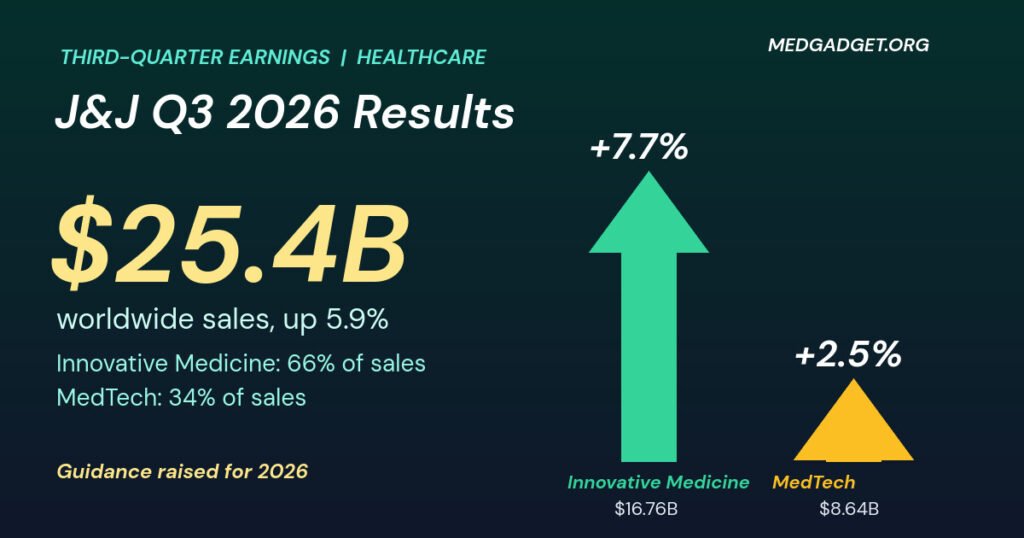

The Johnson & Johnson Q3 2026 results show a company growing about 6% overall, with almost all of the lift coming from medicines, not devices. On 13 October 2026, Johnson & Johnson reported third-quarter sales of $25.4 billion, up 5.9%. Its pharmaceutical arm, Innovative Medicine, rose 7.7% to $16.76 billion, while MedTech, its device business, rose just 2.5% to $8.64 billion. The company also raised its full-year outlook and said it expects to pass $100 billion in annual sales for the first time.
The headline hides some details worth separating: profit measured under standard accounting rules fell sharply because of one-off items, the device slowdown was concentrated in surgery, and the strongest pharmaceutical growth came from cancer and brain medicines, not immunology. Here is what the numbers show.
Johnson & Johnson Q3 2026 results: the numbers
- Worldwide sales: $25,399 million, up 5.9% reported and 6.0% operationally (excluding currency), against $23,993 million a year earlier.
- Innovative Medicine: $16,757 million, up 7.7% reported and 7.9% operationally.
- MedTech: $8,642 million, up 2.5%.
- United States: $14,959 million, up 9.1%.
- International: $10,440 million, up 1.5% reported and 1.8% operationally.
- Adjusted earnings per share: $2.59, down 7.5% from $2.80.
- Earnings per share under standard (GAAP) accounting: $0.09, against $2.12 a year earlier.
The two segments add up: $16,757 million plus $8,642 million is $25,399 million. Reports said the results topped analysts’ forecasts, and that J&J shares fell after the announcement, with market summaries giving different percentage moves. We have not checked analyst consensus figures.
Where MedTech slowed in the Johnson & Johnson Q3 2026 results
MedTech growth of 2.5% was well below the pharmaceutical segment. According to a summary of the company’s presentation, cardiovascular sales grew about 4.1% operationally, led by electrophysiology (treating abnormal heart rhythms) and double-digit growth at Shockwave, though Abiomed declined. Vision rose about 5.1% on contact lenses, and orthopaedics about 3.4%. Surgery was the weak spot, down about 1.0%, with endocutters down about 4%.
The headwinds named in the summary of the company’s commentary were volume-based procurement in China, a surgery restructuring programme, and disruption in the Middle East. Europe sales were $5,405 million, down 0.6% reported and up 1.0% excluding currency. Some reports also cite European healthcare spending limits; we did not see that in the company materials we read. Management said MedTech fell short of its own expectations, according to the same summary.
Where pharmaceutical growth came from in the Johnson & Johnson Q3 2026 results
Immunology is often assumed to be the engine, but the figures say otherwise. Oncology was about $7.6 billion, up roughly 16.7% operationally, driven by Darzalex, Carvykti, Tecvayli, Talvey and the Rybrevant lung cancer combination. Neuroscience was about $2.4 billion, up roughly 17.6%, on Spravato and Caplyta. Immunology was about $4.2 billion and grew only about 1.4%, because gains for Tremfya were largely offset by declines in Stelara, Simponi and Remicade; Stelara alone cut about 690 basis points from segment growth. Describing immunology as the growth driver would therefore overstate what happened. Sixteen Innovative Medicine products now exceed $1 billion in annual sales, according to the summary.
Our calculation: medicines drove most of the growth
Sales rose by $1,406 million year on year. Innovative Medicine contributed $1,194 million of that and MedTech $212 million. By our calculation, MedTech made up about 34% of sales but only about 15% of the increase, while Innovative Medicine supplied about 85%. These are our own figures from the reported totals.
Johnson & Johnson Q3 2026 results: why GAAP and adjusted profit differ
GAAP net earnings were $210 million, down 95.9% from $5,152 million, while adjusted net earnings were $6,339 million, down 6.8%. One summary of the presentation attributes roughly $7 billion of special items to a talc litigation resolution and to acquisitions of Firefly Bio and Sail Biomedicines; we have not verified that breakdown against the company’s filings, which are available through the SEC’s EDGAR database. The company also spent more on research: R&D rose 26.7% to $4.7 billion, or about 18% of sales, and adjusted pre-tax operating margin fell about 60 basis points, less than the 75 it had guided.
The raised outlook after the Johnson & Johnson Q3 2026 results
- Reported sales: $101.0 billion to $101.4 billion, up from $100.8 billion to $101.4 billion.
- Adjusted EPS: $11.05 to $11.15, up from $10.96 to $11.11.
- Operational sales growth: about 6.7% to 7.1%.
Chief Financial Officer Joe Wolk said the company is “very confident” it will surpass $100 billion in annual sales, and Chairman and CEO Joaquin Duato said the focused portfolio gives “clearer line of sight to double-digit growth by the end of the decade.” These are forward-looking statements, not results.
A robotic surgery milestone
One bright spot for devices is OTTAVA, J&J’s robotic surgical system, which received FDA marketing authorisation through the FDA’s De Novo pathway. The company describes it as the first table-integrated soft-tissue robotic system, cleared for 10 general surgery procedures including gastric bypass and gallbladder removal, and says it takes 30% to 50% less space than other robotic systems. It signed its first commercial customer, according to the summary. Authorisation is not sales, and any revenue effect is still ahead. For related context, see our report on the AI-powered surgical software market.
Our assessment of the Johnson & Johnson Q3 2026 results
In our assessment, the Johnson & Johnson Q3 2026 results reinforce a pattern across large healthcare groups: the pharmaceutical business is carrying growth while devices are held back by pricing, procurement and geopolitical pressure. That matters for MedTech investors and suppliers because J&J is a bellwether, but one company’s quarter does not prove an industry trend. The sharp fall in GAAP earnings looks driven by one-off items, so the adjusted figures are a better guide to the underlying business, though adjusted measures exclude real costs. For another earnings read, see our report on Pfizer’s second-quarter results and GE HealthCare’s SOFIE acquisition, or browse our medical device coverage.
What to watch after the Johnson & Johnson Q3 2026 results
- Whether surgery sales recover as the restructuring programme runs.
- The effect of China’s volume-based procurement on device pricing.
- Stelara’s continued decline against Tremfya growth.
- Commercial rollout of OTTAVA.
Frequently asked questions
What were the Johnson & Johnson Q3 2026 results?
Sales of $25.4 billion, up 5.9%, with Innovative Medicine at $16.76 billion (+7.7%) and MedTech at $8.64 billion (+2.5%).
Did J&J raise its outlook?
Yes. It now expects reported sales of $101.0 billion to $101.4 billion and adjusted EPS of $11.05 to $11.15.
Why did MedTech grow slowly in the Johnson & Johnson Q3 2026 results?
The company points to surgery weakness, volume-based procurement in China and Middle East disruption.
Why is GAAP profit so low?
GAAP earnings of $210 million include large one-off items; adjusted earnings were $6.3 billion.
Did immunology drive pharmaceutical growth?
No. Oncology and neuroscience grew fastest; immunology grew about 1.4%.
How we reported this: we relied on the company’s third-quarter 2026 earnings materials as summarised in its public update and in summaries of its results tables and presentation, which we could not read in full. Figures labelled as ours are our own calculations. Last updated: 13 October 2026. This article is news reporting and not investment advice.