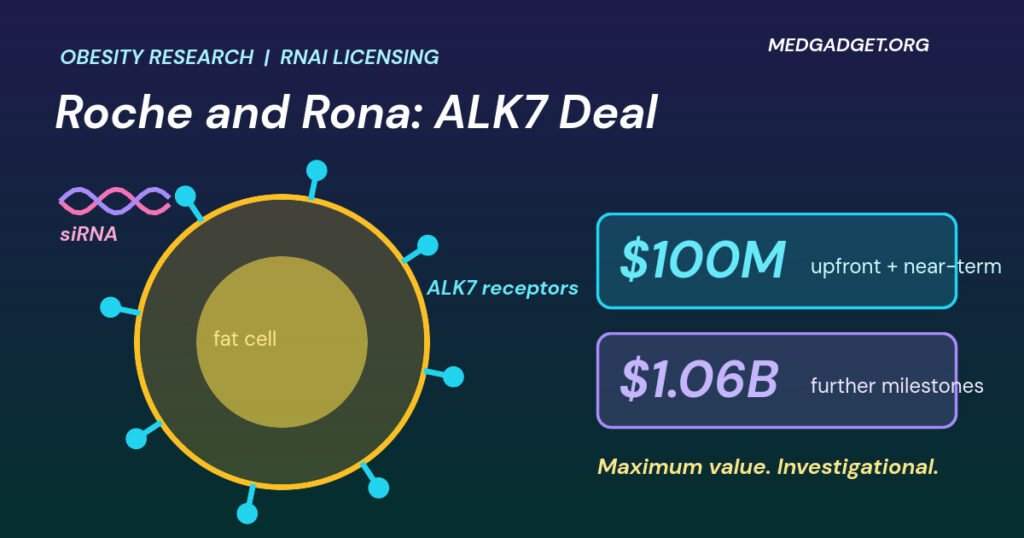

The Roche Rona Therapeutics obesity deal gives the Swiss drugmaker exclusive worldwide rights to an experimental RNA interference (RNAi) therapy that targets a protein called ALK7, according to announcements on 13 October 2026. Roche would pay Rona, a Chinese biotechnology company, up to $100 million in upfront and near-term payments, and up to a further $1.06 billion in development, regulatory and commercial milestones, which together make the headline figure of up to $1.16 billion.
That headline is a ceiling, not a payment. The therapy is investigational, its clinical benefit has not been shown, and the sources we reviewed did not say whether it has been tested in people. This report sets out the terms, the science, the crowded field and what remains unknown.
Roche Rona Therapeutics obesity deal: the terms
- Rights: exclusive, worldwide licence to Rona’s ALK7-targeting RNAi therapy for obesity and metabolic diseases.
- Upfront and near-term: up to $100 million combined.
- Additional milestones: up to $1.06 billion, tied to development, regulatory and commercial goals.
- Royalties: one report says Rona also receives tiered royalties on global sales; the rates were not disclosed in anything we read.
- Not disclosed: the candidate’s name, its development stage and the split between upfront and near-term payments.
We could not read Rona’s own press release because the page was blocked while we were reporting, so the details above come from secondary reports of it.
Reading the $1.16 billion Roche Rona Therapeutics obesity deal
The arithmetic works: $100 million plus $1.06 billion is $1.16 billion. By our calculation, the near-term share is about 9% of the headline, so over 90% depends on milestones that may never be reached. Drug licensing deals often work this way, because most experimental drugs fail before they earn money. Reports differ on royalties: one describes them as paid on top of the milestones, while another summary groups them in with the milestone figure. Because the companies’ release was unavailable to us, we have not treated royalties as part of the total.
What ALK7 is, and why the Roche Rona Therapeutics obesity deal uses RNAi
ALK7, formally activin receptor-like kinase 7, is a receptor found mainly in fat cells that helps regulate how fat is stored and broken down. Rona says that lowering ALK7 production could reduce visceral fat, the fat around internal organs, and fat elsewhere while preserving lean mass. Muscle loss often accompanies weight loss with current injectable obesity drugs, which is why companies are pursuing treatments that act on fat tissue directly and could be used alone or with them.
RNAi works by silencing a gene’s messenger RNA so that less of its protein is made, as described by the National Human Genome Research Institute. In obesity, the attraction is that a single injection might act for a long time. These are hypotheses: the benefits in people have not been established.
Rona’s delivery platform
Most RNAi medicines are designed to reach the liver, where they naturally collect. ALK7 sits in fat tissue, so a drug must reach beyond the liver. Rona says its extrahepatic delivery platform is built to do that, and its chief executive, Stella Shi, promoted it as the basis for the candidate. That is the company’s claim, and we saw no human data supporting it.
A crowded ALK7 field
- Arrowhead Pharmaceuticals has reported interim data for ARO-ALK7: a 14.1% placebo-adjusted reduction in visceral fat eight weeks after one dose. The highest-dose group had only four participants, so the result is very preliminary.
- Alnylam has an ALK7-directed candidate, ALN2232, which is reported to be in early clinical trials.
- GSK licensed an ALK7 RNAi candidate, SA030, from SiranBio in May, in a deal reported at $55 million upfront and up to $1 billion in total.
Roche is therefore entering an area where rivals are already ahead in human testing. Whether its candidate is competitive will depend on data not yet public.
Where the Roche Rona Therapeutics obesity deal fits in Roche’s strategy
Roche has said it wants a major role in obesity treatment. Reports say it stopped development of emugrobart, an antibody meant to preserve muscle, in late September after an interim Phase 2 analysis suggested it was unlikely to meet its goals when combined with other obesity drugs, and that its Genentech unit licensed a Hanmi compound, HM17321, in August for $190 million upfront.
The Rona agreement adds another approach to a portfolio that is built mostly through licensing. Obesity affects a very large share of the world’s adults, according to the World Health Organization, which is why companies are spending heavily. For a similar RNAi obesity programme, see our report on Ribo’s EU trial application for obesity siRNA RBD3133, and for another Roche deal see Roche’s bet of up to $1.27 billion on Alector.
What we do not know about the Roche Rona Therapeutics obesity deal
- Whether the candidate has been given to people, and if so at what dose.
- The name of the molecule and the first indication Roche will pursue.
- How much of the $100 million is paid upfront.
- Whether the therapy reduces fat without harming muscle or safety in humans.
- When any clinical trial could begin.
Our assessment of the Roche Rona Therapeutics obesity deal
In our assessment, the Roche Rona Therapeutics obesity deal is best read as an option on an unproven idea. Roche pays modestly up front, and the rest is contingent on success. The scientific rationale of cutting fat while sparing muscle is reasonable, and competitors have reported early signals, but the only public numbers come from small studies by other companies.
Until Roche or Rona releases human data, there is no basis to compare this candidate with existing obesity drugs. For market background, see our report on Novo Nordisk’s $23 billion pipeline sales target, and browse our pharmaceutical coverage.
What to watch next in the Roche Rona Therapeutics obesity deal
- Disclosure of the candidate’s name and development stage.
- A first-in-human trial registration.
- Early data from rival ALK7 programmes.
- Further obesity licensing deals by Roche.
Frequently asked questions
What is the Roche Rona Therapeutics obesity deal?
An exclusive worldwide licence of Rona’s ALK7-targeting RNAi therapy, worth up to $1.16 billion including milestones.
How much will Rona receive up front?
Up to $100 million in upfront and near-term payments combined.
Is the $1.16 billion Roche Rona Therapeutics obesity deal guaranteed?
No. It is a maximum, and most depends on future milestones.
What is ALK7?
A receptor in fat cells involved in fat storage and breakdown.
Does the therapy work?
That is not known. It is investigational and no clinical benefit has been established.
How we reported this: we relied on secondary reports of the 13 October 2026 announcements by Roche and Rona, which we could not read directly, and on public information about competitors. Figures labelled as ours are our own calculations. Last updated: 13 October 2026. This article is news reporting and not investment or medical advice.