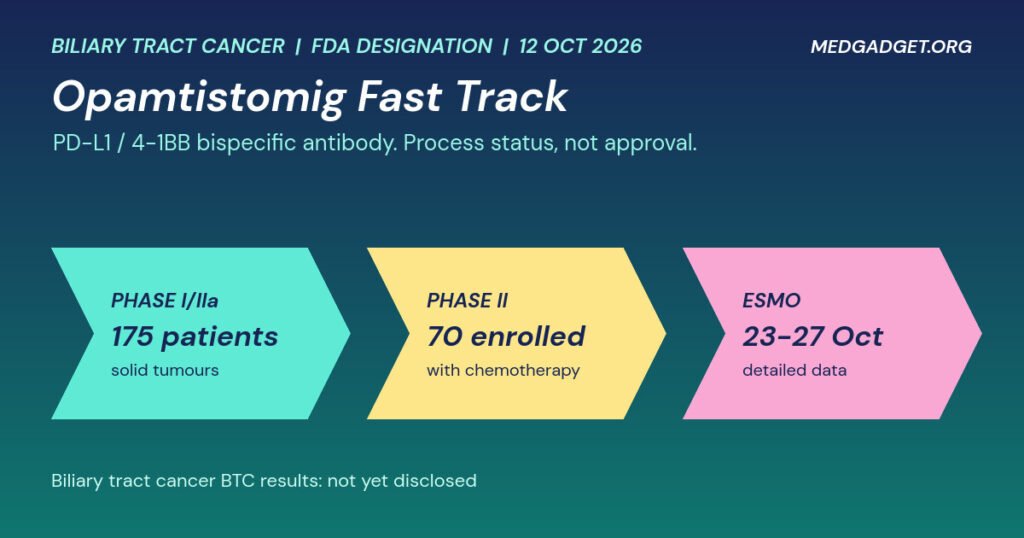

The opamtistomig Fast Track designation announced on 12 October 2026 gives Leads Biolabs a closer line to US regulators for a drug aimed at first-line biliary tract cancer. The company said the FDA granted the status to opamtistomig, its PD-L1 and 4-1BB bispecific antibody, for first-line advanced or metastatic biliary tract cancer, and that the FDA also recommended starting discussions on a US registration strategy for opamtistomig combined with chemotherapy.
Fast Track is a process designation, not a sign that the drug works. This report sets out what the status means, what data exist, and what the company has not yet shown.
Key facts on the opamtistomig Fast Track
- What was granted: FDA Fast Track Designation for first-line advanced or metastatic biliary tract cancer (BTC).
- Speed claim: the company says the designation came nine days after submission.
- FDA recommendation: discuss a US registration path for opamtistomig plus chemotherapy.
- Drug type: a bispecific antibody that blocks PD-L1 and conditionally activates the T-cell receptor 4-1BB.
- Second Fast Track: the first was for extrapulmonary neuroendocrine carcinoma, announced in January 2026.
- Not disclosed: BTC response rates, survival, safety numbers and any approval timeline.
What the opamtistomig Fast Track actually means
The FDA’s description of Fast Track describes a programme intended to speed development of drugs for serious conditions with unmet needs, through more frequent contact with the agency. Drugs with the status can also qualify for rolling review, where a company submits completed sections of an application as they are ready. It does not shorten the evidence requirements, it is not marketing approval, and it does not guarantee faster approval. In our assessment, the useful part for the company is the dialogue with the FDA on trial design, which is why the recommendation to discuss a registration strategy matters more than the label.
The science behind the opamtistomig Fast Track
Opamtistomig (also known as LBL-024) is designed to block PD-L1, a checkpoint that tumours use to switch off immune cells, and at the same time to activate 4-1BB, a receptor that boosts T-cell activity, conditionally within the tumour environment. The idea is to combine a familiar checkpoint effect with an added stimulatory signal. Whether that gives more benefit than existing PD-1 or PD-L1 drugs is the question the trials must answer, and it has not been answered for this indication.
Why the opamtistomig Fast Track targets biliary tract cancer
Biliary tract cancer arises in the bile ducts and gallbladder, and the National Cancer Institute offers background. The company cites about 419,100 new cases worldwide in 2024, and says that current first-line regimens combining a PD-1 or PD-L1 antibody with chemotherapy deliver median overall survival of roughly 11.5 to 12.8 months and objective response rates below 30%. These are the company’s figures. They frame the unmet need that Fast Track is meant to address.
Data behind the opamtistomig Fast Track
The announcement offers little numerical evidence. A Phase I/IIa basket study, listed on the ClinicalTrials.gov entry for the Phase I/IIa basket study (NCT05170958), gave opamtistomig as monotherapy to 175 patients with advanced solid tumours, including BTC, platinum-resistant ovarian cancer, PD-1-refractory liver cancer and previously treated extrapulmonary neuroendocrine carcinoma. The company describes the results as encouraging and reports preliminary signals of potential survival benefit, but gives no response rates, disease control rates or survival figures for BTC.
A Phase II study combining opamtistomig with chemotherapy moved into its expansion stage in April 2026, and the company says all 70 patients had enrolled by 30 July 2026. It describes the safety profile as encouraging and comparable to that of PD-1 and PD-L1 inhibitors, without adverse event data. Detailed data are scheduled for the European Society for Medical Oncology meeting from 23 to 27 October 2026. Until then, the combination data are the missing piece, since that regimen is the one the FDA discussion concerns.
The wider regulatory picture beyond the opamtistomig Fast Track
The company lists several earlier milestones. China’s regulator granted Breakthrough Therapy Designation in October 2024, and the FDA granted Orphan Drug Designation in November 2024. The first FDA Fast Track, for extrapulmonary neuroendocrine carcinoma, followed in January 2026, and the European Commission granted orphan designation in January 2026. In China, the drug received priority review in July 2026 and a new drug application was accepted in August 2026, and Japan granted orphan designation in September 2026. Those China milestones relate to the neuroendocrine carcinoma indication, not BTC, and should not be read as progress in biliary tract cancer.
Our assessment of the opamtistomig Fast Track
In our assessment, the designation is a reasonable step but a modest one. It signals that the FDA sees an unmet need and is willing to engage, and the speed the company reports, nine days, points to a straightforward submission. But it tells us nothing about efficacy. The next test is the ESMO presentation: response rates and survival from 70 combination patients would be small and single-arm, so even good numbers would need confirming in a randomised trial against the current standard.
What the opamtistomig Fast Track leaves unanswered
- Response rate, duration of response and survival in BTC.
- Safety numbers, including immune-related and 4-1BB-related events, which are of particular interest with this mechanism.
- The design of any registrational trial and whether the FDA will accept a single-arm path.
- The timeline to a US filing.
- How the drug compares with existing options in a head-to-head setting.
For related oncology coverage, see our reports on the FDA approval of a Tecentriq combination for stage III dMMR colon cancer and Beactica’s BEA-28 preclinical candidate for solid tumours, or browse more pharmaceutical news.
Frequently asked questions
What is the opamtistomig Fast Track?
An FDA designation, announced on 12 October 2026, for opamtistomig in first-line advanced or metastatic biliary tract cancer.
Is opamtistomig approved after the opamtistomig Fast Track?
No. Fast Track is not approval. The drug is investigational for biliary tract cancer.
What type of drug is opamtistomig?
A PD-L1 and 4-1BB bispecific antibody.
Does the opamtistomig Fast Track show it works in biliary tract cancer?
No. The company has not released BTC response or survival numbers. Detailed data are due at ESMO.
When will detailed data be available?
The company says at the ESMO meeting from 23 to 27 October 2026.
How we reported this: we relied on Leads Biolabs’ announcements and the trial registry. Claims about speed, safety and unmet need are the company’s. Last updated: 13 October 2026. This article is news reporting and not medical advice.