

One of the most closely watched problems in cancer drug development is what happens after a targeted drug stops working. Beactica Therapeutics, a Swedish precision medicine company based in Uppsala, thinks part of the answer lies in a protein family called TEAD. The company has selected BEA-28, a first-in-class small-molecule TEAD degrader, as a preclinical candidate for biomarker-selected solid tumours, and reports that it restored sensitivity to KRAS inhibitors in resistant laboratory models. The announcement was made on 6 October 2026.
Key Takeaways
- The candidate: BEA-28, a small molecule dosed once daily in models, which recruits cereblon to degrade TEAD transcription factors.
- The pathway: it is designed to shut down Hippo-YAP/TAZ-TEAD signalling, which drives growth in some aggressive tumours.
- Preclinical focus: mesothelioma and KRAS-mutant lung cancer, with a plan to select patients by biomarker.
- Evidence so far: company-reported tumour regressions at well-tolerated doses and reversal of KRAS-inhibitor resistance in models.
- Not yet: no human data, no IND date, and no funding or partnership terms were disclosed.
What is a TEAD degrader?
TEAD proteins are transcription factors, meaning they switch genes on or off. When partnered with the co-activators YAP and TAZ, they can switch on programmes that help tumours grow and survive. This is the Hippo pathway, a growth-control circuit that is disrupted in several cancers. Earlier drugs have tried to block TEAD from binding its partners. BEA-28 takes a different route: instead of blocking TEAD, it tags the protein for destruction.
Beactica says BEA-28 is a cereblon-recruiting degrader. Cereblon is part of the cell’s protein-disposal machinery, and a degrader acts like a molecular matchmaker that brings TEAD to that machinery so the protein is broken down. In principle, removing the protein entirely can be more complete than inhibiting it. You can find company background at Beactica and the original announcement.
What data support BEA-28?
The company reports several preclinical findings. All of them are company-reported and none has been peer reviewed in the material we reviewed.
| Finding | Reported by Beactica |
|---|---|
| Tumour response | Robust tumour regressions at well-tolerated doses |
| Drug resistance | Restored sensitivity to KRAS inhibitors in resistant models; reversed acquired resistance in cell models |
| Cell lines | Deep responses in selected cancer cell lines |
| Target engagement | Robust TEAD degradation in target tissue in xenograft models |
| Dosing | Once-daily dosing demonstrated |
Xenograft studies, in which human tumour cells are grown in mice, are a standard early step but have well-known limits. They cannot reproduce the full human immune system or the variability among patients, so tumour shrinkage in mice does not guarantee a response in people. In our assessment, the most interesting claim is the KRAS-resistance reversal, because resistance to KRAS inhibitors is a major clinical problem and a drug that could be combined with them would have an obvious path.
Why combine TEAD with KRAS?
KRAS-mutant cancers, including a share of lung cancers, were long considered undruggable. Newer KRAS inhibitors have changed that, but responses are often limited by tumours finding workarounds. One proposed escape route involves YAP/TAZ-TEAD signalling, which can let cancer cells survive even when KRAS is blocked. A TEAD degrader could, in theory, close that escape route. Beactica says its preclinical data are consistent with that idea. For background on the cancers involved, see the National Cancer Institute pages on lung cancer and mesothelioma.
Mesothelioma is the other lead focus. In a subset of mesotheliomas the Hippo pathway is disabled by genetic changes, leaving tumours dependent on TEAD activity. That is why the company talks about biomarker-selected patients: the drug is intended for tumours with the right genetic dependency, not for every solid cancer.
This selection approach has a practical consequence for future trials. Instead of enrolling everyone with a given tumour type, investigators would first test tumour samples for the relevant marker and enrol only those likely to respond. That can make a trial smaller and faster, and it can also make a modest drug look much better, but it requires a reliable diagnostic test to be developed alongside the medicine.
What happens next for BEA-28?
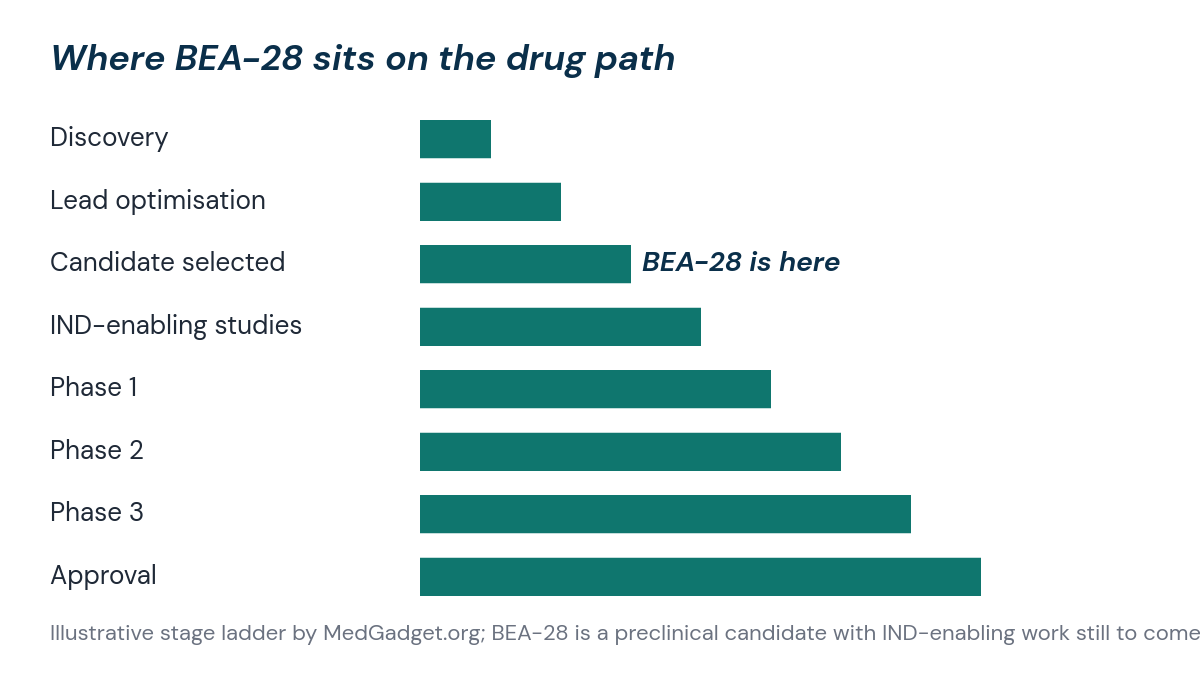
Having named a candidate, Beactica will move into a validation phase. The steps the company lists are non-regulatory, or pre-GLP, toxicology studies, scale-up of the chemistry and advanced formulation work. IND-enabling studies are expected to follow candidate drug nomination, though the company did not give a timeline. CEO Per Kallblad said that selecting BEA-28 reflects the strength of the company’s TEAD degrader programme.
Who is Beactica?
Beactica Therapeutics AB is a Swedish company based in Uppsala that describes itself as a precision medicine business. It has chosen preclinical candidates before, including BEA-17 from its LSD1 programme, and public listings show that the US National Center for Advancing Translational Sciences has evaluated earlier Beactica TEAD degraders in preclinical models. Those details come from public listings and not from this announcement. The company did not disclose any funding or partnership tied to BEA-28, so it is not yet clear who will pay for the expensive IND-enabling work that comes next.
The risks to keep in mind
- Translation: most preclinical oncology candidates never reach approval.
- Safety: the Hippo pathway is involved in normal tissue growth and repair, so on-target effects in healthy organs will be a key question.
- Competition: other companies are pursuing TEAD inhibitors and degraders, and the field is crowded.
- Biomarkers: a patient-selection strategy needs validated tests, which add cost and complexity.
Related reading: our coverage of the Italfarmaco and VeriSIM Life deal and the wider pharmaceutical news section.
Frequently asked questions
What is BEA-28?
BEA-28 is Beactica’s first-in-class cereblon-recruiting TEAD degrader, now selected as a preclinical candidate.
Which cancers is it aimed at?
The company highlights mesothelioma and KRAS-mutant lung cancer in preclinical work, with a biomarker-guided approach.
Is BEA-28 in clinical trials?
No. It is preclinical, and IND-enabling studies come next without a stated date.
What is a degrader?
It is a drug that causes a target protein to be destroyed by the cell’s own disposal system instead of just blocking it.
Where is Beactica based?
In Uppsala, Sweden.
How we reported this: this article is based on Beactica’s announcement of 6 October 2026 and public reference pages linked above. Preclinical findings are company-reported. Earlier programme details come from public listings. Statements marked as our assessment are opinion. Last updated 7 October 2026. This is general information, not medical advice.