
Can artificial intelligence tell drug hunters which molecules will actually become medicines, before years of lab work are spent? Italfarmaco is betting it can. The Italian pharmaceutical group and VeriSIM Life, a US company that builds AI models of how drugs behave in the body, have announced a partnership to discover and develop novel HDAC-targeted therapies for neuromuscular, fibrotic and rare diseases. The agreement, announced on 5 October 2026, has a total potential value above $100 million.
Key Takeaways
- The deal: total potential value exceeding $100 million, including technology service fees, development, regulatory and commercial milestones, and royalties on future products.
- The science: small molecules aimed at histone deacetylases (HDACs), enzymes that help control which genes are switched on.
- The targets: neuromuscular, fibrotic and rare diseases.
- The split: Italfarmaco brings HDAC biology, medicinal chemistry and clinical development; VeriSIM Life brings its BIOiSIM and AtlasGEN AI platforms.
- The catch: the upfront payment and the number of programmes were not disclosed, and no molecule has been named.
What are HDACs, and why do they matter?
Histone deacetylases are enzymes that remove chemical tags from histones, the proteins around which DNA is wound. By doing so they influence how tightly DNA is packed and which genes are active. When this control goes wrong, it can contribute to muscle degeneration, scarring and other chronic diseases. Drugs that block HDACs have been used in some cancers, and Italfarmaco is best known for its HDAC inhibitor givinostat, which is approved in the United States for Duchenne muscular dystrophy under the brand name Duvyzat, as far as we know. The MedlinePlus entry on Duchenne explains the disease background.
The new partnership aims to broaden that experience into further indications. Italfarmaco’s chief scientific officer, Dr Christian Steinkuhler, said the partnership enables the group to expand its pipeline into new indications with high unmet needs.
What does VeriSIM Life bring?
VeriSIM Life describes its BIOiSIM platform as an AI-enabled mechanistic system that evaluates molecules across pharmacology, exposure, safety, biomarkers and variability between patients. Its AtlasGEN platform is used to design novel chemical matter that can be synthesised in the lab. In plain terms, the idea is to simulate how a candidate would behave in a virtual patient population early, so that weak candidates are dropped sooner and strong ones are prioritised. Visit VeriSIM Life and Italfarmaco for company background.
Founder and chief executive Dr Jo Varshney framed the deal in a line aimed squarely at the AI-discovery hype cycle: the future of drug discovery will not be defined by how many molecules can be generated, but by how confidently one can predict which of them become medicines.
How is the deal structured?
| Element | What the companies disclosed |
|---|---|
| Total potential value | More than $100 million |
| Payment types | Technology service fees, development, regulatory and commercial milestones, royalties |
| Therapeutic focus | Neuromuscular, fibrotic and rare diseases |
| Italfarmaco role | HDAC biology, medicinal chemistry, translational science, clinical development |
| VeriSIM Life role | BIOiSIM and AtlasGEN AI platforms for evaluation and design |
| Upfront payment | Not disclosed |
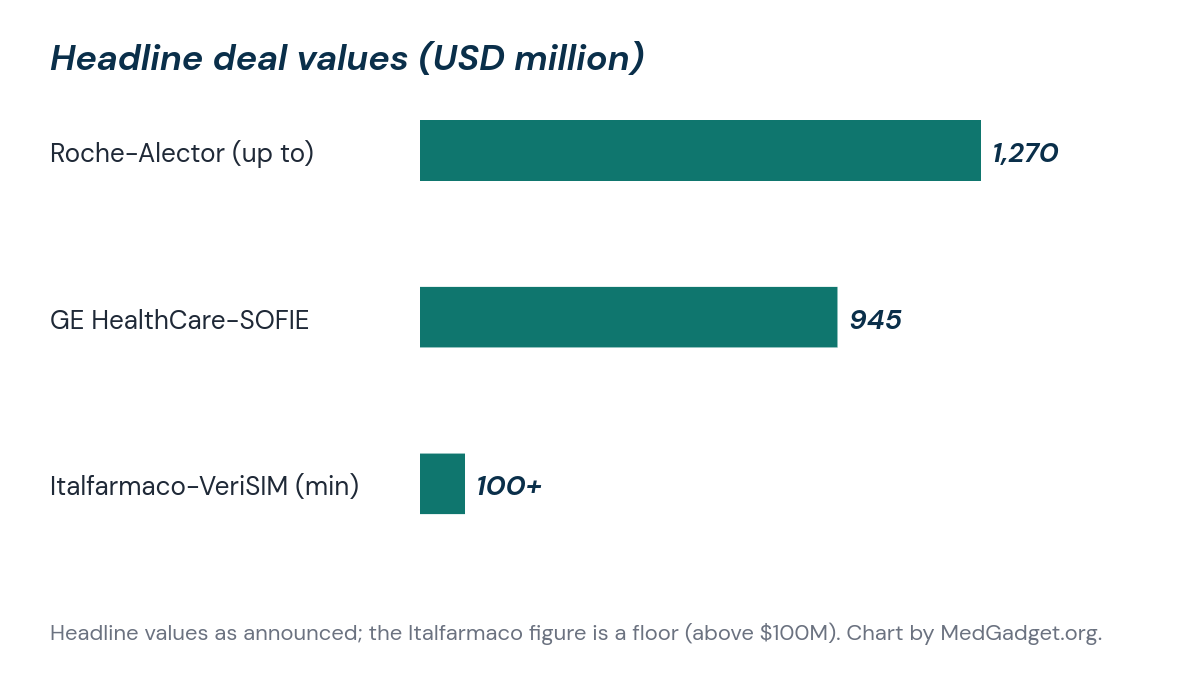
Deals of this kind usually pay out in stages, and the headline figure is a ceiling that is reached only if molecules succeed. The size and timing of any upfront payment matter more than the total in signalling commitment, and neither was disclosed. In our assessment, a figure above $100 million for a platform-plus-expertise collaboration is modest compared with large pharma licensing deals, but it is meaningful for a mid-sized group and a specialist AI company.
Is the AI promise justified?
AI-based drug discovery has produced many partnerships but few approved drugs so far. Computational models can predict some properties, such as how a molecule is absorbed and cleared, better than others, such as whether it will work in a complex disease. The most useful role for such platforms may be to reduce avoidable failures in exposure and safety rather than to find a cure on their own. The deal pairs the AI side with a company that already has human clinical experience in HDAC inhibition, which is a sensible way to ground the models in real data.
It is also not Italfarmaco’s first digital collaboration: the group has previously announced work with another AI company, Iktos, on HDAC inhibitors for non-cancer indications, according to public listings. That suggests a strategy of using more than one computational partner to widen its options.
What it means for rare disease drug development
Rare and neuromuscular diseases are hard to study because patient numbers are small and trials are slow. Better prediction in the lab is therefore especially valuable. If the collaboration works, it could shorten the path from idea to clinical candidate; if it does not, the milestone-based structure limits the financial downside for both sides. Readers following dealmaking in this area may also want to see how our coverage of the Roche and Alector deal compares, or browse more pharmaceutical news.
What we do not know yet
- Programmes: the number of targets and the first candidates have not been named.
- Upfront money: no upfront payment figure was released.
- Timeline: no dates for nominating a candidate or entering clinical trials were given.
- Exclusivity: the scope of rights for each party was not described.
Frequently asked questions
What is the Italfarmaco and VeriSIM Life partnership about?
It is a collaboration to discover and develop novel HDAC-targeted therapies for neuromuscular, fibrotic and rare diseases using VeriSIM Life’s AI platforms.
How much is the deal worth?
The companies say the total potential value exceeds $100 million, including milestones and royalties.
What does HDAC stand for?
Histone deacetylase, a family of enzymes that regulate gene activity.
What are BIOiSIM and AtlasGEN?
They are VeriSIM Life’s AI platforms for evaluating molecules across pharmacology, safety and patient variability, and for designing new chemical matter.
Is a drug already in trials from this deal?
No. The collaboration is at the discovery stage and no candidate has been named.
How we reported this: this article is based on the companies’ announcement of 5 October 2026 and public reference pages linked above. Deal terms are as disclosed by the companies. The statement about givinostat approval and the Iktos collaboration reflects public information and should be checked against the company’s own materials. Statements marked as our assessment are opinion. Last updated 7 October 2026. This is general information only.