For people with advanced Parkinson’s disease, the hardest part is often not the disease itself but the unpredictability of the medicine: good hours followed by sudden OFF periods, and involuntary movements when levodopa is at its peak. Lundbeck has now presented Phase Ib data on Lu AF28996, an oral dopamine agonist prodrug, showing that patients gained an average of 3.6 more hours of good ON-time a day after six weeks, while dyskinesia scores fell. The study was open-label and small, and a placebo-controlled Phase II trial has begun.
Key Takeaways
- ON-time: good ON-time rose by 3.6 hours at week 6 and 3.4 hours at week 18 from a baseline of 9.5 hours a day.
- OFF-time: fell by 2.3 hours at week 6 and 2.0 hours at week 18 from a baseline of 4.7 hours.
- Dyskinesia: the Unified Dyskinesia Rating Scale score dropped 8.5 points at week 6 and 14.5 points at week 18 from a baseline of 28.3.
- Caution: the trial was open-label with no placebo group, so the results are encouraging but not proof.
- What next: the randomised Phase II trial DARE2 (about 150 participants) has dosed its first patient.
What is Lu AF28996?
Lu AF28996 is an oral prodrug of a dopamine agonist that acts on both D1-like and D2-like dopamine receptors, according to Lundbeck. A prodrug is a medicine that the body converts into its active form after it is swallowed. Dopamine agonists mimic the brain chemical that people with Parkinson’s lose, and acting on both receptor families is intended to deliver a smoother, more continuous effect than levodopa alone. Lundbeck presented the data at the International Congress of Parkinson’s Disease and Movement Disorders (MDS 2026) in Seoul on 6 October 2026. You can read the company announcement and visit Lundbeck for more.
How was the Phase Ib study designed?
The study, registered as NCT04291859, was open-label and used ascending-dose cohorts. Part A tested once- and twice-daily dosing, and Part B tested twice-daily dosing. In Part B, 34 participants took part, with a six-week treatment period followed by an optional 12-week extension; 25 of them continued into the extension. Everyone knew they were receiving the drug, which is common in early studies but means placebo effects cannot be excluded.
What did the results show?
| Measure | Baseline | Week 6 change | Week 18 change |
|---|---|---|---|
| Good ON-time (hours/day) | 9.5 | +3.6 | +3.4 |
| OFF-time (hours/day) | 4.7 | −2.3 | −2.0 |
| Dyskinesia (UDysRS score) | 28.3 | −8.5 | −14.5 |
| ON-time with dyskinesia (hours) | Not stated | −1.2 to −1.4 | −1.2 to −1.4 |
| Levodopa dose reduction | Not applicable | 53.4% | 29.2% |
“Good ON-time” means hours when symptoms are controlled without troublesome dyskinesia. A gain of more than three hours a day is large by the standards of Parkinson’s add-on therapies. The company also reports that the average levodopa dose fell by 53.4 percent at week 6 and 29.2 percent at week 18. That reduction matters because the dyskinesia improvement may partly reflect lower levodopa exposure, and it also shows that the drug may be doing some of levodopa’s work.
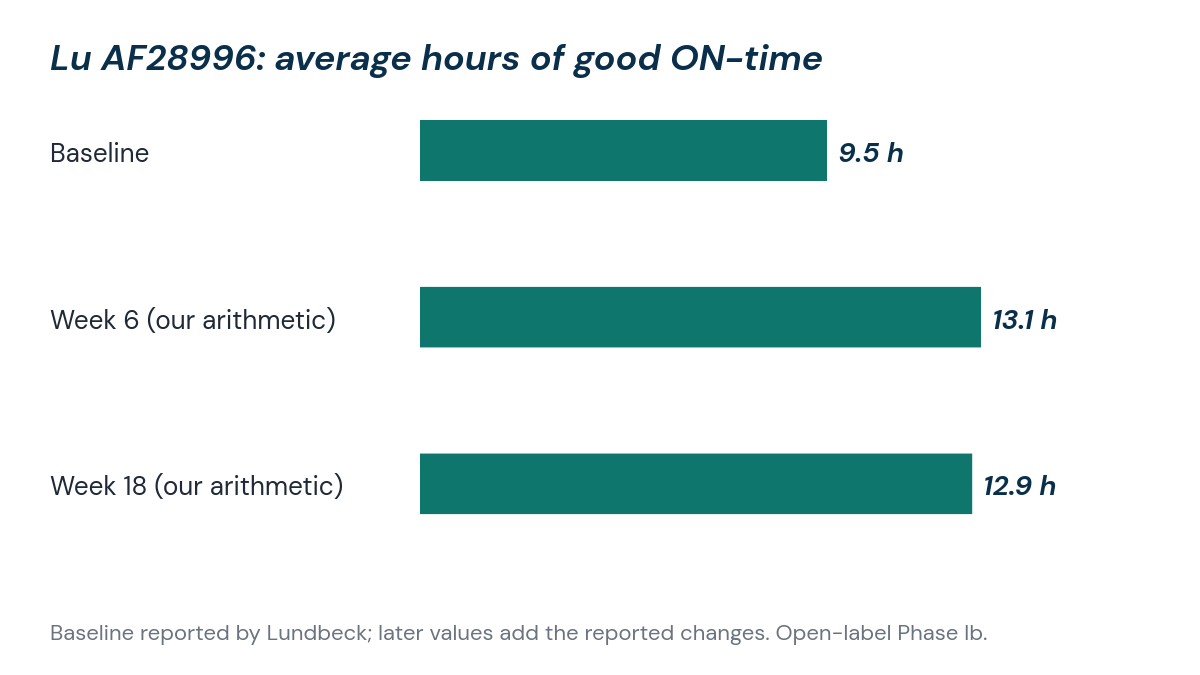
By our own arithmetic, the reported changes imply average good ON-time of about 13.1 hours at week 6 and 12.9 hours at week 18, and average OFF-time of roughly 2.4 and 2.7 hours. These are our calculations from the reported baselines and changes, not figures stated by the company.
Was the drug safe and tolerable?
Lundbeck says most adverse events were mild and no unexpected safety signals were observed. The most common events were nausea, dizziness and falls. Falls deserve attention: they are a known risk in advanced Parkinson’s, and dopamine agonists can cause dizziness and sleepiness. A larger controlled study is needed to separate the drug’s effect from the background rate of falls in this population.
What happens in the Phase II trial?
The next step is DARE2 (NCT07514858), a randomised, double-blind, placebo-controlled, flexible-dose study of about 150 participants. Its primary endpoint is the change from baseline to week 19 in daily good ON-time. Lundbeck says the first patient has been randomised and recruitment is under way in the US, UK, Spain, Italy, Germany, France, Poland, the Czech Republic, Sweden and Japan.
Tarek Samad, Executive Vice President and Head of R&D at Lundbeck, said many people with advanced Parkinson’s continue to experience motor fluctuations and dyskinesia that significantly affect daily life. That unmet need is the commercial and clinical rationale for the programme.
Our assessment
In our assessment, the Phase Ib numbers are strong enough to justify the Phase II investment, but three questions will decide the drug’s future. First, will the gain survive a placebo comparison? In Parkinson’s trials, placebo groups can show surprising improvements in ON-time. Second, will tolerability hold up at flexible doses over longer periods, given that falls and dizziness were among the common events? Third, how will it compare with existing options for motor fluctuations, which include levodopa adjustments, other agonists, infusion therapies and device-based treatments? None of that can be answered from a 34-patient open-label study.
The field remains busy. Our recent report on Roche and Alector’s AL050 deal shows how much capital is flowing into Parkinson’s research, while background on the condition is available from the National Institute of Neurological Disorders and Stroke. For more drug development news see our pharmaceutical section.
Frequently asked questions
What is Lu AF28996?
It is an oral prodrug of a D1-like and D2-like dopamine receptor agonist being developed by Lundbeck for advanced Parkinson’s disease.
What were the Phase Ib results?
Good ON-time increased by 3.6 hours at week 6 and 3.4 hours at week 18, while OFF-time and dyskinesia scores fell, according to the company.
Was there a placebo group?
No. The Phase Ib study was open-label. The Phase II DARE2 trial is placebo-controlled.
Is Lu AF28996 approved?
No. It is an investigational drug and has not been approved by any regulator.
When will Phase II results be available?
The company has not given a date. The primary endpoint is measured at week 19 for each participant.
How we reported this: this article is based on Lundbeck’s announcement of 6 October 2026 and the trial registry entries linked above. Results are company-reported and from an open-label study. The week 6 and week 18 averages derived from baselines are our own calculations. Last updated 7 October 2026. This is general information, not medical advice.