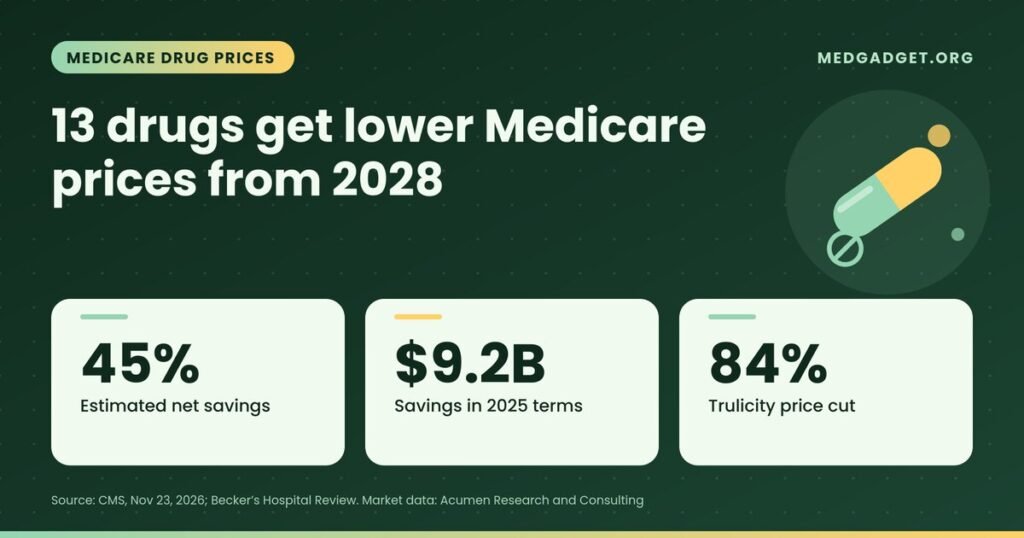

Medicare negotiated drug prices for a third group of medicines were announced by the Centers for Medicare & Medicaid Services (CMS) on November 23, 2026: 13 high-cost drugs, from Eli Lilly’s diabetes injection Trulicity to Gilead’s HIV pill Biktarvy, will carry lower “maximum fair prices” from January 1, 2028. CMS estimates the deals would have cut net Medicare spending on these drugs by 45%, or about $9.2 billion, had they applied in 2025. The steepest cut, 84%, lands on Trulicity.
Key takeaways on Medicare negotiated drug prices
- 13 drugs get new Medicare prices effective January 1, 2028, the third annual round of the Inflation Reduction Act negotiation program.
- CMS puts net savings at 45% (about $9.2 billion) in 2025 terms; counting the separate Part D manufacturer discount program, the gain is smaller, roughly $5.5 billion or 33%, according to Becker’s Hospital Review.
- Discounts range from 34% (Entyvio) to 84% (Trulicity). Tradjenta, already negotiated for 2026, was cut again by 83% in the program’s first renegotiation.
- For the first time, Part B drugs given in clinics and doctors’ offices are included alongside pharmacy (Part D) drugs.
- Patients’ own savings are modest next to the headline: an estimated $69 million for Part D enrollees and $395 million for Part B enrollees.
The 13 drugs and their new Medicare prices
CMS’s press release gives program-wide totals; the drug-by-drug figures below were published by Becker’s Hospital Review from the CMS data. Becker’s labels the Trulicity figure as a 30-day price and compares it with a 2025 Medicare gross cost of $965; the pricing unit for the other drugs was not specified, so treat the dollar amounts as indicative and the percentage cuts as the clearer comparison.
| Drug (maker) | Main use | Negotiated price | Cut |
|---|---|---|---|
| Trulicity (Eli Lilly) | Type 2 diabetes | $150 | 84% |
| Tradjenta (Boehringer Ingelheim) | Type 2 diabetes | $81 | 83% |
| Anoro Ellipta (GSK) | COPD | $130 | 72% |
| Cosentyx (Novartis) | Psoriasis, arthritis | $2,600 | 67% |
| Orencia (Bristol Myers Squibb) | Rheumatoid arthritis | $1,750 | 57% |
| Erleada (Johnson & Johnson) | Prostate cancer | $7,004 | 51% |
| Lenvima (Eisai) | Thyroid, kidney, liver cancers | $12,985 | 46% |
| Verzenio (Eli Lilly) | Breast cancer | $8,650 | 44% |
| Kisqali (Novartis) | Breast cancer | $8,650 | 43% |
| Rexulti (Otsuka/Lundbeck) | Depression, schizophrenia | $780 | 41% |
| Cimzia (UCB) | Crohn’s, arthritis | $1,375 | 37% |
| Biktarvy (Gilead) | HIV | $2,600 | 37% |
| Entyvio (Takeda) | Ulcerative colitis, Crohn’s | $2,645 | 34% |
Two patterns stand out. Older pills facing generic competition soon, such as Trulicity and Tradjenta, took the deepest cuts. Cancer drugs and biologics with longer patent runways, including Verzenio, Kisqali and Entyvio, held more of their value. Lilly and Novartis each have two products on the list.
Who actually saves, and how much
According to CMS, about 1.4 million people with Medicare used the Part D drugs on the list in 2025, at a gross cost of $22.3 billion, roughly 6% of all Part D spending. About 120,000 people used the four Part B drugs, which cost $3.3 billion, around 2% of Part B spending.
The headline $9.2 billion mostly accrues to the Medicare program, not directly to patients’ wallets. Becker’s reports estimated out-of-pocket savings of $69 million a year for Part D enrollees, who spent $522 million on these drugs in 2025, and $395 million for Part B enrollees, who spent $785 million. By our calculation, that is roughly a 13% reduction in Part D out-of-pocket costs and about a 50% reduction for Part B patients. The Part D gap is smaller largely because the program’s redesign already caps yearly out-of-pocket drug spending for Part D enrollees.
CMS Administrator Dr. Mehmet Oz framed the round around access: “Every year, millions of seniors leave the pharmacy empty-handed because they can’t afford their medication.”
How the deals were struck
Nine of the prices were agreed through rounds of offers and counteroffers, five of them at a manufacturer’s revised counteroffer. The other four companies accepted CMS’s written final offer. CMS says it will publish its explanation of each price by March 2027.
Some selected drugs dropped out. Xeljanz, Xeljanz XR and Xolair received no negotiated price because generic or biosimilar versions reached the market, which the law treats as an exit ramp. Botox and Botox Cosmetic were excluded under a court order in AbbVie’s lawsuit against HHS.
Where this round fits in the program
| Round | Drugs | Prices take effect | Notable names |
|---|---|---|---|
| First | 10 | January 1, 2026 | Eliquis, Jardiance, Tradjenta |
| Second | 15 | January 1, 2027 | Ozempic, Wegovy, Rybelsus |
| Third | 13 (incl. Tradjenta renegotiated) | January 1, 2028 | Trulicity, Biktarvy, Kisqali |
The GLP-1 drugs many readers ask about are not in this round: semaglutide (Ozempic, Wegovy, Rybelsus) was in the second group, with prices starting in 2027. For context on how GLP-1 pricing is already shifting outside Medicare, see our explainer on Novocare’s $149 to $399 Wegovy prices and the CVS study on GLP-1 break-even pricing.
Market context: what $9.2 billion means for pharma
According to Acumen Research and Consulting’s prescription drugs market report (updated November 2026), the global prescription drugs market was worth $1,342.6 billion in 2025 and is projected to reach $2,633.0 billion by 2035, a 6.95% compound annual growth rate. North America held a 45.0% share in 2025, about $604.2 billion, and branded, patented medicines made up 64.0% of the market. Acumen also expects anti-diabetic drugs, including GLP-1 medicines, to be the fastest-growing therapy class at 10.2% a year.
Set against that, the third round’s savings are meaningful for specific products but small for the industry as a whole. The bigger commercial effect is strategic: companies now plan launch prices, new indications and lifecycle timing around the date a drug becomes eligible for selection, which helps explain why oncology and immunology brands dominate this list.
What to watch before 2028
- January 2027: the second-round prices, including semaglutide, go live, giving the first test of how Part D plans pass savings through.
- March 2027: CMS’s written explanation of each negotiated price.
- Litigation: the Botox exclusion shows courts can still reshape the list; further industry challenges remain possible.
- Premiums and formularies: whether plans change coverage tiers for drugs with lower negotiated prices.
Frequently asked questions
Which drugs are in Medicare’s 2028 negotiated price list?
Trulicity, Tradjenta, Anoro Ellipta, Cosentyx, Orencia, Erleada, Lenvima, Verzenio, Kisqali, Rexulti, Cimzia, Biktarvy and Entyvio.
When do the new Medicare drug prices start?
January 1, 2028. Nothing changes at the pharmacy counter for these 13 drugs before then.
Will I pay 84% less for Trulicity?
Not necessarily. The 84% cut applies to the price Medicare pays. Your own cost depends on your plan’s design, deductible and the Part D out-of-pocket cap, so savings to individuals are usually smaller than the headline cut.
Are Ozempic and Wegovy included?
Not in this round. Semaglutide was negotiated in the previous round, with prices taking effect January 1, 2027.
Sources: CMS press release (November 23, 2026); Becker’s Hospital Review. Market data: Acumen Research and Consulting. More in our Pharmaceutical section. This article is for information only and is not medical or investment advice. Last updated November 24, 2026.