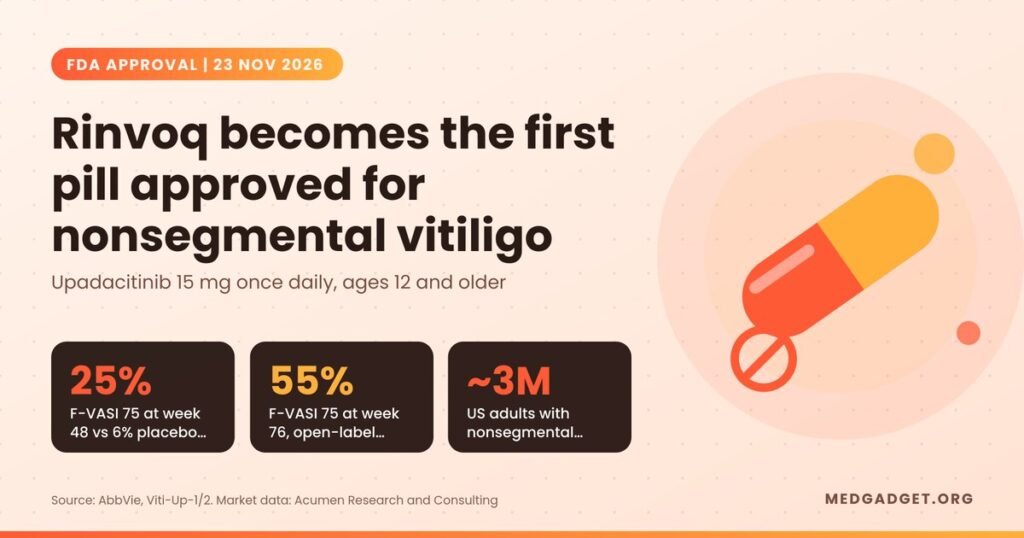

The FDA approved Rinvoq for vitiligo on 23 November 2026, making AbbVie’s once-daily upadacitinib 15 mg tablet the first systemic medicine cleared in the US for nonsegmental vitiligo (NSV) in adults and children aged 12 and older. The decision rests on two replicate Phase 3 trials, Viti-Up-1 and Viti-Up-2, in which about one in four patients on the drug regained at least 75% of facial pigment after 48 weeks, compared with roughly one in sixteen on placebo. Until now, the only FDA-approved option for the condition was a topical cream limited to small areas of skin.
Key takeaways on Rinvoq vitiligo approval
- Indication: nonsegmental vitiligo, ages 12+, at 15 mg once daily. AbbVie’s release lists no requirement to fail topical treatment first.
- Facial repigmentation (F-VASI 75) at week 48: 25% vs 6% placebo in Viti-Up-1 and 23% vs 7% in Viti-Up-2.
- Whole-body response (T-VASI 50) at week 48: 19% vs 6% and 21% vs 6%.
- Responses kept building in the open-label extension: F-VASI 75 reached 55% and 47% at week 76 in patients still on treatment.
- The JAK inhibitor class safety warnings (serious infections, cancer, heart events, blood clots) apply to this use too.
- This is Rinvoq’s 10th US indication; nearly 3 million US adults live with NSV, according to AbbVie.
Why a pill matters for a skin disease
Vitiligo is an autoimmune condition in which immune cells attack melanocytes, the cells that make skin pigment, leaving white patches. Nonsegmental vitiligo is the most common form. It usually appears on both sides of the body and can spread unpredictably, even after years of stability. For people with patches across large areas, topical treatment is impractical: the cream approved in 2022, ruxolitinib (Opzelura), is restricted to a limited body surface area.
Upadacitinib works from the inside. It blocks Janus kinase 1 (JAK1), a signalling enzyme that carries the interferon-gamma messages thought to drive the immune attack on melanocytes. Calming that pathway lets surviving pigment cells, often hiding in hair follicles, repopulate the skin. That process is slow, which is why the trials ran for 48 weeks rather than the 12 to 16 weeks typical of eczema or psoriasis studies.
What the Viti-Up trials showed
The two studies enrolled 614 people aged 12 and older with NSV affecting both the face and body, randomised two to one to upadacitinib or placebo. Doctors scored repigmentation with the Vitiligo Area Scoring Index (VASI) for the face (F-VASI) and the total body (T-VASI). The co-primary goals were a 75% improvement on the face and a 50% improvement across the body at week 48. Both trials met both goals, with multiplicity-controlled p-values of 0.001 or lower.
| Week 48 endpoint | Viti-Up-1: Rinvoq vs placebo | Viti-Up-2: Rinvoq vs placebo | Placebo-adjusted gain (by our calculation) |
|---|---|---|---|
| F-VASI 75 (face, 75% repigmented) | 25% vs 6% | 23% vs 7% | 19 and 16 points |
| T-VASI 50 (body, 50% repigmented) | 19% vs 6% | 21% vs 6% | 13 and 15 points |
| F-VASI 90 (near-complete face) | 16% vs 2% | 12% vs 3% | 14 and 9 points |
By our calculation, those gaps mean a doctor would need to treat about five to six patients for one extra person to reach the facial target at 48 weeks. That is a modest absolute effect, but vitiligo repigmentation has historically been hard to achieve at all, and the trend lines matter. In the open-label extension, where placebo patients switched to active drug, the share of patients still on treatment who reached F-VASI 75 climbed to 55% in Viti-Up-1 and 47% in Viti-Up-2 by week 76. Those later figures are observed cases without a control group, so they likely flatter the true rate, but they support the idea that longer treatment yields more pigment.
Safety and who should be cautious
AbbVie said the safety profile in both Viti-Up studies was broadly in line with Rinvoq’s other approved uses. Trade press coverage of the trials listed upper respiratory infections, acne, nasopharyngitis and headache as the most common side effects. The bigger concern is the class labelling every JAK inhibitor carries in the US: risk of serious infections including tuberculosis, lymphoma and other cancers, major cardiovascular events and death in people 50 and older with at least one heart risk factor, and blood clots in the legs, lungs or brain. Testing for tuberculosis and routine blood work are required.
For a condition that is not life-threatening, that trade-off deserves a frank conversation. Younger, otherwise healthy patients with extensive or rapidly spreading disease, or vitiligo that seriously affects quality of life, are the most likely candidates. People who smoke, are over 50 with heart risk factors, are pregnant or plan to become pregnant face a different calculation. AbbVie notes that safety and efficacy have not been established under age 12, and long-term data in adolescents are still limited.
Market context
Vitiligo has long been a gap in a fast-growing field. According to Acumen Research and Consulting, the global dermatologicals market was worth USD 23.7 billion in 2022 and is projected to reach USD 64.7 billion by 2032, a compound annual growth rate of 10.7%, with prescription drugs holding the largest share and North America the leading region. A first systemic vitiligo approval for a drug already familiar to dermatologists from atopic dermatitis gives AbbVie an early lead, though oral JAK rivalry is coming, with Incyte’s povorcitinib and Pfizer’s ritlecitinib both in Phase 3 vitiligo programmes.
What we still do not know
- Pricing and insurance coverage: AbbVie did not disclose any vitiligo-specific pricing or payer terms, and plans may require prior authorisation or step therapy.
- Durability: whether pigment holds after stopping the drug has not been reported. Relapse after withdrawal is common with other vitiligo treatments.
- Combination with light therapy: narrowband UVB is a standard vitiligo treatment, but the pivotal trials tested upadacitinib alone.
- Real-world uptake: dermatologists will weigh the boxed warnings against a cosmetic and psychological benefit that is real but harder to quantify.
Readers following the JAK class in hair and skin disease can also see our report on a breakthrough designation in alopecia areata, and more in our pharmaceutical news section.
FAQ
Is Rinvoq FDA approved for vitiligo?
Yes. On 23 November 2026 the FDA approved Rinvoq (upadacitinib) 15 mg once daily for nonsegmental vitiligo in adults and children 12 and older. It is the first systemic, whole-body treatment approved for the condition in the US.
How long does Rinvoq take to work for vitiligo?
Repigmentation is gradual. The trials measured results at 48 weeks, and responses continued to improve to week 76 in patients who stayed on treatment.
What is the difference between Rinvoq and Opzelura for vitiligo?
Opzelura is a ruxolitinib cream applied to limited areas of skin. Rinvoq is a tablet that acts throughout the body, which suits widespread disease but carries the JAK inhibitor boxed warnings.
What are the side effects of Rinvoq for vitiligo?
The most common were upper respiratory infections, acne and headache. Serious but less common risks include infections, cancers, heart events and blood clots, especially in people over 50 with heart risk factors.
Sources: AbbVie press release (23 Nov 2026); Viti-Up-1 and Viti-Up-2 Phase 3 trials (NCT06118411), The Lancet (Aug 2026); Dermatology Times and Contemporary Pediatrics (23 Nov 2026). Market data: Acumen Research and Consulting, Dermatologicals Market report. This article is for information only and is not medical or investment advice. Last updated 24 November 2026.