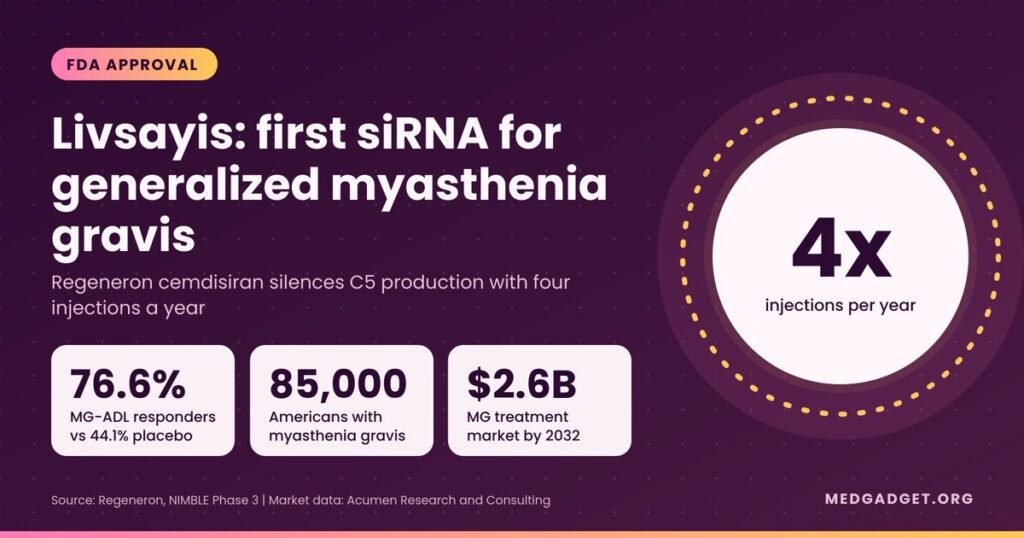

The Livsayis FDA approval came on November 18, 2026, when the US Food and Drug Administration cleared Regeneron’s cemdisiran for adults with generalized myasthenia gravis (gMG) who test positive for anti-acetylcholine receptor (AChR) antibodies. Livsayis is the first small interfering RNA (siRNA) medicine approved for the disease, and it is injected under the skin just once every three months, the least frequent schedule of any approved gMG therapy.
For the roughly 85,000 Americans Regeneron estimates live with myasthenia gravis, the decision adds a fourth way to block the complement protein C5, and the first that works by switching off production of the protein rather than mopping it up in the bloodstream.
Key takeaways on Livsayis FDA approval
- What: Livsayis (cemdisiran), a C5-directed siRNA from Regeneron, licensed from Alnylam.
- Who: Adults with AChR antibody-positive generalized myasthenia gravis, the most common form of the disease.
- Dosing: Subcutaneous injection every three months, four times a year.
- Evidence: In the Phase 3 NIMBLE trial, 76.6% of treated patients had a meaningful gain in daily function at week 24, versus 44.1% on placebo.
- Main risk: A boxed warning for serious meningococcal infection; access is restricted through a REMS program and vaccination is required before the first dose.
- Still unknown: Price, launch date and how it will be used alongside C5 antibodies.
How an siRNA treats myasthenia gravis
In AChR-positive gMG, autoantibodies attack the junction where nerves signal muscles. Those antibodies trigger the complement cascade, and the terminal step, driven by C5, punches holes in the muscle membrane. The result is the drooping eyelids, double vision, slurred speech, swallowing trouble and limb weakness that define the disease.
Existing C5 drugs are proteins that bind C5 already circulating in the blood. Cemdisiran takes a different route: it silences the messenger RNA that cells use to build C5, so less of the protein is made in the first place. Because the effect lasts for weeks, a single injection can keep C5 low for a full quarter.
That design trades a daily, weekly or fortnightly routine for four clinic or home injections a year. By our calculation, a patient on a weekly self-injected C5 drug would take 52 shots in the same period.
What the NIMBLE Phase 3 trial showed
NIMBLE is a randomized, double-blind, placebo-controlled study that is still ongoing. Patients kept their background immunosuppressants. It tested cemdisiran alone, cemdisiran combined with a C5 antibody, a C5 antibody alone and placebo. The approval rests on the cemdisiran monotherapy results at week 24, released by Regeneron.
| Measure at week 24 | Livsayis | Placebo | Difference |
|---|---|---|---|
| MG-ADL improvement (points) | 4.5 | 2.2 | 2.3 (p=0.0005) |
| MG-ADL responders (3+ points) | 76.6% | 44.1% | 32.5 points |
| QMG improvement (points) | 4.2 | 1.5 | 2.8 (p=0.0015) |
| QMG responders (5+ points) | 48.4% | 19.0% | 29.4 points |
MG-ADL is a patient-reported scale of everyday tasks such as chewing, breathing and brushing teeth; QMG is a clinician-scored strength exam. Regeneron said a clinically meaningful 2.5-point MG-ADL gain appeared as early as week two. One NIMBLE investigator, Dr. Tuan Vu, described “rapid, deep disease control” that held through the end of each dosing interval.
Put another way, by our calculation roughly three patients need to be treated for one additional person to reach the MG-ADL responder threshold compared with placebo. The placebo response of 44% is high, which is common in gMG trials and a reason not to over-read cross-trial comparisons.
Safety: the boxed warning and REMS
Like every drug that blocks C5, Livsayis carries a boxed warning for life-threatening meningococcal infection caused by Neisseria meningitidis. Patients must complete meningococcal vaccination at least two weeks before the first dose unless treatment is urgent, in which case antibiotics are given alongside vaccines. Because the drug’s effect lingers, patients carry a safety card for 12 months after their last dose, a longer window than many people will expect.
The label also flags infections from other encapsulated bacteria, including Streptococcus pneumoniae, Haemophilus influenzae and Neisseria gonorrhoeae. The most common side effects that were more frequent than placebo were injection site reactions, viral infections and urinary tract infections. Prescribing runs through a restricted REMS program, as with other C5 medicines.
Where Livsayis fits among myasthenia gravis treatments
The gMG market has crowded quickly. Doctors can now choose between several C5 blockers and a group of FcRn blockers that lower disease-causing antibodies.
| Drug | Mechanism | Typical schedule |
|---|---|---|
| Soliris (eculizumab) | C5 antibody | IV every 2 weeks (maintenance) |
| Ultomiris (ravulizumab) | C5 antibody | IV every 8 weeks (maintenance) |
| Zilbrysq (zilucoplan) | C5 peptide | Daily self-injection |
| Klygefa (gefurulimab) | C5 nanobody | Weekly self-injection |
| Livsayis (cemdisiran) | C5 siRNA | Injection every 3 months |
| Vyvgart, Rystiggo, Imaavy | FcRn blockers | Cyclic or regular IV/subcutaneous |
The practical pitch is convenience and steady control. The open questions are cost, whether insurers will treat it as interchangeable with older C5 drugs, and whether the combination arm in NIMBLE eventually supports pairing the siRNA with an antibody for harder cases. Our earlier coverage of Cosentyx’s polymyalgia rheumatica approval shows how fast immunology labels are expanding, and RNA-targeting drugs are spreading too, as our report on pelacarsen’s HORIZON results explains.
Market context
According to Acumen Research and Consulting, the global myasthenia gravis treatment market was valued at USD 1.3 billion in 2022 and is projected to reach USD 2.6 billion by 2032, a compound annual growth rate of 7.3%. Acumen found that intravenous immunoglobulin (IVIg) held the largest drug-class share in 2022 and that North America dominated the market, with Asia-Pacific forecast to grow fastest. Long-acting targeted drugs such as Livsayis compete directly for patients who today rely on IVIg and older immunosuppressants.
What to watch next
- Price and launch: Regeneron has not disclosed either; its myRARE program will handle insurance checks and financial support.
- Europe and Japan: An EU decision is expected in the second half of 2027, with Japanese and other filings planned.
- Longer data: NIMBLE is ongoing, so durability and the combination results will be closely followed.
- Antibody-negative patients: The label covers only AChR-positive adults.
Frequently asked questions
What is Livsayis used for?
Livsayis (cemdisiran) is approved in the US for adults with generalized myasthenia gravis who are anti-acetylcholine receptor antibody-positive.
How often is Livsayis given?
It is a subcutaneous injection given once every three months, or four times a year, the least frequent dosing among approved gMG treatments.
Is Livsayis the same as Soliris or Ultomiris?
All three block the complement protein C5, but Soliris and Ultomiris are antibodies that bind C5 in the blood, while Livsayis is an siRNA that reduces how much C5 the body makes.
What are the main risks of Livsayis?
The biggest risk is serious meningococcal infection, which is why vaccination is required beforehand and the drug is only available through a REMS program. Common side effects include injection site reactions, viral infections and urinary tract infections.
For more drug news, see our pharmaceutical section.
Sources: Regeneron press release (November 18, 2026); NIMBLE Phase 3 data as reported by Regeneron. Market data: Acumen Research and Consulting, Myasthenia Gravis Treatment Market report (last updated October 2025). This article is for information only and is not medical or investment advice. Last updated November 19, 2026.