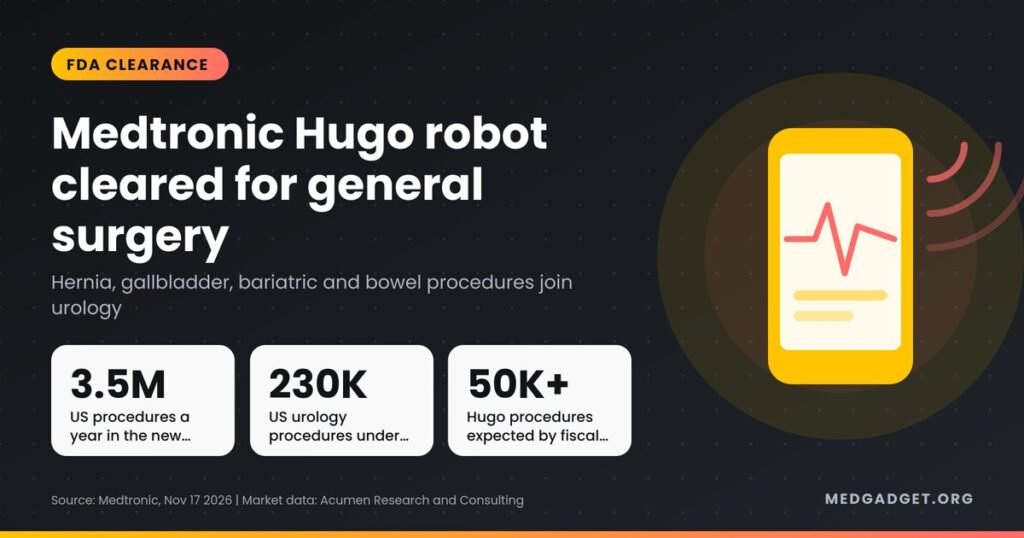

Medtronic Hugo general surgery clearance arrived on November 17, 2026, when Medtronic said the US Food and Drug Administration had cleared its Hugo robotic-assisted surgery (RAS) system for a broad group of general surgery procedures through an expanded 510(k). The decision takes Hugo beyond the urology-only US label it received in December 2025 and into operations that Medtronic estimates add up to about 3.5 million US surgeries a year, the biggest slice of the soft-tissue robotics market that Intuitive Surgical’s da Vinci has led for two decades.
Key takeaways on Medtronic Hugo general surgery
- The FDA cleared Hugo for general surgery, including gallbladder removal, Roux-en-Y gastric bypass, ventral and inguinal hernia repair, small bowel resection and appendectomy.
- Medtronic says those procedures make up roughly 3.5 million US operations a year, more than half of all US soft-tissue procedures.
- Hugo’s first US clearance, in December 2025, covered urology only, which Medtronic sized at about 230,000 US procedures a year.
- No new clinical outcome figures came with the announcement, and Medtronic did not give a US rollout schedule or installed-base number.
- Gynecology, which Medtronic filed alongside general surgery in April 2026, was not part of this clearance.
What the FDA cleared, procedure by procedure
According to the Medtronic announcement, the expanded clearance spans both the upper and lower abdomen. The company describes the list below as representative rather than complete.
| Procedure | Area | What it treats |
|---|---|---|
| Cholecystectomy | Upper abdomen | Gallbladder removal, usually for gallstones |
| Roux-en-Y gastric bypass | Upper abdomen | Bariatric (weight-loss) surgery |
| Ventral hernia repair | Upper abdomen | Hernias through the front abdominal wall |
| Small bowel resection | Upper abdomen | Removal of a diseased section of intestine |
| Inguinal hernia repair | Lower abdomen | Groin hernias |
| Appendectomy | Lower abdomen | Appendix removal |
A 510(k) clearance means the FDA found the system substantially equivalent to devices already on the market for these uses. It is not a finding that Hugo produces better outcomes than other robots or than conventional laparoscopy.
Why general surgery is the prize
Urology was a sensible first foothold, but it is a small market by comparison. Intuitive’s own SEC filing, as reported by MedTech Dive, put US da Vinci volume at about 2 million procedures in 2025: roughly 1.25 million in general surgery, 468,000 in gynecology and 201,000 in urology. By our calculation, general surgery was about 62% of da Vinci’s US caseload, and the procedures in Hugo’s new scope are roughly 15 times larger than the urology market Medtronic previously addressed.
Medtronic is leaning on its long history in open and laparoscopic general surgery, where its staplers, energy devices and visualization tools are already in many operating rooms. Matt Anderson, president of the company’s Surgical business, put it simply: “For decades, Medtronic has partnered with general surgeons.” The company also offers its LigaSure RAS Maryland vessel-sealing instrument for robotic cases; Medtronic says LigaSure technology has been used in more than 45 million open and laparoscopic procedures.
How Hugo is built differently
Hugo uses a modular design: each robotic arm sits on its own cart, so a team can roll in only the number of arms a given operation needs. Medtronic pitches this as a way to fit robotics into more operating rooms and case types without dedicating a room to a single large system.
Outside the US, Hugo has been in use for several years across more than 30 countries, and Medtronic says general surgery is now its fastest-growing procedure category there, ahead of urology and gynecology. The company says Hugo procedure growth is running at more than twice the rate of the overall robotic surgery market and expects the system to pass 50,000 procedures before the end of its fiscal year.
Market context
The commercial stakes are large. Acumen Research and Consulting projects the global surgical robots market to reach around US$13.7 billion by 2026, growing at a CAGR of about 10.4% over 2019 to 2026, with North America holding the largest regional share. A second credible system cleared for the highest-volume procedures gives US hospitals more negotiating leverage on capital and per-procedure instrument costs, which is where competition is likely to show up first.
What remains unclear
- Rollout pace: Medtronic describes Hugo as in use at a growing number of US hospitals but has not published an installed-base figure or a timetable for general surgery cases.
- Comparative outcomes: there are no published head-to-head data against da Vinci in these procedures. Medtronic has previously said Hugo met its endpoints in a hernia repair study.
- Gynecology: the filing submitted in April 2026 is still pending as far as public disclosures show.
- Pricing: system and instrument costs have not been disclosed, and hospital capital budgets remain tight.
What it means for patients
For most people facing hernia, gallbladder or bariatric surgery, the clearance will not change much immediately. Robotic platforms are tools; results depend heavily on the surgeon’s experience and the hospital’s volume. If you are offered robotic surgery, it is reasonable to ask which system will be used, how many similar cases the surgeon has done with it, and whether a laparoscopic or open approach would be equally suitable. Over time, more competition could widen access to robotic options at hospitals that have not been able to justify a da Vinci purchase. Read more in our medical device news, including our look at the AI-powered surgical software market and Medtronic’s SPYRAL AFFIRM renal denervation data.
Frequently asked questions
What is the Medtronic Hugo robot used for?
Hugo is a robotic-assisted surgery system for minimally invasive soft-tissue operations. In the US it is now cleared for urologic procedures such as prostatectomy and for general surgery procedures including hernia repair, gallbladder removal, gastric bypass, small bowel resection and appendectomy.
Is Medtronic Hugo FDA approved for general surgery?
Yes. Medtronic announced on November 17, 2026 that the FDA cleared Hugo for general surgery through an expanded 510(k). Devices of this type are cleared rather than approved, which reflects the regulatory pathway, not a lower standard of use in practice.
How is Hugo different from da Vinci?
The most visible difference is Hugo’s modular, cart-based arms, which can be deployed individually. Da Vinci has a far larger installed base and two decades of published outcome data in these procedures; Hugo has no head-to-head US data yet.
When will US hospitals use Hugo for hernia and gallbladder surgery?
Hospitals that already own Hugo can begin cases within the cleared indications, but Medtronic has not given a public schedule for wider adoption. Expect a gradual rollout tied to hospital purchasing cycles and surgeon training.
Sources: Medtronic press release (November 17, 2026); MedTech Dive reporting on Medtronic filings and Intuitive procedure volumes. Market data: Acumen Research and Consulting, Surgical Robots Market report. This article is for information only and is not medical or investment advice. Last updated November 17, 2026.