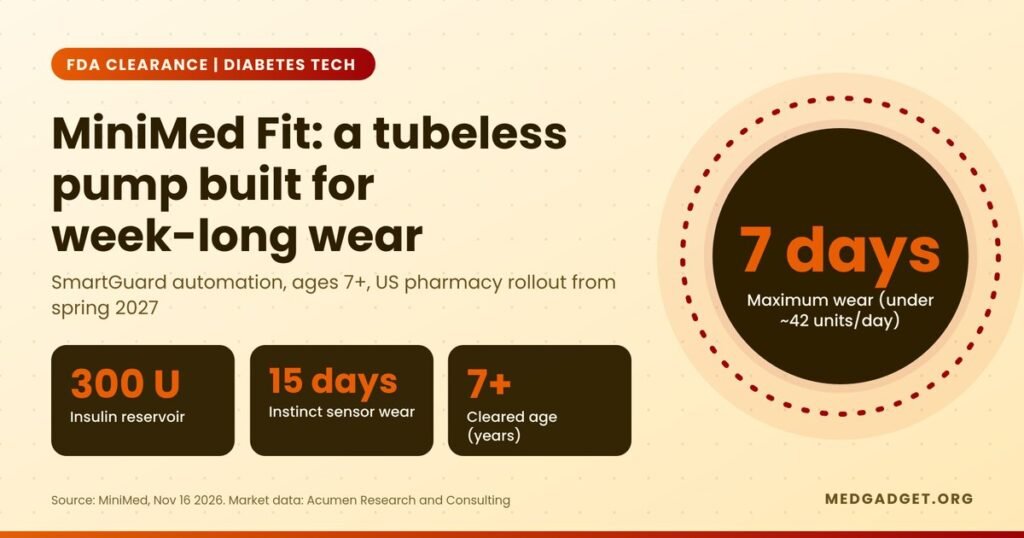

MiniMed Fit, the first tubeless insulin pump from MiniMed (Nasdaq: MMED), received FDA clearance on November 16, 2026 for people with type 1 or type 2 diabetes aged 7 and older. The patch pump runs MiniMed’s SmartGuard automated insulin delivery algorithm, holds 300 units of insulin and can stay on the body for up to 7 days, with a phased US rollout through pharmacies planned to start in spring 2027.
The clearance lands three days after Tandem Diabetes Care won FDA clearance for its own tubeless Mobi configuration, which we covered here. For the first time, all of the big US pump makers will be competing for the same patch-pump user, and the battleground is wear time, reservoir size and sensor choice.
Key takeaways on MiniMed Fit
- FDA cleared MiniMed Fit on November 16, 2026 for type 1 and type 2 diabetes in people aged 7 and up.
- It is a waterproof, app-controlled patch pump with no tubing, using the SmartGuard algorithm that can deliver auto-corrections every five minutes plus Meal Detection.
- Wear time is up to 7 days, but only for users needing fewer than about 42 units of insulin a day; the reservoir holds 300 units.
- It pairs with the Simplera Sync sensor (up to 7 days) or the Abbott-made Instinct sensor (up to 15 days).
- An early customer phase starts in MiniMed’s fiscal Q4 2027, with a phased US pharmacy launch from spring 2027. Price has not been disclosed.
What the FDA cleared
MiniMed Fit is a small pump that sticks directly to the skin and is controlled from a smartphone app on compatible iOS and Android devices. It can be worn on the back of the arm, lower back, upper buttocks, abdomen or thigh. According to the company announcement, it is waterproof to 8 feet for 1 hour 45 minutes, although sensor readings may not reach the pump while it is under water.
The pump works with three rapid-acting insulins: Humalog, NovoLog and Admelog. Its automation comes from SmartGuard, the same algorithm family used on the tubed MiniMed 780G, which adjusts basal insulin automatically, can give correction doses every five minutes and includes Meal Detection to add insulin when a meal bolus is missed or underestimated. MiniMed also says the device is designed to accept its investigational fully closed-loop software in the future.
How MiniMed Fit compares with other tubeless pumps
The table below uses the figures MiniMed cited in its own footnotes. Real-world wear for any patch pump depends on insulin use, adhesion and site health, so treat these as manufacturer maximums rather than guarantees.
| Pump | Max wear (as cited) | Insulin capacity |
|---|---|---|
| MiniMed Fit | Up to 7 days (under ~42 units/day) | 300 units |
| Tandem Mobi (tubeless) | Up to 7 days, cartridge change at 3 days | 200 units |
| Omnipod | 3 days | 200 units |
| Mint | 3 days plus 12-hour grace period | 200 units |
By our calculation, 300 units spread over 7 days works out to roughly 42.9 units per day, which explains the 42-unit ceiling for a full week of wear. Many adults with type 2 diabetes, and some adults with type 1, use more insulin than that, so they would change the pump more often. Children and lean adults with type 1 diabetes are the users most likely to reach the full 7 days.
Sensor choice: Simplera Sync or Abbott Instinct
At launch MiniMed Fit will pair with two all-in-one continuous glucose monitors. Simplera Sync is MiniMed’s own disposable sensor with up to 7 days of wear. Instinct is made by Abbott and lasts up to 15 days, which means fewer sensor changes even if the pump itself is swapped weekly. Offering an Abbott-built sensor matters commercially because many people already use Abbott’s FreeStyle Libre platform and may not want to switch sensor families to get a tubeless pump.
What the evidence does and does not show
MiniMed backs its pitch with real-world data from 101,629 SmartGuard users, of whom 86.3% spent more than 70% of the time in the target glucose range. With recommended settings, users reached up to 80% time in range overall and 91% overnight. Those figures come from people using the tubed MiniMed 780G system, and the company’s own footnotes caution that real-world data have limitations and may not translate to new patients.
In other words, the clearance tells us the patch pump meets FDA’s requirements for safety and performance, but there is not yet published outcome data from people wearing MiniMed Fit itself. Early adopters will be the first test of whether the algorithm performs the same way when insulin is delivered through a short on-body cannula instead of a tubed infusion set.
Market context
Tubeless pumps are the fastest-moving corner of diabetes technology. Acumen Research and Consulting valued the global insulin pump market at USD 5.1 billion in 2022 and projects it to reach USD 11.4 billion by 2032, a compound annual growth rate of 8.5%. Acumen notes that patch pumps are a distinct product segment alongside traditional tubed pumps, that type 1 diabetes was the largest application, and that North America leads demand while Asia-Pacific grows fastest. The report was last updated in April 2023, so the figures predate this year’s wave of tubeless clearances and should be read as indicative.
Who should pay attention, and what to watch
- Current 780G users who want to drop tubing while keeping SmartGuard may be the first group offered the device.
- Omnipod users may compare the 3-day pod change with a weekly change, provided their daily insulin use is low enough.
- Pricing and coverage remain unknown. Distribution through pharmacies, the model Omnipod popularised, often means lower upfront cost than durable pumps, but MiniMed has not given figures.
- Launch timing: early customer experience in fiscal Q4 2027, then a phased US rollout from spring 2027.
FAQ
When will MiniMed Fit be available?
MiniMed plans an early customer experience phase in its fiscal fourth quarter of 2027 and a phased US launch through the pharmacy channel starting in spring 2027.
Who can use MiniMed Fit?
The FDA clearance covers people with type 1 or type 2 diabetes aged 7 and older. Your diabetes team decides whether a pump is right for you.
Does MiniMed Fit really last 7 days?
Only for people using less than about 42 units of insulin per day. Higher insulin users will empty the 300-unit reservoir sooner and need to change the pump more often.
Which CGM works with MiniMed Fit?
At launch it pairs with MiniMed’s Simplera Sync sensor (up to 7 days) and the Abbott-made Instinct sensor (up to 15 days).
More device coverage: Medical Device news | Tandem Mobi recall explained
Sources: MiniMed press release (November 16, 2026); market data from Acumen Research and Consulting, Insulin Pump Market report. This article is for information only and is not medical or investment advice. Last updated November 16, 2026.