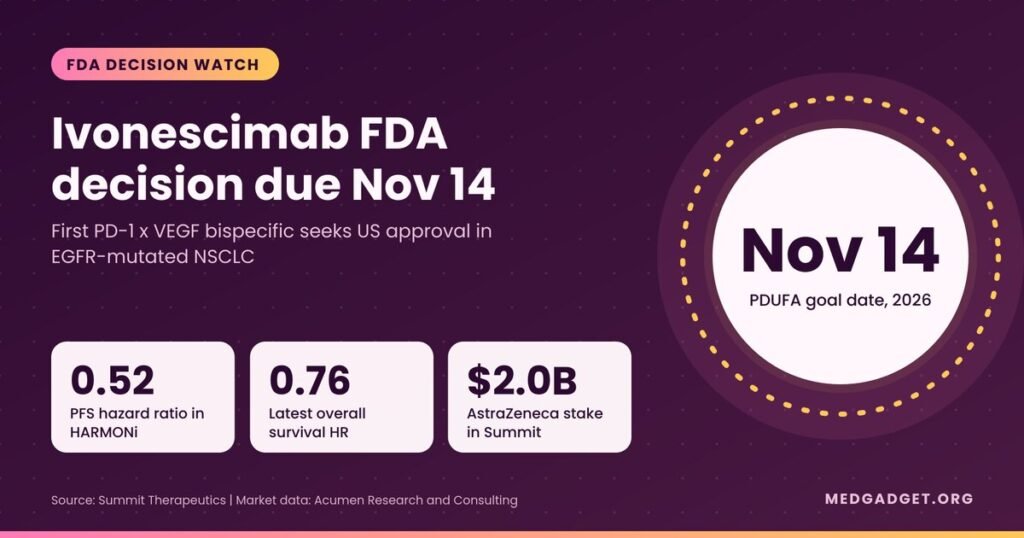

The ivonescimab FDA decision is due on November 14, 2026, when the agency is scheduled to rule on Summit Therapeutics’ application for ivonescimab plus chemotherapy in people with EGFR-mutated, non-squamous non-small cell lung cancer (NSCLC) whose disease has progressed after an EGFR tyrosine kinase inhibitor. A yes would make it the first PD-1 x VEGF bispecific antibody cleared in the United States. The catch: the pivotal HARMONi trial did not deliver the statistically significant overall survival result the FDA had said it wanted.
Key takeaways on ivonescimab FDA decision
- The FDA goal date (PDUFA) is November 14, 2026, confirmed in Summit’s third-quarter report on November 5.
- The request covers ivonescimab with platinum-doublet chemotherapy after an EGFR TKI, a setting Summit sizes at more than 14,000 US patients a year.
- HARMONi met its progression-free survival (PFS) endpoint, but overall survival (OS) missed statistical significance in the primary analysis.
- Later data cuts improved: the global OS hazard ratio reached 0.76 (nominal p=0.0151) at a June 2026 cut.
- AstraZeneca invested $2.0 billion in Summit in October, a strong outside vote of confidence in the drug class.
What the FDA is being asked to approve
Ivonescimab, engineered by China’s Akeso and licensed to Summit for North America, South America, Europe, the Middle East, Africa and Japan, is a single antibody that blocks two targets at once: the PD-1 immune checkpoint and VEGF, the growth signal tumors use to build blood vessels. In China it has been on the market since May 2024, and Summit says more than 60,000 patients have received it there when commercial use is counted.
The US filing is narrower. It covers adults whose EGFR-mutated tumors keep growing after a third-generation EGFR TKI such as osimertinib, the point at which chemotherapy is usually the next step. The FDA accepted the Biologics License Application in January 2026 under a standard review and had already granted Fast Track designation for this setting, according to Summit’s filing announcement.
The HARMONi numbers regulators are weighing
HARMONi randomized 438 patients to ivonescimab plus chemotherapy or placebo plus chemotherapy. The trial hit its PFS goal: in data presented in 2025, the combination cut the risk of progression or death by 48% (hazard ratio 0.52), with median PFS of 6.8 months versus 4.4 months. Survival is the sticking point, as the table shows.
| Data cut | Population | OS hazard ratio | Statistically significant? |
|---|---|---|---|
| Primary analysis (2025) | All 438 patients | 0.79 | No |
| Primary analysis (2025) | Western subgroup (165) | 0.98 | No |
| September 2025 | Western subgroup | 0.84 | No |
| June 2026 | Global ITT | 0.76 (95% CI 0.61-0.95) | Nominal p=0.0151, not a pre-specified test |
| June 2026 | Western subgroup | 0.76 (95% CI 0.52-1.10) | No |
Two things stand out. First, the Western subgroup, which matters to US reviewers because practice patterns differ from China, moved from essentially no survival difference to a 24% lower risk of death as follow-up lengthened from about 9 to 23 months. Second, the global confidence interval no longer crosses 1.0, but because that analysis was not the pre-planned primary test, the p-value is described as nominal. The FDA can weigh it; it does not have to treat it as a formal win.
Three ways November 14 could go
Approval. There is precedent for clearing drugs in post-EGFR lung cancer without a significant OS result. J&J’s Rybrevant regimen (2024) and AstraZeneca and Daiichi Sankyo’s Datroway (2025) both reached the market on progression-based evidence in related settings, a point analysts have repeatedly raised.
A complete response letter. The FDA told Summit it wanted statistically significant OS, and HARMONi’s pre-specified test fell short. A rejection would likely push Summit toward its first-line trials for a US entry.
A delay. Analysts had flagged that the updated survival submission could be treated as a major amendment, which typically adds three months. Summit’s November 5 report still listed November 14, so no extension had been disclosed as of this writing. Because the date falls on a Saturday, any announcement could come late on Friday or early next week.
Why AstraZeneca’s $2 billion matters
On September 28, AstraZeneca agreed to buy about 108,955 convertible preferred shares for $2.0 billion, priced at an implied $18.36 per common share, and the deal closed on October 5. By our calculation, that converts to roughly 109 million common shares, around 12% of Summit on a fully converted basis using the 798 million shares the company reported for the third quarter. The two companies also agreed to test ivonescimab alongside AstraZeneca’s sonesitatug vedotin in gastrointestinal cancers and signed a non-binding plan for broader combinations, including with antibody-drug conjugates. AstraZeneca’s Susan Galbraith said PD-1/VEGF bispecifics are “rapidly advancing in development.”
The investment matters for the decision because it extends Summit’s runway regardless of outcome. The company reported $629.8 million in cash and short-term investments at September 30, before the AstraZeneca money arrived, against a third-quarter GAAP net loss of $208.4 million.
Market context: a crowded, fast-growing lung cancer field
According to Acumen Research and Consulting, the global lung cancer market was valued at USD 21.1 billion in 2021 and is projected to reach USD 67.9 billion by 2030, a 14.1% compound annual growth rate, with North America holding the largest share and Asia-Pacific growing fastest. The report was last updated in February 2023, so treat the figures as indicative. A US approval would let ivonescimab compete in the post-TKI segment first, while the bigger prize, first-line use against Merck’s Keytruda, depends on HARMONi-3 and HARMONi-7.
What to watch after the decision
- HARMONi-3 squamous cohort: PFS events expected in the fourth quarter of 2026, with an early OS interim look alongside; a further OS interim is planned for the first half of 2027.
- HARMONi-3 non-squamous cohort: PFS events expected in the first half of 2027.
- HARMONi-7: first-line, high PD-L1 NSCLC versus pembrolizumab; enrolment due to complete in 2027. Akeso’s similar HARMONi-2 study reported an OS hazard ratio of 0.73 against pembrolizumab in September 2026.
- Label wording: if approved, whether survival data appear in the label will shape how oncologists use it.
For more lung and solid tumor regulatory coverage, see our analysis of the Optune Mya not-approvable letter in NSCLC brain metastases and the Tecentriq stage III colon cancer approval, or browse our pharmaceutical news.
FAQ
When is the ivonescimab FDA decision date?
The PDUFA goal date is November 14, 2026. The FDA can act on or before that date.
Is ivonescimab approved anywhere?
Yes, in China, where Akeso has marketed it since May 2024. It is not approved in the US or Europe.
How is ivonescimab different from Keytruda?
Keytruda blocks PD-1 only. Ivonescimab is a bispecific antibody that blocks PD-1 and VEGF in one molecule, aiming to combine immunotherapy with an anti-angiogenic effect.
Did ivonescimab improve survival in HARMONi?
Survival trended better (hazard ratio 0.76 at the latest cut), but the pre-specified OS analysis was not statistically significant. PFS improvement was significant.
Sources: Summit Therapeutics Q3 2026 report; Summit/AstraZeneca investment release; Summit BLA announcements. Market data: Acumen Research and Consulting. This article is for information only and is not medical or investment advice. Last updated November 13, 2026.