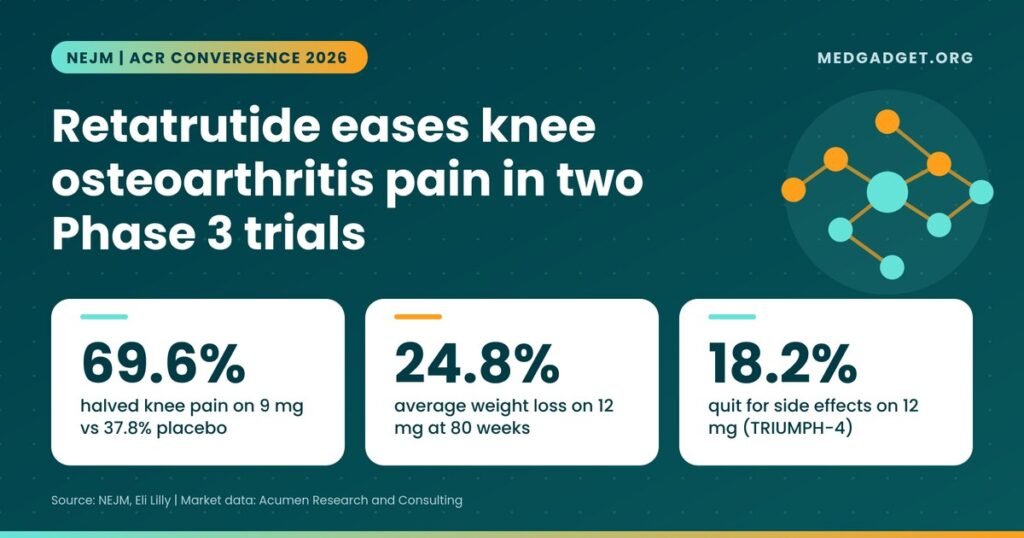

Retatrutide knee osteoarthritis results from two Phase 3 trials, published in the New England Journal of Medicine on November 8, 2026 and presented at ACR Convergence 2026 in Orlando, show Eli Lilly’s experimental weekly injection cut knee pain more than placebo in adults with obesity or overweight, while producing average weight loss of up to about 25%. Across 1,019 participants in TRIUMPH-4 and TRIUMPH-1-OA, roughly two in three people on retatrutide halved their pain score, compared with about one in three on placebo.
The results matter because knee osteoarthritis has no approved drug that changes the course of the disease, and Lilly estimates that about 80% of people with knee osteoarthritis also carry excess weight.
Key takeaways on retatrutide knee osteoarthritis
- Two randomized, placebo-controlled Phase 3 trials (TRIUMPH-4, n=445, 68 weeks; TRIUMPH-1-OA, n=574, 80 weeks) met their knee pain goals with P<.001 at the doses tested.
- In TRIUMPH-4, WOMAC pain scores fell 3.96 points on 9 mg and 3.74 points on 12 mg, versus 2.12 points on placebo.
- Average weight loss reached 23.7% (TRIUMPH-4, 12 mg) and 24.8% (TRIUMPH-1-OA, 12 mg), against about 4% to 5% on placebo.
- About 70% of patients on 9 mg achieved at least a 50% pain reduction in a pooled analysis, versus 37.8% on placebo.
- Stopping treatment because of side effects was far more common on retatrutide (up to 18.2%) than placebo (4.0%), and dysesthesia, an abnormal skin sensation, appeared in up to 20.9% of treated patients.
- Retatrutide is still investigational; it is not approved for any use.
What the TRIUMPH trials tested
Retatrutide is a triple agonist that activates the GIP, GLP-1 and glucagon receptors, one more target than tirzepatide (Zepbound). The two osteoarthritis studies asked whether it relieves knee pain in people whose arthritis is worsened by excess weight.
TRIUMPH-4 enrolled 445 adults without diabetes, with a BMI of 27 or higher and moderate-to-severe knee pain (a WOMAC pain score of 4 to 9 on a 0 to 10 scale). They received 9 mg or 12 mg of retatrutide, or placebo, once a week for 68 weeks. TRIUMPH-1-OA was a knee osteoarthritis sub-study inside Lilly’s larger obesity trial: 574 participants, three doses (4 mg, 9 mg, 12 mg) plus placebo, and 80 weeks of treatment. About 80% of that group had a BMI above 35.
The numbers, side by side
| Measure | TRIUMPH-4 (68 weeks) | TRIUMPH-1-OA (80 weeks) |
|---|---|---|
| Participants | 445 | 574 |
| Doses tested | 9 mg, 12 mg | 4 mg, 9 mg, 12 mg |
| WOMAC pain change vs placebo | -1.83 (9 mg); -1.61 (12 mg) | -1.35 (4 mg); -1.61 (9 mg); -1.77 (12 mg) |
| Weight change on top dose | -23.7% (placebo -4.6%) | -24.8% (placebo -4.3%) |
| Pain-free at end of study | More than 1 in 8 on retatrutide | More than 1 in 6 on retatrutide |
| Quit due to side effects | 12.8% (9 mg); 18.2% (12 mg); 4.0% placebo | 2.8% to 15.3%; 6.2% placebo |
How big is the benefit, really?
Headlines have focused on Lilly’s figure of a pain reduction of up to 75.8%, or 4.5 points from a baseline of 6.0. That number deserves context. Lilly itself notes the percentage was a post hoc calculation, not a pre-specified endpoint, and it describes change within the treated group rather than the gap versus placebo.
Placebo patients improved substantially too, by 2.12 points in TRIUMPH-4. That is common in pain trials. The fairer measure is the placebo-adjusted difference: roughly 1.6 to 1.8 points on a 10-point scale. By our calculation, that is around 27% to 30% of the average starting pain score of about 6, which is a clinically meaningful but more modest effect than the headline number implies.
The responder data tell a similar story. In the pooled analysis at week 68, 69.6% of patients on 9 mg and 63.2% on 12 mg cut their pain by at least half, compared with 37.8% on placebo. Physical function improved in parallel: 64.6% and 63.5% of treated patients reached a 50% improvement, versus 33.1% on placebo. By our calculation, that means roughly one extra patient in three reaches a halving of pain on 9 mg compared with placebo.
One unanswered question is whether the pain relief comes purely from carrying less weight, or whether the drug also acts on inflammation in the joint. Interestingly, the 9 mg dose did at least as well on pain as 12 mg in TRIUMPH-4 despite producing less weight loss, which some commentators have read as a hint that weight is not the whole story. The trials were not designed to settle that question.
Side effects and the tolerability question
The safety profile looked broadly like other incretin drugs, with nausea, diarrhea and constipation the most common problems, mostly while the dose was being stepped up. But the gaps against placebo were notable. Serious adverse events occurred in 9.5% (9 mg) and 10.8% (12 mg) of TRIUMPH-4 patients versus 2.0% on placebo. Dysesthesia, a tingling or altered skin sensation that has emerged as a retatrutide-specific signal, was reported in 6.3% to 20.9% of treated participants against 0.7% on placebo. One death occurred in each retatrutide group in TRIUMPH-4; investigators judged both unrelated to treatment.
With up to 18.2% quitting on the top dose, a lower dose may suit many patients, and regulators will scrutinise the dysesthesia signal.
Market context
An osteoarthritis indication would push the obesity drug class deeper into musculoskeletal care. Acumen Research and Consulting sized the global anti-obesity drugs market at USD 2.1 billion in 2022 and projected USD 8.2 billion by 2032, a 14.6% compound annual growth rate, with Asia-Pacific the fastest-growing region. Separately, Acumen’s osteoarthritis therapeutics market report expected that market to reach around USD 12.5 billion by 2027 at about 7.7% annual growth; that report was last updated in 2021, so treat it as indicative.
What happens next
Lilly’s ACR release did not give a filing date specific to knee osteoarthritis, and retatrutide remains investigational in the US. Further TRIUMPH obesity readouts will shape the first regulatory submission, and an osteoarthritis claim could follow as a label section or separate indication. For more on Lilly’s broader pipeline, see our coverage of Eli Lilly’s Q3 2026 results and the clinical obesity study in Nature, or browse more pharmaceutical news.
Frequently asked questions
Does retatrutide help knee arthritis pain?
In two Phase 3 trials of people with knee osteoarthritis and obesity or overweight, retatrutide reduced WOMAC pain scores by about 1.4 to 1.8 points more than placebo on a 10-point scale, a statistically significant difference.
Is retatrutide FDA approved?
No. Retatrutide is an investigational drug and is not approved by the FDA or any other major regulator for weight loss or osteoarthritis.
How much weight did people lose on retatrutide in the knee trials?
Average weight loss on the 12 mg dose was 23.7% at 68 weeks in TRIUMPH-4 and 24.8% at 80 weeks in TRIUMPH-1-OA, compared with 4.6% and 4.3% on placebo.
What are the side effects of retatrutide?
The most common were nausea, diarrhea and constipation. Dysesthesia (abnormal skin sensations) was reported in up to about one in five treated participants, and more patients stopped treatment because of side effects than on placebo.
Sources: Schnitzer TJ, Hunter DJ, Conaghan PG, et al., New England Journal of Medicine, November 8, 2026 (as reported by Rheum Live); Eli Lilly ACR Convergence 2026 release. Market data: Acumen Research and Consulting. This article is for information only and is not medical or investment advice. Last updated November 13, 2026.