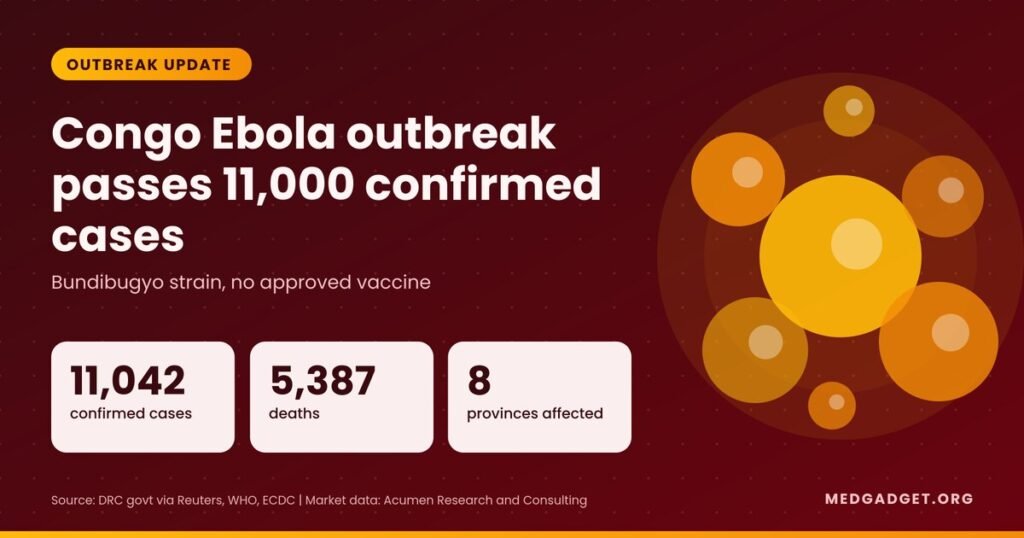

The Congo Ebola outbreak has passed 11,000 confirmed infections, with Democratic Republic of Congo government figures reported by Reuters on 11 November 2026 showing 11,042 cases and 5,387 deaths since the epidemic was declared in mid-May. It is now the second-largest Ebola outbreak ever recorded, behind only the 2014-2016 West Africa epidemic, and it is caused by the rare Bundibugyo virus, a species for which no vaccine or specific treatment has been approved.
The milestone matters for more than its size. Close to half of everyone confirmed infected has died, a large share of deaths are happening at home rather than in treatment centres, and the response in eastern Congo is being slowed by armed conflict and attacks on health facilities. Below, we set out what the latest official data show, why this strain is harder to fight, and what to watch next.
Key takeaways on the Congo Ebola outbreak
- Confirmed cases reached 11,042 with 5,387 deaths, according to Congolese government data reported on 11 November 2026.
- The virus is Bundibugyo ebolavirus. There is no licensed vaccine or targeted therapy for it; the Ervebo shot used against Zaire Ebola is being tested only within research protocols.
- Eight of Congo’s 26 provinces are affected, with Ituri and North Kivu carrying roughly nine in ten cases.
- The WHO declared a public health emergency of international concern on 17 May 2026 and rates the risk as very high nationally, high regionally and low globally.
- Cases linked to the outbreak have been confirmed in Kenya and Nigeria, while Uganda and France controlled earlier introductions.
- A Phase 2/3 vaccine platform trial called TUMAINI started in Bunia on 23 October.
How fast the outbreak is still growing
Official counts have climbed steadily rather than levelling off. The WHO’s Disease Outbreak News published on 6 November listed 10,668 confirmed cases and 5,198 deaths in Congo as of 3 November. The European Centre for Disease Prevention and Control (ECDC) put the total at 10,990 cases and 5,354 deaths on 9 November. Two days later, the government count passed 11,000. By our calculation, that is an increase of about 374 confirmed cases and 189 deaths in roughly a week, or more than 50 new confirmed infections a day.
| Reporting point | Confirmed cases (DRC) | Deaths (DRC) | Source |
|---|---|---|---|
| 3 Nov 2026 | 10,668 | 5,198 | WHO DON625 |
| 8-9 Nov 2026 | 10,990 | 5,354 | ECDC |
| 10-11 Nov 2026 | 11,042 | 5,387 | DRC government via Reuters |
The case fatality rate among confirmed patients works out to roughly 48.8% by our calculation, close to the WHO’s own 48.7% estimate. That is a crude figure: it counts all deaths against all confirmed cases and does not adjust for people still in care.
Where the cases are concentrated
ECDC’s 10 November provincial breakdown shows how heavily the epidemic sits in Congo’s conflict-affected northeast. Ituri alone accounts for about 70% of confirmed cases, by our calculation, and North Kivu has the highest provincial death rate.
| Province | Confirmed cases | Deaths | Crude fatality (our calculation) |
|---|---|---|---|
| Ituri | 7,654 | 3,613 | 47.2% |
| North Kivu | 2,720 | 1,488 | 54.7% |
| Haut-Uele | 491 | 214 | 43.6% |
| Tshopo | 98 | 32 | 32.7% |
| Bas-Uele, Nord-Ubangi, Sud-Kivu, Sud-Ubangi | 27 | 7 | n/a (small numbers) |
Outside Congo, Kenya has confirmed nine cases and two deaths, with its last confirmed case on 20 October. Nigeria reported one imported case in Abuja on 20 October, and the source of that infection is still under investigation. Several infected or exposed health and aid workers have been medically evacuated to Europe, including to Switzerland, the UK, Germany and the Netherlands. We covered the earlier spread in our reports on the Kenya cluster and the Abuja case.
Why Bundibugyo is harder to stop than Zaire Ebola
Most of the tools that turned recent Ebola outbreaks into manageable events were built for a different species, Zaire ebolavirus. The licensed Ervebo vaccine and the two approved antibody treatments target Zaire, not Bundibugyo. That leaves responders relying on classic measures: finding cases early, isolating them, tracing contacts and carrying out safe burials.
Those basics are under strain. The WHO reported that contact follow-up averaged 86% over two weeks, below its 95% target, and that 335 of 512 deaths recorded after 21 October occurred in the community, many among young children. Community deaths usually mean late detection and unsafe burials, both of which fuel further spread. Reuters and other outlets have also described attacks on treatment centres driven by mistrust and misinformation.
Vaccine and treatment candidates in testing
The TUMAINI Phase 2/3 platform trial began enrolling in Bunia on 23 October and is designed to add candidates as they receive national approvals. According to ECDC and WHO summaries, candidates in development or entering trials include:
- ChAdOx1-BDBV from the University of Oxford, produced with the Serum Institute of India.
- Moderna’s mRNA candidate (mRNA-1469).
- Two rVSV-based candidates from IAVI and Public Health Vaccines.
- MVA-CR19 from Minapharm.
- Ervebo, used for frontline workers in Kisangani since late August under a research protocol, to test whether it offers any cross-protection.
None of these has shown efficacy against Bundibugyo yet, so any claim that a vaccine is available should be treated with caution until trial results are published.
Market context: diagnostics and infectious disease tools
Outbreaks like this one put pressure on the testing and countermeasure supply chain. Acumen Research and Consulting valued the global infectious disease market at USD 26.4 billion in 2022 and projects it will reach USD 50.7 billion by 2032, a compound annual growth rate of 6.9%. The firm reports that assays and reagents held the largest product share, which reflects how central fast, reliable testing is to outbreak control. These are broad market estimates, not a measure of Ebola-specific spending.
What to watch next
- Kenya’s countdown: Kenya discharged its last patient this week and has started the 42-day clock toward declaring the outbreak over.
- Trial readouts: Any early immunogenicity or safety data from TUMAINI would be the first evidence for a Bundibugyo-specific vaccine.
- Security: Whether fighting in Ituri and North Kivu eases enough for teams to reach contacts.
- Funding: The WHO has flagged critical gaps in the Congo response budget.
- Risk level: The WHO says its risk assessment is being revised; an upgrade of the regional rating would signal growing concern about spread.
For travellers, the WHO advises against travel and trade bans and recommends targeted entry screening instead. ECDC rates the risk to people living in Europe as very low. Anyone who develops fever, weakness, vomiting, diarrhoea or unexplained bleeding within 21 days of being in an affected area should call ahead to a health facility before visiting. More public health coverage is in our Healthcare Services section.
FAQ
How many Ebola cases are there in Congo now?
Congolese government data reported on 11 November 2026 show 11,042 confirmed cases and 5,387 deaths since the outbreak was declared in mid-May 2026.
Is there a vaccine for the Bundibugyo Ebola virus?
No approved vaccine exists for Bundibugyo. Several candidates, including ones from Oxford and Moderna, are being tested, and the Zaire-strain vaccine Ervebo is being studied under research protocols only.
Is the 2026 Ebola outbreak the largest ever?
It is the second largest on record. The 2014-2016 West Africa epidemic infected more than 28,600 people and killed more than 11,000. By our calculation, the current outbreak has reached about 39% of that case total.
Which countries have reported Ebola cases in 2026?
Congo, Kenya and Nigeria have active or recent confirmed cases. Uganda and France reported earlier cases that were contained, and several patients were evacuated to European hospitals for care.
Sources: DRC health ministry data via Reuters (11 Nov 2026); WHO Disease Outbreak News DON625; ECDC outbreak update, 10 Nov 2026. Market data: Acumen Research and Consulting. This article is for information only and is not medical advice. Last updated 12 November 2026.