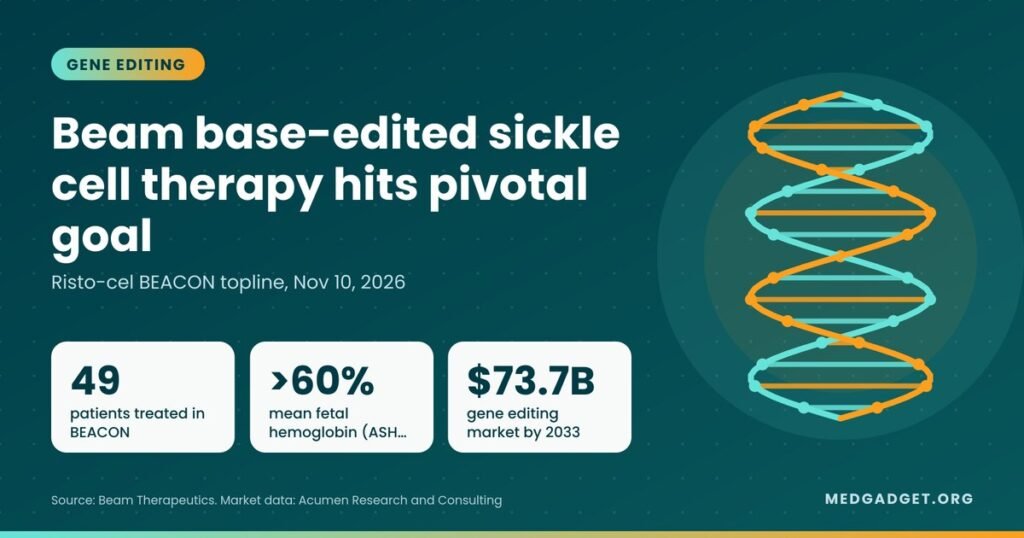

Risto-cel sickle cell data took a major step on November 10, 2026, when Beam Therapeutics said its base-edited cell therapy risto-cel (ristoglogene autogetemcel, formerly BEAM-101) met the primary efficacy endpoint of the pivotal BEACON trial, with 49 patients treated and a U.S. Biologics License Application (BLA) planned as early as the end of 2026. If filed and accepted, it would be the first BLA for any base editing medicine.
Key takeaways on risto-cel sickle cell
- BEACON met its primary goal: freedom from severe vaso-occlusive crises (VOCs) for at least 12 straight months, judged by independent adjudication.
- All secondary endpoints were met, including no inpatient hospital stays for severe VOCs over 12 consecutive months; the primary safety endpoints were met at an interim analysis.
- 49 patients (39 adults, 10 adolescents) had been treated by the October 20, 2026 cutoff; 31 had enough follow-up for the primary endpoint.
- Beam has not yet disclosed the share of patients who achieved the endpoint. Detailed numbers are due at ASH (December 12 to 15, 2026) and a 2027 meeting.
- The treatment still requires busulfan chemotherapy conditioning, the main safety and access hurdle for every gene-modified sickle cell therapy.
What Beam announced, and what it held back
BEACON is an open-label, single-arm Phase 1/2 study in people with sickle cell disease (SCD) and a history of severe VOCs, the painful blockages that drive most hospital admissions in the disease. According to the Beam Therapeutics release, the independently adjudicated primary endpoint (called VF12) was achieved, and safety findings matched what was seen earlier in the trial.
The headline is notable for what it leaves out. The release gives no response rate, no fetal hemoglobin values and no adverse event counts for the pivotal cohort. Analysts at H.C. Wainwright flagged the same gap, saying detailed safety, response rates and longer-term outcomes are the next things to scrutinise. For readers, the practical meaning is simple: the study worked by its own predefined test, but how well it worked versus approved options cannot yet be judged.
Chief executive John Evans called risto-cel “a potentially transformative, one-time treatment for people living with sickle cell disease.”
BEACON data so far, side by side
The most recent numbers in the public domain come from the December 2025 American Society of Hematology (ASH) meeting. The table sets them against the new topline disclosure.
| Measure | ASH 2025 update (31 patients) | Pivotal topline (Nov 10, 2026) |
|---|---|---|
| Patients treated | 31 | 49 (39 adults, 10 adolescents) |
| Mean fetal hemoglobin (HbF) | Above 60% | Not disclosed |
| Sickle hemoglobin (HbS) | Below 40% | Not disclosed |
| Median neutrophil engraftment | 17.5 days | Not disclosed |
| Median platelet engraftment | 19 days | Not disclosed |
| Severe VOCs after engraftment | None reported by investigators | Primary endpoint (VF12) met |
| Deaths | 1 (attributed to busulfan conditioning) | No new deaths described |
The “60/40” pattern in the earlier data, meaning HbF above 60% and HbS below 40%, is the profile clinicians look for because it resembles people who carry hereditary persistence of fetal hemoglobin and rarely have symptoms. Whether the larger pivotal cohort holds that line is the key question for ASH.
How base editing differs from Casgevy’s CRISPR cut
Risto-cel and Vertex’s Casgevy pursue the same biological goal: switch fetal hemoglobin back on so that red cells resist sickling. They get there differently.
- Casgevy uses CRISPR-Cas9 to cut both DNA strands at an enhancer of the BCL11A gene, reducing that repressor in red cell precursors.
- Risto-cel uses a base editor to change single DNA letters in the promoters of the HBG1 and HBG2 genes, without a double-strand break. The edit stops BCL11A from binding there while leaving BCL11A itself intact, mimicking natural variants that keep HbF high for life.
Avoiding double-strand breaks is designed to lower the risk of large unintended DNA rearrangements, though long-term human data will be needed to show a real-world safety advantage. For Casgevy’s commercial trajectory, see our coverage of Vertex’s Q3 2026 results.
The conditioning problem has not gone away
Like every approved gene-modified SCD therapy, risto-cel involves collecting a patient’s own stem cells with plerixafor, editing them, then wiping out the bone marrow with myeloablative busulfan before reinfusion. In November 2024 Beam disclosed that a BEACON patient died of respiratory failure four months after treatment; the company judged the death unrelated to the edited cells and likely linked to busulfan. Beam describes the adverse events seen in the pivotal readout as consistent with plerixafor, cell collection, busulfan, the transplant process and underlying SCD.
That matters for uptake. Hospital time, fertility risk from chemotherapy and the small number of qualified treatment centres have slowed adoption of one-time SCD therapies. Beam is separately developing a gentler antibody-based conditioning approach (ESCAPE), which could change the equation if it reaches the clinic at scale.
Market context
Risto-cel lands in a fast-growing field. Acumen Research and Consulting estimates the global gene editing market at USD 18.3 billion in 2024 and projects USD 73.7 billion by 2033, a compound annual growth rate of 16.9% from 2025 to 2033. Acumen notes that North America dominates the market, while Asia-Pacific is the fastest-growing region. A first base editing approval would add a new technology class to a market that CRISPR nuclease products currently lead.
Timeline: what to watch next
- December 12 to 15, 2026: oral presentation at the 68th ASH Annual Meeting in New Orleans, using an earlier data cutoff.
- As early as end of 2026: BLA submission to the FDA.
- 2027: full pivotal BEACON results at a medical meeting, including the exact share of patients who met VF12.
FAQ
What is risto-cel?
Risto-cel (ristoglogene autogetemcel) is an investigational one-time therapy made from a patient’s own CD34+ blood stem cells, base-edited to raise fetal hemoglobin and then returned through a stem cell transplant.
Is risto-cel FDA approved?
No. Beam plans to file for FDA approval as early as the end of 2026. A standard review would put a decision well into 2027 or later.
How is risto-cel different from Casgevy?
Both raise fetal hemoglobin. Casgevy cuts DNA with CRISPR-Cas9 at a BCL11A enhancer; risto-cel changes single DNA letters in the gamma-globin gene promoters without cutting both strands. No head-to-head trial exists.
Does risto-cel still need chemotherapy?
Yes. Patients receive busulfan conditioning before the edited cells are infused, which carries serious risks including infertility and, rarely, death.
More gene and cell therapy news: Bio Technology.
Sources: Beam Therapeutics press release (November 10, 2026); ASH 2025 BEACON data coverage; analyst commentary reported by BioSpace. Market data: Acumen Research and Consulting, Gene Editing Market report. This article is for information only and is not medical or investment advice. Last updated November 11, 2026.