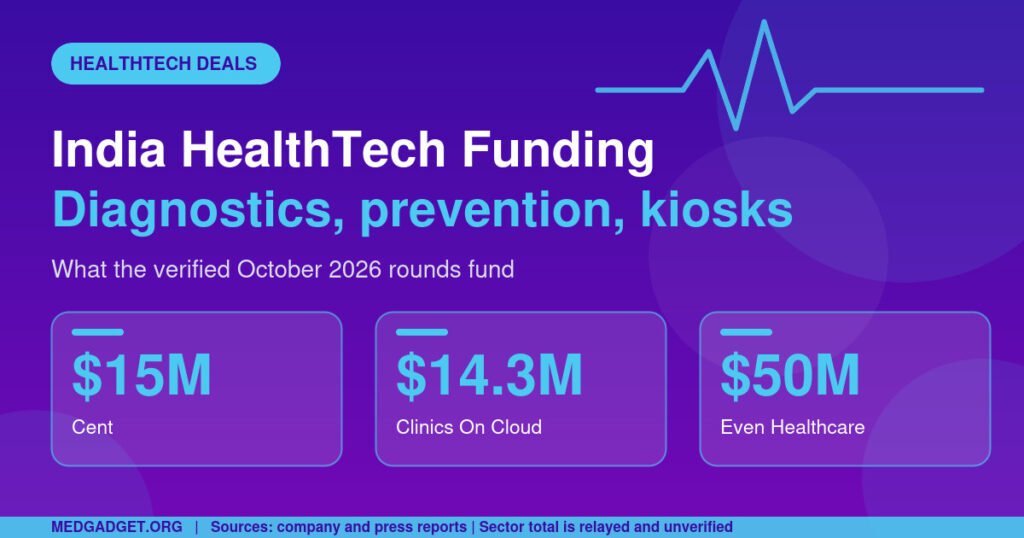

India HealthTech funding in October 2026 went partly to products that readers can examine on their merits: AI-assisted diagnostics, preventive care and digital health kiosks. A reported headline of $173 million across 19 rounds for healthcare and life sciences, attributed to the data platform Tracxn, could not be verified against the original report, so we treat it as relayed. Three rounds can be confirmed: Even Healthcare raised $50 million, Cent $15 million and Clinics On Cloud $14.3 million. This evidence-oriented article looks at what those companies say they are building, what is and is not known about their results and why funding totals say little about clinical value.
Key takeaways on India HealthTech funding in October 2026
- Reported sector total: $173 million across 19 rounds, relayed and unverified.
- Even Healthcare: $50 million, among the largest Indian startup rounds in October.
- Cent: $15 million from backers including Blume and South Park Commons, for preventive healthcare and AI diagnostics.
- Clinics On Cloud: $14.3 million from Model42.ae, for digital health kiosks, based in Pune.
- No clinical outcome data accompanied these funding announcements in the material we reviewed.
What the funded products are
| Company | Area | What funding does not tell us |
|---|---|---|
| Even Healthcare | Healthcare services | Clinical outcomes and unit economics |
| Cent | Preventive care and AI diagnostics | Diagnostic accuracy and validation status |
| Clinics On Cloud | Digital health kiosks | Quality of measurements and usage data |
Funding shows that investors see potential; it does not show that a product works. For diagnostics in particular, evidence means validation against a reference standard, reported sensitivity and specificity, and regulatory clearance where required. For kiosks that take measurements such as blood pressure, evidence means accuracy against clinical devices. For preventive programmes, evidence means change in outcomes or risk markers over time. None of these was part of the funding announcements we reviewed.
Why AI diagnostics need validation
AI-assisted diagnostic tools learn from data and can perform differently in new populations or settings, so validation in the intended setting matters. Regulators and clinicians usually look for peer-reviewed or regulatory-submitted evidence before relying on a tool. In India, diagnostic devices and software may fall under the medical device rules overseen by the Central Drugs Standard Control Organisation. Whether and how the companies named have addressed this is not covered in the announcements we saw, and we make no assumption.
A reader’s guide to evidence for digital health products
Readers who want to judge a digital health product can look for a handful of signals. First, is there a published study, and was it done in people similar to the intended users? Second, does it report measures such as sensitivity, specificity or agreement with a reference device, with confidence intervals? Third, was the study independent of the company, or run by it? Fourth, is the product cleared or registered where required? Fifth, are outcomes such as earlier diagnosis or reduced hospital visits measured, and over what period? A product that scores well on several of these is more convincing than one backed only by usage numbers or funding news. We apply none of these tests to the named companies because the announcements do not provide the data.
Questions to ask a funded health startup
- What clinical validation has been completed, and where is it published?
- What regulatory status applies to each product in India and elsewhere?
- How is patient data protected, and who has access?
- What outcomes will the new funding be used to measure?
The funding context
Across all sectors, Indian startups raised about $678 million in October 2026, down 47.5% from September according to one tracker, which implies about $1.29 billion in September by our calculation; another source gave $694 million, down 51%. Growth-stage companies raised about $414.6 million and early-stage companies about $263 million. Healthcare-specific month-on-month and stage-split figures were not available to us. Tracxn publishes funding trackers, and the Startup India portal covers policy.
Evidence gaps
- No peer-reviewed validation data were cited for the products.
- Usage, retention and outcome data were not disclosed.
- The 16 rounds beyond the three verified ones were not identified.
- Trackers differ on totals, so any total should be treated cautiously.
Timeline
- October 2026: Even Healthcare raises $50 million.
- 23 to 29 October 2026: Cent and Clinics On Cloud announce rounds.
- Early November 2026: monthly funding totals published.
Market context: digital health
Acumen Research And Consulting’s Digital Health Market report gives USD 217 billion in 2022 and USD 1,592 billion by 2032, a compound annual growth rate of 25.3% for 2023 to 2032, with North America above 43%, Asia-Pacific growing at more than 45% and services above 66%. By our calculation the endpoints imply about 22%. The page mislabels one table and merges two company names, and dates from July 2024, so it is indicative only and not about Indian funding.
Our analysis
In our assessment, readers should separate funding momentum from clinical evidence. The verified rounds point to investor interest in preventive care, diagnostics and clinic-based access, but the announcements give no way to judge effectiveness. The most useful follow-up would be validation studies and outcome data from the companies.
What is not disclosed
- The original source of the $173 million total.
- Validation or outcome data for the funded products.
- Valuations and terms of the rounds.
- The remaining 16 rounds.
Risks and caveats
- The sector total is relayed and unverified.
- Funding is not evidence of clinical effectiveness.
- Market data are indicative.
- This article is news reporting and not medical or investment advice.
What to watch next
- Validation publications from funded companies.
- Regulatory clearances where applicable.
- November funding data.
- Follow-on rounds.
General background
Related coverage: an AI health start-up’s launch. More in the Healthcare IT category.
Questions readers are asking about India HealthTech funding
Does funding mean a product works?
No. Funding shows investor interest, not clinical evidence.
What did Cent raise?
$15 million, for preventive healthcare and AI diagnostics.
Is the $173 million total confirmed?
No. It is relayed and could not be verified.
FAQ
What is sensitivity?
The share of people with a condition whom a test correctly identifies.
What is specificity?
The share of people without a condition whom a test correctly clears.
What is a digital health kiosk?
A booth or station that offers basic checks or consultations.
How we reported this: deal details come from company and press reports; the $173 million headline is relayed and unverified; market figures are attributed to Acumen Research And Consulting; calculations marked as ours are our own. Last updated 5 November 2026. This is news reporting and not medical or investment advice.