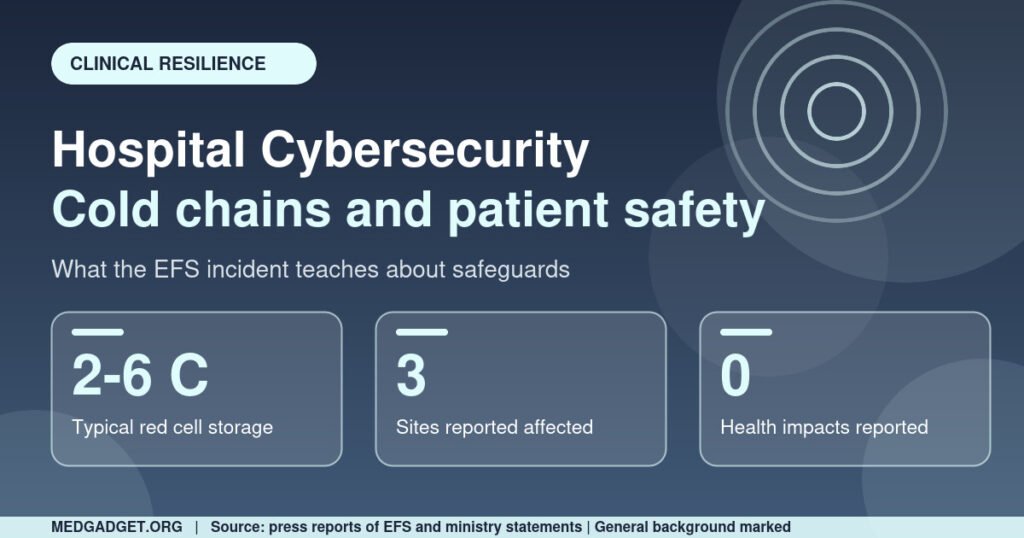

Hospital cybersecurity is usually discussed in terms of patient records and ransomware, but the reported incident at French blood storage sites in early November 2026 points to another dimension: the connected equipment that keeps medical products safe. According to press reports of statements by the French blood establishment, the EFS, and the health ministry, cold-storage equipment at three sites was affected overnight on 1 and 2 November, safeguards flagged the problem, no blood products were lost and no health consequences were recorded. Investigators are working on cause and scope. This article uses the incident to explain how blood cold chains are protected, without speculating about the attack itself.
Key takeaways on hospital cybersecurity and blood storage
- The EFS reportedly said no health consequences occurred and no blood products were lost.
- Alarms reportedly flagged the problem, and collection and distribution continued.
- ANSSI, the French cybersecurity agency, and the health ministry are investigating.
- Method, perpetrators, motive and any data exposure are not established.
- General lesson: refrigeration and monitoring equipment is part of healthcare’s digital attack surface.
How blood is kept safe in storage
As general background and not a finding about this incident, blood components have different storage needs. Red blood cells are normally stored refrigerated, plasma is stored frozen, and platelets are kept at room temperature with gentle agitation. If a product leaves its approved range for too long, it may have to be discarded because quality cannot be assured. Storage units therefore have temperature sensors, alarms and logs, and blood establishments follow procedures for responding to alarms, such as moving or quarantining products.
| Component | Typical storage (general) | Why monitoring matters |
|---|---|---|
| Red blood cells | Refrigerated | Temperature excursions can damage cells |
| Plasma | Frozen | Thawing can degrade clotting factors |
| Platelets | Room temperature with agitation | Short shelf life and contamination risk |
Layers of protection
Good practice relies on several independent layers rather than a single control. Sensors and alarms detect deviations. Independent monitoring, separate from the equipment being controlled, can confirm conditions. Written procedures tell staff what to do. Redundant storage allows products to be moved. And in the digital layer, network segmentation, access control and monitoring reduce the chance that one compromised system affects equipment. The reported facts, that alarms flagged the issue and no products were lost, are consistent with at least some of these layers having worked, though the EFS has not described them in detail in the material we reviewed.
A checklist a hospital transfusion service could use
- List every storage unit for blood and blood components and note which are connected to a network or remote monitoring.
- Confirm that temperature alarms have an independent sensor and that alerts reach staff by more than one route.
- Rehearse the response to an alarm, including who moves stock and where it goes.
- Keep manual temperature logs as a back-up and check them regularly.
- Ask equipment suppliers how remote access is secured and how updates are handled.
This checklist is our general suggestion based on common practice and is not guidance from the EFS or any regulator. Local policies and national rules take precedence.
Evidence gaps
Because the investigation is open, several evidence gaps remain. We do not know how the equipment was affected, whether other systems were involved, how long conditions were out of range, if at all, or what monitoring data show. Without those data, no one outside the investigation can judge how close the incident came to causing harm. The reported absence of lost products is reassuring, but it is a statement and not a published dataset, and it should be read as such.
What has been attributed and what has not
The information on effects comes from press reports quoting the EFS and the health ministry. Other technical details have circulated, including specific temperature figures and links to other incidents, but they have not been confirmed by officials, and we do not repeat them. The investigation by ANSSI and the ministry will determine what happened. Information on the establishment is at the EFS website, and cybersecurity guidance is published by ANSSI at cyber.gouv.fr.
Why clinicians and hospitals should care
Hospitals depend on blood establishments for transfusions in surgery, trauma, cancer care and obstetrics. A disruption in supply, even if short, can affect scheduled procedures. The reported absence of operational consequences is therefore the key outcome. For hospital teams, the general lesson is to know which medical supplies depend on connected equipment, to have manual back-up procedures and to ask suppliers about their security practices. Related coverage on our site includes an outage affecting UK GP websites and work at a regional blood centre.
Timeline
- Overnight 1 to 2 November 2026: incident reportedly affects three EFS cold-storage sites.
- 2 to 4 November 2026: reports quote officials on no health consequences.
- Ongoing: investigation.
Market context
Acumen Research And Consulting’s Healthcare Cybersecurity Market report gives USD 17.6 billion in 2022 and USD 79.7 billion by 2032, a compound annual growth rate of 16.6% for 2023 to 2032, with North America at about 40% and Asia-Pacific the fastest growing. By our calculation the endpoints imply about 16.3%, and 16.6% compounded gives about USD 81.8 billion. The page dates from July 2024 and has some name errors. It describes spending and does not mention this incident.
Our analysis
In our assessment, the most useful reading of the reported facts is cautious: safeguards appear to have limited harm, and the cause is still being established. Resilience in healthcare cybersecurity comes from layers, not from one control, and from procedures that work when systems do not.
What is not disclosed
- Method and scope of the incident.
- Responsibility and motive.
- Whether data was accessed.
- The precise role of each safeguard.
Risks and caveats
- Reports are of statements and not primary statements.
- Storage information is general background and not specific to the EFS.
- Market data are indicative.
- This article is news reporting and not security or medical advice.
What to watch next
- Investigation findings.
- Official EFS communication.
- Guidance for other blood establishments.
- Any change to monitoring requirements.
General background
More in the Healthcare IT category.
Questions readers are asking about hospital cybersecurity
Can cyberattacks affect medical refrigeration?
Connected equipment is part of the digital attack surface in general, which is why monitoring and back-up procedures matter.
Were blood products lost in the French incident?
The EFS reportedly said no.
Has the cause been established?
No. The investigation is ongoing.
FAQ
What is network segmentation?
Dividing a network so a problem in one part does not spread to others.
What is a temperature excursion?
Storage outside the approved temperature range.
What is the EFS?
The French blood establishment.
How we reported this: details come from press reports of statements by the EFS and the French health ministry between 2 and 4 November 2026; general background is marked as such; market figures are attributed to Acumen Research And Consulting; calculations marked as ours are our own. Last updated 5 November 2026. This is news reporting and not security or medical advice.