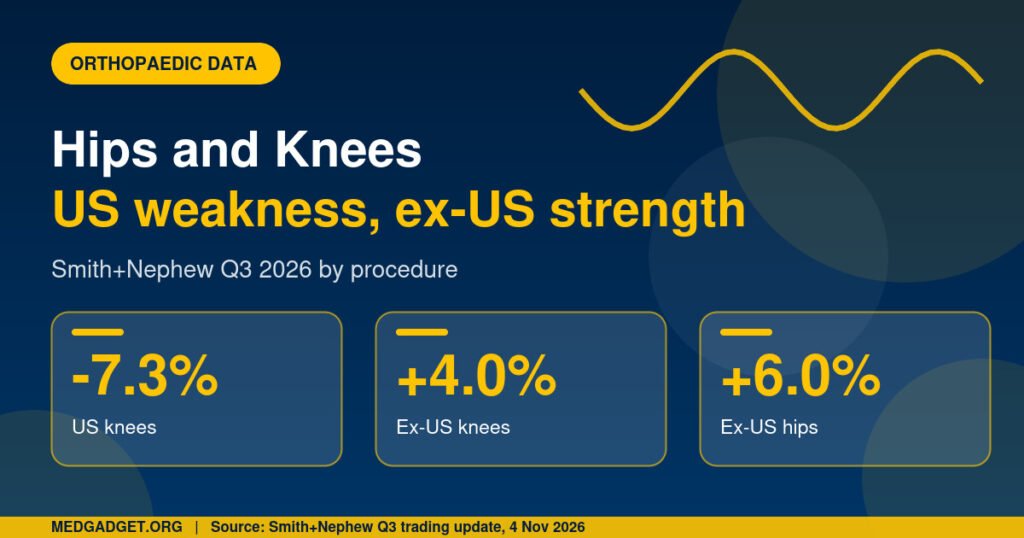

The orthopaedic medical devices market looks different depending on where you stand: Smith+Nephew’s third-quarter update of 4 November 2026 shows US knee sales down 7.3% while knees outside the US grew 4.0% and hips outside the US grew 6.0%. The company cut its 2026 outlook on the weakness in US hips and knees and confirmed that its talks with Johnson & Johnson have ended, without giving a reason. This data-focused article reads the procedure-level numbers, notes what they can and cannot tell us and flags what the company has not explained.
Key takeaways on the orthopaedic medical devices market
- Orthopaedics revenue was $590 million, up 2.5% underlying; knees $229 million (down 2.0%) and hips $157 million (up 2.0%).
- US knees fell 7.3% and US hips fell 1.0%; outside the US knees grew 4.0% and hips 6.0%.
- Trauma and Extremities grew 1.8%.
- Group underlying growth was 3.4% (4.0% excluding China); the full-year guide is now about 3%.
- The company cites the fourth-quarter outlook for US hips and knees for the guidance cut.
Reading the procedure data
| Product line | Revenue | Underlying growth |
|---|---|---|
| Knees (total) | $229 million | minus 2.0% |
| US knees | Not stated | minus 7.3% |
| Knees outside US | Not stated | +4.0% |
| Hips (total) | $157 million | +2.0% |
| US hips | Not stated | minus 1.0% |
| Hips outside US | Not stated | +6.0% |
| Trauma and Extremities | Not stated | +1.8% |
The totals and the regional splits allow a simple inference: because the group figure for knees is negative while ex-US knees are positive, the US must make up most of the knee business, and its fall outweighs gains elsewhere. The company does not give the US revenue by product line, so we cannot calculate exact shares. Total US revenue in the quarter was $812 million, up 3.0%, which means weakness in hips and knees was offset by other products.
What procedure-level data can and cannot show
Underlying growth figures strip out currency and portfolio changes, which makes them a cleaner measure of demand than reported revenue. But they have limits. They do not separate volume from price, so a fall could reflect fewer implants sold, lower prices, or a mix shift toward cheaper products. They do not show market share unless compared with competitors’ figures for the same period, which we do not have here. And a single quarter can be affected by timing, such as hospital ordering patterns or the length of a selling period. For all these reasons, a 7.3% fall in US knees is a signal worth investigating but not a verdict on the underlying market.
How to compare with peers
A fair comparison would line up the same procedures, the same period and the same definition of growth across several companies. Joint replacement is dominated by a handful of large manufacturers, so if rivals also reported weak US knees, the cause may be market-wide, such as slower procedure growth or hospital pricing pressure. If rivals reported growth, the cause is more likely company-specific, such as product transitions or sales execution. Readers can use the peer reports on our site, including coverage of J&J device growth slowing in Q3 2026, as a starting point, while noting that definitions differ between companies.
Other segments for comparison
| Segment | Revenue | Underlying growth |
|---|---|---|
| Sports Medicine and ENT | $507 million | +7.9% |
| Advanced Wound Management | $454 million | minus 0.2% |
| Orthopaedics | $590 million | +2.5% |
In Sports Medicine, joint repair grew 11.2% and arthroscopic enabling technologies 7.5%, while ENT fell 5.6%. In Wound Management, bioactives fell 8.8%, and the company noted a skin-substitute headwind toward the top of a $20 to 40 million range.
The J&J talks and the strategic review
Smith+Nephew confirmed that it approached Johnson & Johnson as part of a review of options for Orthopaedics and that discussions have ended. It gave no reason and no terms, and said it will keep exploring strategic options. Press reports said the talks ended over a leadership disagreement, which neither company has confirmed. The Johnson & Johnson website hosts that company’s own announcements.
Timeline
- August 2026: guidance cut to about 4% underlying growth.
- September 2026: LANDMARK knee FDA 510(k) clearance.
- 4 November 2026: Q3 update, talks ended, guidance cut to about 3%.
- 1 March 2027: full-year results.
Market context
Acumen Research And Consulting’s Orthopedic Devices Market report projects about USD 81.3 billion by 2027 at about 5% a year from 2020, which implies roughly USD 58 billion in 2020 by our calculation. North America has a large share, Europe is second and Asia-Pacific is the fastest-growing region, which fits the ex-US strength seen at Smith+Nephew. The report was last updated in May 2020 and contains garbled text, so it is dated and indicative only.
Our analysis
In our assessment, the data suggest a regional rather than a product-wide problem: the same product lines grow outside the US and shrink inside it. That points toward US market conditions or competitive dynamics, but the company has not said which. The next datapoint is the fourth-quarter outcome in the full-year results.
What is not disclosed
- US revenue by product line.
- The reasons for US hip and knee weakness.
- Why talks with J&J ended.
- Details of the strategic options under review.
Risks and caveats
- Percentages are underlying growth rates reported by the company.
- Inferences marked as ours are not company statements.
- Market data are dated.
- This article is news reporting and not investment advice.
What to watch next
- Fourth-quarter US hip and knee data.
- Any news on the Orthopaedics review.
- Launch progress for LANDMARK.
- Competitors’ US joint replacement results.
General background
Company information is on the Smith+Nephew website. More in the Medical Device category.
Questions readers are asking about the orthopaedic medical devices market
Are US hip and knee sales falling?
For Smith+Nephew, US knees fell 7.3% and US hips fell 1.0% in Q3.
Is the weakness global?
No. Knees outside the US grew 4.0% and hips 6.0%.
Why was guidance cut?
The company cites the fourth-quarter outlook for US hips and knees.
FAQ
What are underlying growth rates?
Growth excluding currency and certain portfolio changes.
What is a cementless knee?
A knee implant fixed by bone growth into the implant surface instead of bone cement.
What is arthroscopy?
Keyhole surgery to examine or repair a joint.
How we reported this: details come from Smith+Nephew’s third-quarter trading update of 4 November 2026 and press reports; market figures are attributed to Acumen Research And Consulting; inferences marked as ours are our own. Last updated 5 November 2026. This is news reporting and not investment advice.