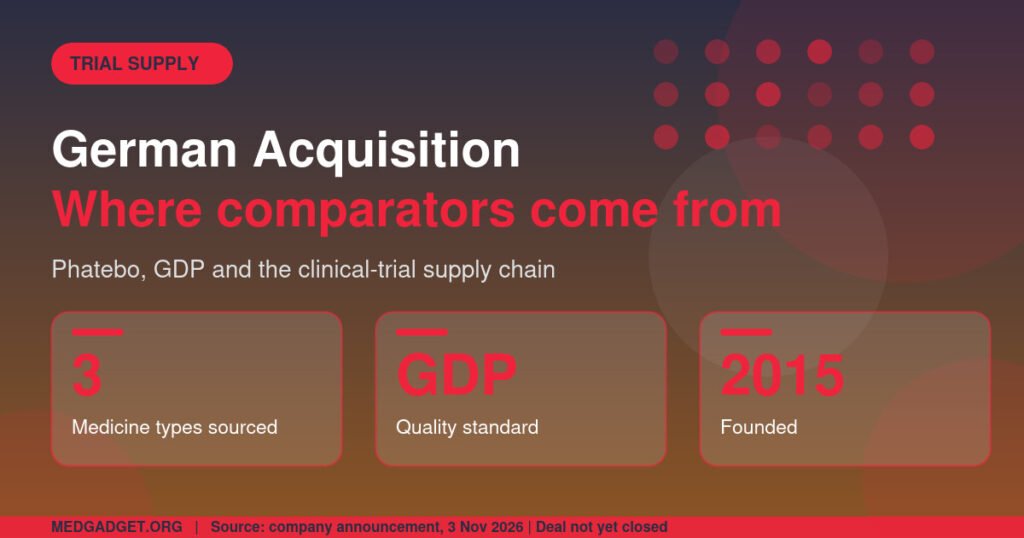

A German pharmaceutical company acquisition announced on 3 November 2026 puts a lesser-known part of drug development in view: the supply of medicines for clinical trials. HRV Pharma, based in Hyderabad, has signed definitive agreements to buy Phatebo GmbH of Hilzingen from ZeroStack Corp. Phatebo sources comparator, investigational and ancillary medicines for trials. The price, the closing date and any conditions have not been disclosed. This article explains how trial supply works, why quality rules matter and what the announcement leaves unanswered.
Key takeaways from the German pharmaceutical company acquisition
- HRV Pharma will acquire 100% of Phatebo GmbH under definitive agreements; no price or closing date is given.
- Phatebo sources comparator, investigational and ancillary medicines for global pharmaceutical companies and contract research organisations.
- It holds a German pharmaceutical wholesale authorisation and works under good distribution practice.
- Revenue was about ₹350 crore in 2025, according to the company.
- Phatebo is a sourcing and distribution business and not a drug manufacturer.
How clinical-trial supply works
A clinical trial is more than the experimental drug. Many trials compare a new treatment against an existing one, the comparator, which must be sourced in the right strength and quantity, often from the market in several countries, and then relabelled and packaged so that patients and investigators may not know which they are receiving. Ancillary medicines, such as rescue treatments or supportive drugs, may also be needed. Sponsors, the companies running trials, and contract research organisations often outsource this sourcing to specialists because it combines procurement, regulatory paperwork and cold-chain or controlled-temperature logistics.
Blinding and relabelling in practice
In a blinded trial, participants, and sometimes investigators, do not know which treatment is being given. To keep it that way, comparator and experimental products may need to look identical or be packaged in identical kits, with coded labels that meet the rules of each country. Relabelling a marketed medicine is a regulated activity that requires documentation showing the source, batch and handling history of every unit. Any gap in that record can raise questions about the integrity of the trial data. These tasks are usually done by specialised packaging and labelling facilities, and the announcement does not say whether Phatebo performs them or relies on partners, so we make no assumption.
Why distribution standards matter
Medicines must be stored and moved under controlled conditions so that their quality is not compromised. Good distribution practice sets expectations for premises, temperature control, documentation, traceability and handling of complaints. A wholesale authorisation, which Phatebo holds in Germany, is the licence to hold and supply medicines. Regulators such as the BfArM in Germany and the European Medicines Agency set out the framework in Europe. For an acquirer, inheriting a licensed operation means inheriting its compliance record and obligations, which is why continuity of management matters; Managing Director Martin Lisker and the team are staying.
| Trial-supply item | What it is | Why it is sourced separately |
|---|---|---|
| Comparator | An existing medicine used as the standard of care | Needs to be sourced and blinded for the trial |
| Investigational medicine | The experimental product | Often supplied by the sponsor but may need distribution |
| Ancillary medicine | Supportive or rescue drugs | Needed at sites in specific quantities |
What would show that integration worked
For a trial-supply business, success after an acquisition would show up in retention of sponsor and contract research customers, an unbroken compliance record, on-time delivery to trial sites and continued staff stability. None of these has been reported yet, because the deal has not closed. Readers looking for evidence in the coming year should watch for regulatory inspections, customer announcements and any change in the licences held by Phatebo.
What the deal does and does not change
HRV is an API specialist with an asset-light, intellectual-property-led model. Phatebo adds a European, licensed distribution business serving trial sponsors. HRV’s chief executive described it as the company’s first finished formulations business, but because Phatebo does not manufacture, the deal does not give HRV formulation manufacturing capacity. Whether it helps HRV’s ingredient sales depends on customer overlap, which the announcement does not discuss.
Timeline
- 2015: both companies founded.
- 2025: Phatebo revenue of about ₹350 crore.
- 3 November 2026: definitive agreements signed.
- Later: closing and integration, with no dates given.
Market context
Acumen Research And Consulting’s Active Pharmaceutical Ingredient Market report gives USD 255.47 billion in 2025 and USD 473.20 billion by 2035, a compound annual growth rate of 6.3% for 2026 to 2035, with North America above 39% and Asia-Pacific the fastest growing at 8.5%. The page header says the forecast runs to 2036, which conflicts with the title, and the report covers ingredients, not clinical-trial supply. We therefore treat it as context for HRV’s core market and not for Phatebo.
Our analysis
In our assessment, the acquisition is better understood as a diversification into a regulated services niche than as a step into manufacturing finished medicines. The value depends on Phatebo’s customer relationships, its compliance record and how well it is integrated, none of which can be assessed from the announcement.
What is not disclosed
- Price, financing and closing conditions.
- Phatebo’s profitability and customer concentration.
- Inspection and licence history.
- Plans for finished-product manufacturing.
Risks and caveats
- Signed but not closed.
- Distribution compliance and integration risk.
- Trade and logistics disruption risk.
- This article is news reporting and not investment or medical advice.
What to watch next
- Closing announcement.
- Financial disclosure.
- Customer retention at Phatebo.
- Strategy for HRV’s formulations ambitions.
General background
Related coverage: Laurus Labs’ peptide and oligonucleotide business. More in the Pharmaceutical category.
Questions readers are asking about the German pharmaceutical company acquisition
What does Phatebo supply?
Comparator, investigational and ancillary medicines for clinical trials.
Is the deal complete?
No. Definitive agreements are signed; closing has not been announced.
Will management change?
The managing director and team are staying, and the name is retained.
FAQ
What is a contract research organisation?
A company that runs clinical trials on behalf of sponsors.
What is a wholesale authorisation?
A licence to hold and supply medicines.
What is blinding?
Keeping participants or investigators unaware of which treatment is given.
How we reported this: details come from the HRV Pharma announcement of 3 November 2026 as reported in trade and business press; market figures are attributed to Acumen Research And Consulting. Last updated 5 November 2026. This is news reporting and not investment or medical advice.