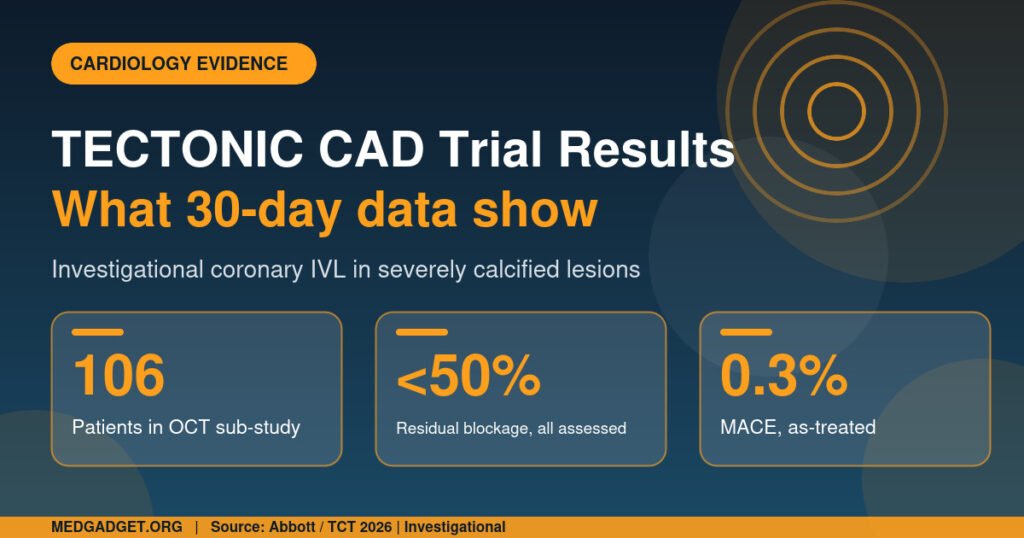

The TECTONIC CAD trial results are the first public evidence for Abbott’s investigational SonicForce coronary intravascular lithotripsy (IVL) system. Presented on 1 November 2026 at TCT in San Diego and published in JACC: Cardiovascular Interventions, the study enrolled 335 patients with severely calcified coronary artery disease at 40 US sites and met both primary endpoints at 30 days.
Key takeaways from the TECTONIC CAD trial results
- Primary effectiveness: procedural success in 97% of patients.
- Primary safety: 30-day target lesion failure of 0.3%.
- Key secondary: remaining vessel blockage below 50% in all patients assessed by the core laboratory.
- MACE in the as-treated population was 0.3%, defined as cardiac death, any myocardial infarction and target vessel revascularisation.
- A prespecified OCT sub-study of 106 patients showed calcium fractures and improved stent expansion.
The biology: what calcium does to a coronary artery
In atherosclerosis, fatty plaque builds up in the artery wall and can calcify over time. Calcified plaque is stiff. When an interventional cardiologist inflates a balloon or deploys a stent in such a lesion, the rigid wall resists expansion, and the stent can end up smaller than intended. Investigator Eric Secemsky, who directs vascular intervention at Beth Israel Deaconess Medical Center and is a co-principal investigator, called coronary calcium one of the greatest challenges to optimal percutaneous coronary intervention outcomes.
IVL addresses the problem mechanically. A balloon-mounted catheter emits acoustic pressure waves, similar in principle to those used for kidney stones, that crack calcium from within the vessel wall. Abbott says SonicForce delivers up to 160 pulses at two per second, with longer treatment lengths and improved deliverability.
What the OCT sub-study adds
Optical coherence tomography is an intravascular imaging technique that uses light to produce detailed cross-sections of the artery. In the sub-study of 106 patients, it identified calcium fractures inside treated lesions and showed improved stent expansion afterwards. That is useful because it connects the device’s mechanism, fracturing calcium, with the outcome that matters mechanically, a fuller stent expansion. It is imaging evidence of mechanism, though, not a clinical outcome, and the release does not give the numerical expansion data.
Reading the endpoints carefully
| Endpoint | Reported result | Evidence caveat |
|---|---|---|
| Procedural success | 97% | Definition not stated in the release |
| 30-day target lesion failure | 0.3% | Definition not stated in the release |
| Residual stenosis after IVL (core lab) | Below 50% in all assessed | Reported for patients assessed by the core lab |
| 30-day MACE (as-treated) | 0.3% | Cardiac death, myocardial infarction, target vessel revascularisation |
The primary results are 30-day outcomes. The distinction between procedural success and long-term patient outcomes matters here: procedural success says the procedure achieved its technical goals, whereas long-term outcomes, such as survival, heart attacks and repeat procedures over years, are not yet reported. Readers can find the paper at JACC: Cardiovascular Interventions.
Timeline of the TECTONIC CAD study
- 1 November 2026: results presented at TCT 2026 and published online.
- After 30 days: patients continue in follow-up; later data have not been reported.
- Regulatory status: investigational and not approved by the FDA.
Study design: what we know and what we do not
The trial was run under an Investigational Device Exemption, which allows a device to be studied in patients before approval. The announcement does not say whether TECTONIC CAD had a comparison group, and it does not give baseline lesion features, so the results should be read as a performance and safety assessment of the device against pre-set criteria, not a head-to-head comparison.
How a clinician might read the paper
These are questions we would expect a reader to bring to the full publication; they are our framing and not statements from the investigators. First, how were procedural success and target lesion failure defined, and are the definitions the same as those used in earlier lithotripsy studies, so that results can be compared fairly? Second, what proportion of enrolled patients had the most severe calcium, and how were lesions selected? Third, how many lesions needed additional preparation tools before or after IVL? Fourth, what was the rate of complications such as vessel perforation or dissection, which the announcement does not itemise?
None of these can be answered from the announcement, which is why the peer-reviewed paper is the right place to look. Independent commentary after the TCT presentation will also help place the numbers in context.
What longer follow-up would need to show
- Durability: whether stents placed after IVL stay open without repeat procedures at 12 months and beyond.
- Safety over time: rates of stent thrombosis, heart attack and death compared with expectations for similar patients.
- Generalisability: whether results hold across more complex lesions and in routine practice outside a trial.
- Comparative performance: how the device performs against other lesion-preparation approaches in comparable patients.
Market context: lithotripsy technology
The underlying principle of IVL comes from lithotripsy. According to Acumen Research And Consulting, the global lithotripsy device market was valued at USD 1.4 billion in 2022 and is projected to reach USD 2.4 billion by 2032, a compound annual growth rate of 5.8% for 2023 to 2032, with North America at about USD 462 million in 2022 and Asia-Pacific growing at above 6%.
This report is mainly about kidney-stone lithotripsy, so it describes the parent technology and not coronary IVL. It also has quality problems: its page is dated November 2023, lists some companies that look like diagnostics firms and includes unsourced statistics. We cite it only as background.
Our analysis
In our assessment, the most scientifically meaningful element is the link between mechanism and result: imaging that shows fractured calcium and better stent expansion, together with low 30-day event rates. What the data cannot yet show is whether those mechanical gains translate into better long-term outcomes. For that, follow-up and, ideally, comparison with existing approaches will be needed.
What is not disclosed
- Definitions of procedural success and target lesion failure.
- Whether the study had a control arm.
- Numerical stent-expansion data from the OCT sub-study.
- Follow-up beyond 30 days.
Risks and caveats
- SonicForce is investigational and not FDA-approved.
- The announcement is from the manufacturer.
- Thirty-day data cannot show long-term durability.
- This article is not medical advice.
What to watch next
- Longer-term follow-up from TECTONIC CAD.
- Regulatory review of the system.
- Independent analyses of the JACC paper.
- Comparisons with other lesion-preparation tools.
General background
Abbott (see the company website and the FDA medical devices pages for regulatory status) also appears in our recent device coverage, including its CardioMEMS HF system upgrade and its Q3 2026 results. More on our Medical Device section.
Questions readers are asking about the TECTONIC CAD trial results
What does the trial show?
That the investigational system met its 30-day safety and effectiveness endpoints in 335 patients.
Does it prove SonicForce is better than other treatments?
No. The announcement does not describe a comparison.
What did OCT show?
Calcium fractures and improved stent expansion in a 106-patient sub-study.
FAQ
What is OCT?
Optical coherence tomography, an intravascular imaging method that uses light.
What is target lesion failure?
A composite measure of problems at the treated lesion; the exact definition used here is not stated in the release.
Is SonicForce available?
No, it is investigational.
How we reported this: details come from Abbott’s announcement of the TECTONIC CAD results and the associated publication; market figures are attributed to Acumen Research And Consulting. Last updated 4 November 2026. This is news reporting and not medical advice.