
For people living with an implanted heart-failure sensor, the numbers that guide their care have so far stayed with their clinicians. That is changing. Abbott said on 5 October 2026 that the US Food and Drug Administration has approved new capabilities for the CardioMEMS HF System that let patients view their own pulmonary artery pressure on a smartphone through a new app called CardioGuide HF, when their care team chooses to enable it.
Key Takeaways
- FDA approved updates to the CardioMEMS HF System that add patient-facing features through the CardioGuide HF app on iOS and Android.
- Patients can see pulmonary artery pressure (PAP) readings and trends, but only if their care team enables access.
- A Dynamic Treatment Plan feature lets clinicians set personalised medication-adjustment plans tied to pressure changes and send instructions to the patient through the app.
- Abbott says the new capabilities will be available later in 2026. Pricing and rollout details were not disclosed.
- Abbott describes the update as a first for US CardioMEMS patients. That is a company claim.
What Exactly Did FDA Approve?
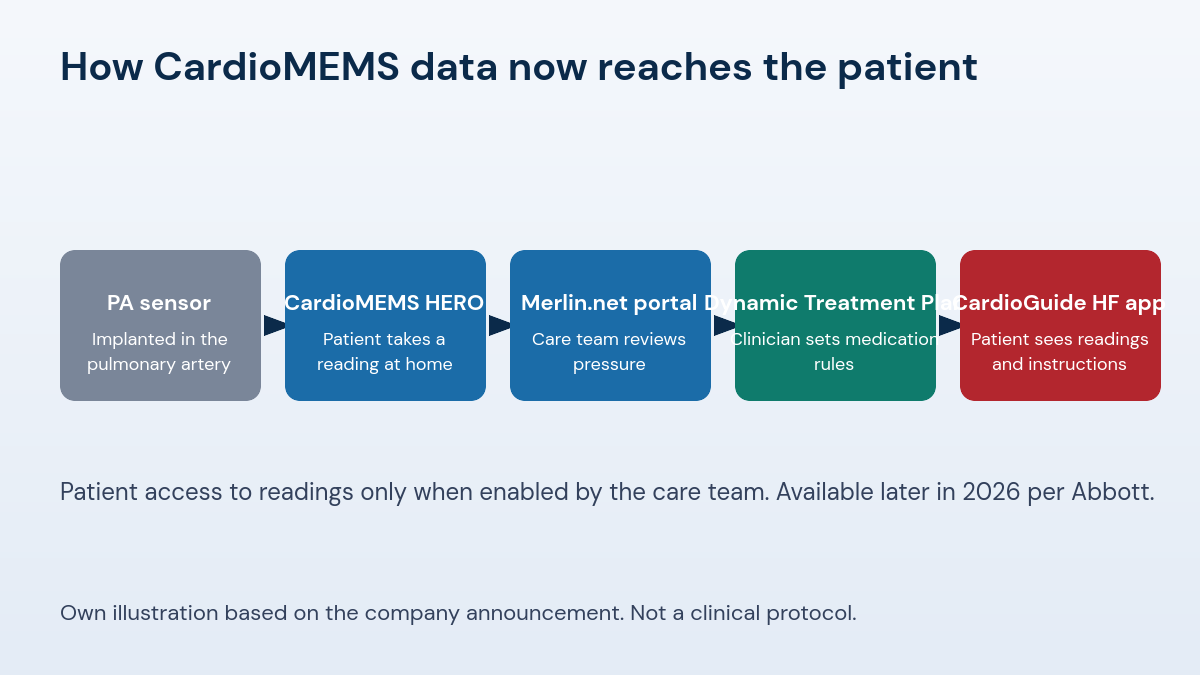
The approval covers updates to the CardioMEMS HF System rather than a new implant. The sensor itself, a small device permanently placed in the pulmonary artery, is unchanged. According to Abbott, it remotely monitors the pressure of blood flowing from the heart to the lungs. Patients take their readings with a home device called CardioMEMS HERO, and the data are sent to clinicians through the Merlin.net Patient Care Network portal. What is new is a direct line from that data to the patient’s phone.
| Item | Detail |
|---|---|
| Company | Abbott |
| Announced | 5 October 2026 |
| Product | CardioMEMS HF System (updated capabilities) |
| New software | CardioGuide HF app (iOS and Android) with Dynamic Treatment Plan |
| Patient access | Only when enabled by the care team |
| Data pathway | Implanted PA sensor, CardioMEMS HERO home device, Merlin.net portal |
| Availability | Later in 2026 (company statement) |
| Not disclosed | Pricing, rollout sites, new trial data |
How Does the CardioGuide HF App Work?
Think of it as a window and a messenger. As a window, the app displays PAP readings and trends so a patient can see how their numbers move over days. As a messenger, the Dynamic Treatment Plan lets a clinician pre-set how medication should change if pressure rises or falls, and the app delivers those instructions. Abbott says care teams decide which patients get access to their readings, so clinician oversight stays in place.
The reasoning behind the design is straightforward. Heart failure can worsen before a patient notices symptoms, and pressure readings can help reveal changes earlier, said Dr Andrew J. Sauer of Saint Luke’s Mid America Heart Institute in the company announcement. Abbott’s heart failure business vice president, Katie Spayde, said the company is bringing meaningful, actionable information directly to patients. Both statements are part of the company announcement.
What Does the Evidence Say?
Abbott cites earlier research for the CardioMEMS approach, including the GUIDE-HF, CHAMPION and LAPTOP-HF investigations referenced in a meta-analysis, and says PAP-guided management is associated with fewer heart failure hospitalisations, fewer 30-day readmissions and lower mortality risk. The announcement does not give specific percentages, and we have not seen new trial data for the app itself. The approval concerns the software capabilities, so the key open question is whether showing patients their own numbers, and prompting medication changes, improves outcomes beyond what clinic-based monitoring already achieves.
One caution: results from earlier trials of the sensor do not automatically carry over to the new patient-facing features. Showing patients data can improve engagement, but it can also create anxiety or lead to over-reaction to short-term changes. Real-world data after launch will matter.
Why Does This Matter for Heart Failure Care?
heart failure affects millions of people and is a leading cause of hospital admission, according to Abbott and public health sources. Much of the cost and distress comes from the sudden decompensations that lead to emergency admissions. Remote pressure monitoring tries to catch the trend sooner, and a patient-facing app tries to shorten the time between a clinician’s decision and the patient acting on it. The American Heart Association offers general guidance on living with the condition, which remains the reference for patients who do not have an implant.
What We Do Not Yet Know
- The exact launch date and which centres will switch the app on first.
- Whether the app will be offered to every CardioMEMS patient or only to selected groups.
- How alerts are handled, and what happens if a patient has a worrying reading outside clinic hours.
- Whether new outcome data will be published for the Dynamic Treatment Plan itself.
- Any impact on cost or reimbursement.
Related Coverage
For more on connected and remote monitoring, see our reports on Abbott’s partnership with Google Health on glucose data, Happy Health’s at-home sleep apnea monitoring and CoreMap’s Medtronic-led funding round for atrial fibrillation mapping.
Our Assessment
In our assessment, the most interesting part of this approval is not the screen but the loop it closes. Until now, remote pressure monitoring generated data that clinicians had to interpret and relay; the Dynamic Treatment Plan hands part of that loop to the patient, within limits the clinician sets. That could make the system more useful, but it also raises the stakes for how well alerts and instructions are designed. We will be looking for post-launch evidence rather than marketing claims.
Frequently Asked Questions
What is the CardioMEMS HF System?
It is an implanted pulmonary artery pressure sensor, with a home reader and clinician portal, used to monitor patients with heart failure remotely.
What is the CardioGuide HF app?
It is a smartphone app that shows patients their PAP readings and trends and delivers medication instructions from their care team.
Can every CardioMEMS patient see their readings?
No. Abbott says care teams determine which patients can access their readings.
When will it be available?
Abbott says later in 2026.
Is this a new implant?
No. The approval covers new capabilities for the existing system, and the sensor is unchanged.
Should patients change their medication on their own?
No. Patients should follow the plan set by their care team and contact their clinician about any concerns or symptoms. In an emergency, call local emergency services.
How we reported this: details come from Abbott’s announcement of 5 October 2026 and related company materials. Claims about clinical benefit and being first are company-reported. This is not medical advice. Last updated 6 October 2026.