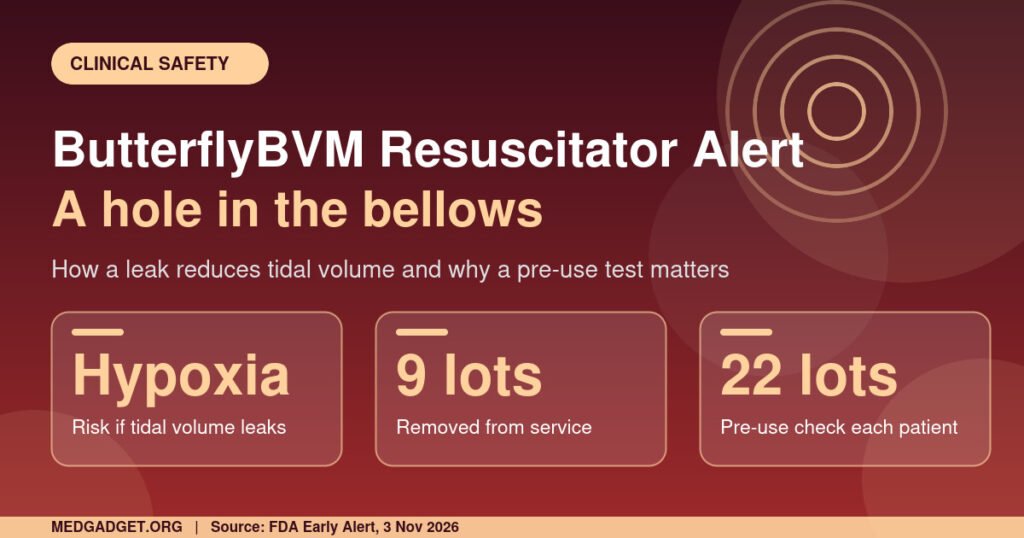

The ButterflyBVM resuscitator alert is, at heart, a physiology problem. A manual resuscitator works only if the volume squeezed out of the bag reaches the lungs. The FDA says a hole can develop in the bellows of Compact Medical’s ButterflyBVM devices, letting that volume leak away and risking inadequate ventilation and hypoxia. The agency published an Early Alert on 3 November 2026 and has not assigned a recall class.
Key takeaways from the ButterflyBVM resuscitator alert
- Defect: a hole can develop in the bellows; lots 000109 to 000117 show a higher rate of holes than previously observed.
- Hazard: leaked tidal volume can mean inadequate ventilation and hypoxia, and if uncorrected serious injury or death.
- Action: remove nine lots from use once backups are in place; apply a pre-use test to 22 further lots.
- Reported harm: none serious as of 2 November 2026, per the company.
- Status: an FDA Early Alert, not a classified recall.
The clinical logic: why a leak in a manual resuscitator matters
When a patient cannot breathe adequately, a clinician squeezes the bag to deliver a breath. The size of that breath, the tidal volume, determines how much oxygen reaches the lungs and how much carbon dioxide is removed. If part of the squeezed volume escapes through a hole, the patient receives less than intended, even though the clinician applies the same force.
The FDA states that, if this goes uncorrected, the result could be inadequate ventilation and hypoxia. Clinicians are trained to watch the patient’s chest rise and to monitor oxygen saturation, which is why the alert tells users to check the device for a hole when ventilation seems inadequate. If a hole is found, they should switch immediately to a backup BVM.
What the alert says about the two groups of lots
The FDA separates the lots by the action required, and the manufacturer’s notices of 26 September and 7 October 2026 are the source.
| Group | Lots | Products | What users do |
|---|---|---|---|
| Removal | 000109 to 000117 (9 lots) | ButterflyBVM READY (R300, R308) and ButterflyBVM (A100, A108) | Stop use and remove once backups are in place; quarantine and label Do Not Use |
| Correction | 000081 to 000108 (22 lots) | READY, ButterflyBVM and ButterflyBVM PLUS (P200, P208) | Keep in use only if the Pre-Use Test passes before every patient |
The agency’s page, the FDA Early Alert, carries the full table of SKUs, unit identifiers and lot numbers, and users should check their stock against it.
Timeline of the ButterflyBVM resuscitator alert
- 26 September 2026: Compact Medical’s first customer letter.
- 7 October 2026: follow-up letter.
- 2 November 2026: the company’s latest report of no serious injuries or deaths.
- 3 November 2026: FDA Early Alert published.
What evidence exists so far, and what does not
The evidence in the public record is limited to the manufacturer’s notices as summarised by the FDA. The agency reports a higher hole rate in lots 000109 to 000117 than previously observed, but it does not give the rate itself, the number of units affected or the root cause. There is no published clinical study of patient outcomes tied to this issue, and the company reports no serious injuries or deaths. A reported absence of events is reassuring, but it is not proof that none occurred, because under-reporting is possible for any device problem.
Reading the pre-use test as a safety control
For correction lots, the main control is a pre-use test or equipment check, performed according to the instructions for use before each patient. In safety terms, this is a detection step: it aims to catch a hole before the device is used on someone. It does not remove the defect, which is why the FDA also asks users to keep backup devices available in every patient-care scenario. Combining detection with a backup is a common layered approach, and the alert relies on both.
Market context: manual ventilation
According to Acumen Research And Consulting, the global bag-valve-mask ventilation market was valued at USD 563.2 million in 2023 and is projected to reach USD 887.6 million by 2032, a 5.2% compound annual growth rate for 2024 to 2032. Disposable BVMs held 54% share and hospitals and clinics 60% of end use. The report was last updated in February 2025 and has some inconsistencies, including a trend statement about reusable textiles that sits oddly with disposable dominance. The figures are market-wide and do not describe ButterflyBVM.
Our analysis
In our assessment, the evidence supports a lot-based, graded response and not a blanket judgement on the product. The FDA’s two-tier structure, removal for the lots with a higher hole rate and checks for the rest, mirrors the information available. What remains unknown is the cause and magnitude of the problem, and those details will determine whether the agency classifies the event and how. For clinicians, the practical message is the same either way: check the device, keep a backup and report problems.
What is not disclosed
- The measured hole rate in each lot group.
- The root cause of the defect.
- Distribution dates and the number of units affected.
- Any recall classification decision.
Risks and caveats
- Our summary of the lot lists is not a substitute for the FDA table.
- The company’s injury report is as of 2 November 2026.
- The alert may be updated as the FDA reviews the event.
- This article is not clinical advice.
What to watch next
- An FDA update or recall classification.
- Manufacturer root-cause information.
- MedWatch reports on the affected lots.
- Guidance from resuscitation and emergency-care bodies.
General background
The FDA MedWatch programme collects reports of adverse events and product quality problems. For a related FDA device alert, see our report on the Edwards Commander M delivery system lots, and for more, our Medical Device section.
Questions readers are asking about the ButterflyBVM resuscitator alert
What can go wrong with a leaking resuscitator?
Less air reaches the patient, which can cause inadequate ventilation and hypoxia.
Is it safe to use the correction-lot devices?
The FDA allows continued use only if each unit passes the pre-use test before every patient and backups are available.
Has the FDA classified the event?
No, it is an Early Alert.
FAQ
What is tidal volume?
The volume of air delivered in one breath.
How do I report a problem?
Through FDA MedWatch and to Compact Medical.
Should failed units be thrown away?
No. Quarantine units that failed in use or are linked to injury, in their original packaging, and contact the manufacturer.
How we reported this: details come from the FDA Early Alert dated 3 November 2026; market figures are attributed to Acumen Research And Consulting. Last updated 4 November 2026. This is news reporting and not medical advice.