
Imagine a diagnostic algorithm cleared today that quietly gets worse next year because patients, scanners or data change around it. A regulator that checks a product once, before sale, would never see it. That is the gap the UK says it will close. The government has accepted all 44 recommendations of an independent commission on regulating AI in healthcare, and the head of the Medicines and Healthcare products Regulatory Agency (MHRA) has described a shift to monitoring AI medical devices across their whole working life. The change is a plan, not yet a rulebook.
Key Takeaways
- The UK government has accepted all 44 recommendations of the National Commission into the Regulation of AI in Healthcare, which reported in September 2026.
- The core idea is lifecycle regulation: continued post-market surveillance and monitoring of AI-enabled devices, not only a one-off check before approval.
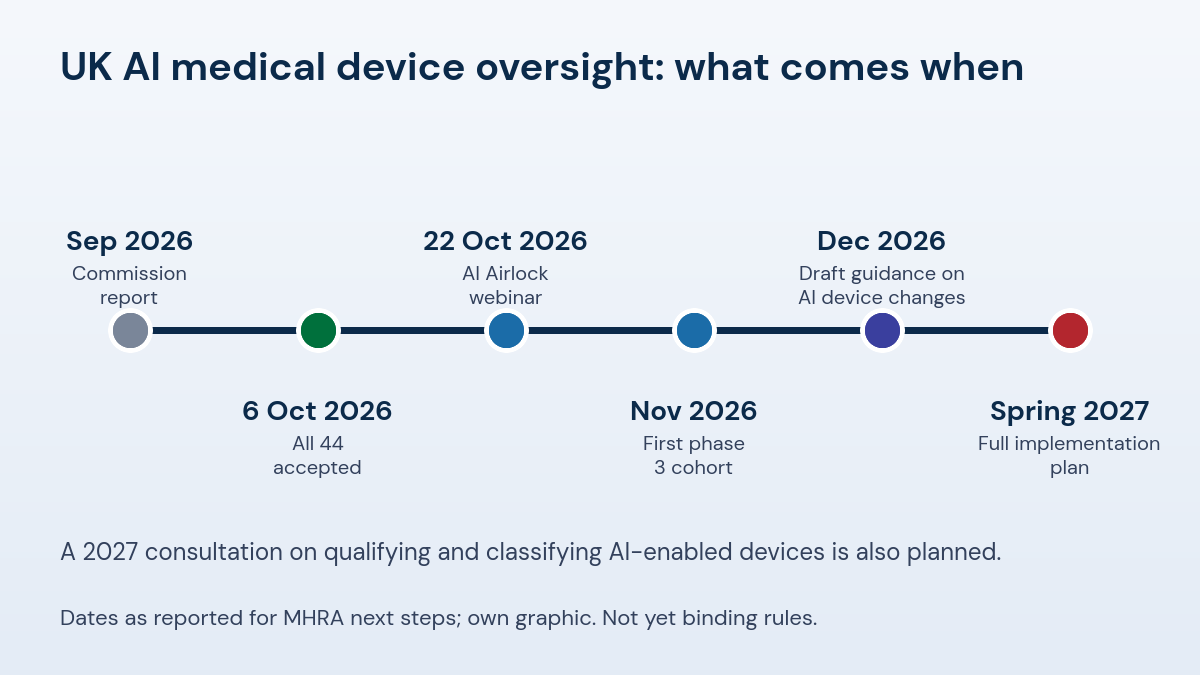
- The MHRA says a draft implementation plan is due by the end of 2026 and a full plan in spring 2027, with draft guidance on managing changes to AI devices by December 2026.
- Applications are open for phase three of the MHRA’s AI Airlock testing programme, which the MHRA says has secured three more years of government funding.
- Liability is acknowledged but unresolved. Broader legal reform will take time.
What Has Actually Been Announced?
The announcement is a government acceptance of recommendations plus a set of next steps for the MHRA. It does not by itself change the law that currently governs devices. MHRA chief executive Lawrence Tallon said the world is moving into “a much more sophisticated and complex era of AI as a medical device where we have non-deterministic algorithms”, meaning software whose outputs can vary and whose behaviour can shift after deployment. Reports describing the announcement also say the UK is the first country to develop comprehensive rules of this kind; we could not verify that claim independently.
| Item | Detail |
|---|---|
| Regulator | MHRA (UK) |
| Source of recommendations | National Commission into the Regulation of AI in Healthcare, September 2026 |
| Government response | All 44 recommendations accepted |
| Core change | From one-off pre-market assessment to lifecycle regulation with continuous monitoring |
| AI Airlock phase 3 | Applications open; webinar 22 October 2026; first cohort November 2026 |
| Draft guidance on changes to AI devices | December 2026 |
| Draft implementation plan | End of 2026 |
| Classification consultation | 2027 |
| Full implementation plan | Spring 2027 |
What Does Continuous Monitoring Mean in Practice?
The Commission’s report, as summarised by law-firm analysis, replaces one-off pre-market assessment with oversight that runs from development through deployment, monitoring and updating. Five ideas stand out.
- Proportionate surveillance: post-market requirements scaled to a device’s risk and the uncertainty around it.
- Drift detection: manufacturers should build performance reporting and escalation processes from day one, so that falling accuracy is noticed and acted on.
- Version tracking: mechanisms to identify AI devices and their versions after deployment, so a problem can be traced to the model that caused it.
- Staged authorisation: a device deploys within a limited scope and expands as real-world evidence accumulates, an idea described as “L plates” for healthcare AI.
- Transparency: clear information for patients about when AI is used in their care, with opt-out where appropriate.
Why Is This a Big Shift?
Traditional medical device rules assume a product is largely fixed once approved. AI changes that, because models can be retrained, updated or affected by changes in the data they see. The Commission recommends expanding predetermined change control plans so that developers can set boundaries and guardrails within which an AI system may adapt, including AI agents. The US has its own approach to updates and publishes the FDA list of AI-enabled medical devices, and the UK plan is notable for putting continuous monitoring at the centre of the system, not at the edges.
The Commission also asks manufacturers to disclose dependence on general-purpose foundation models and the risks that follow, and proposes an opt-in confidential “master file” through which upstream model developers can share technical specifications with the regulator. Both address a new problem: a device may rely on a model that its maker does not control.
What Happens Next?
The MHRA plans a webinar for prospective AI Airlock applicants on 22 October 2026 and expects to select the first wave of phase three innovators in November 2026. Draft guidance on managing changes to AI devices is due in December 2026. A consultation on how AI-enabled devices should be qualified and classified is planned for 2027, and the full implementation plan with delivery targets and timelines across the NHS follows in spring 2027. Updating the Medical Devices Regulations 2002, which the Commission calls for, would take longer and require legislation.
Who Is Affected?
- Manufacturers will need monitoring, drift reporting and change-control capability built into products and quality systems.
- NHS and care providers will face clearer duties on transparency and on who is responsible at each stage; the Commission recommends contractual allocation of risk controls so that no responsibility goes unassigned.
- Patients and clinicians are promised clearer information on when AI is used, and clearer accountability if things go wrong.
What We Do Not Yet Know
- Which duties become binding law and which remain guidance.
- How much monitoring cost will fall on small manufacturers and on hospitals.
- How liability will be allocated when an updated AI system causes harm.
- How the UK approach will line up with the EU and the US for companies selling in all three.
Related Coverage
For more on AI in healthcare, see our reports on the Manchester sandbox for NHS AI innovation, Samsung’s AI health assistant and OpenAI’s health feature expansion.
Our Assessment
In our assessment, the sensible reading is a direction of travel with real teeth still to come. The policy is right that AI is not a static product, and monitoring after launch is where most of the safety value lies. But monitoring is only as good as the data it uses, and the plan will need to say who collects performance data, who pays and what triggers action. Until the draft guidance appears in December and the roadmap in spring, manufacturers should plan for the principles and not for the details.
Frequently Asked Questions
What has the UK announced for AI medical devices?
The government accepted all 44 recommendations of the National Commission, including lifecycle regulation with continuous post-market monitoring of AI-enabled devices.
Is the continuous monitoring framework in force yet?
No. A draft implementation plan is due by the end of 2026 and the full plan in spring 2027.
What is the MHRA AI Airlock?
A regulatory testing programme for AI-enabled medical device developers. Phase three is open for applications.
What is drift in an AI medical device?
A change over time in how well a model performs, for example because patients or data differ from those it was trained on.
Who is responsible if an AI device causes harm?
Not fully settled. The Commission acknowledges that liability reform will take time and recommends clear contractual allocation of responsibilities meanwhile.
How we reported this: details come from the Commission’s publication on GOV.UK, statements by the MHRA chief executive and related reports and legal analysis of the announcement. Dates and figures are as reported. This is not legal or medical advice. Last updated 6 October 2026.