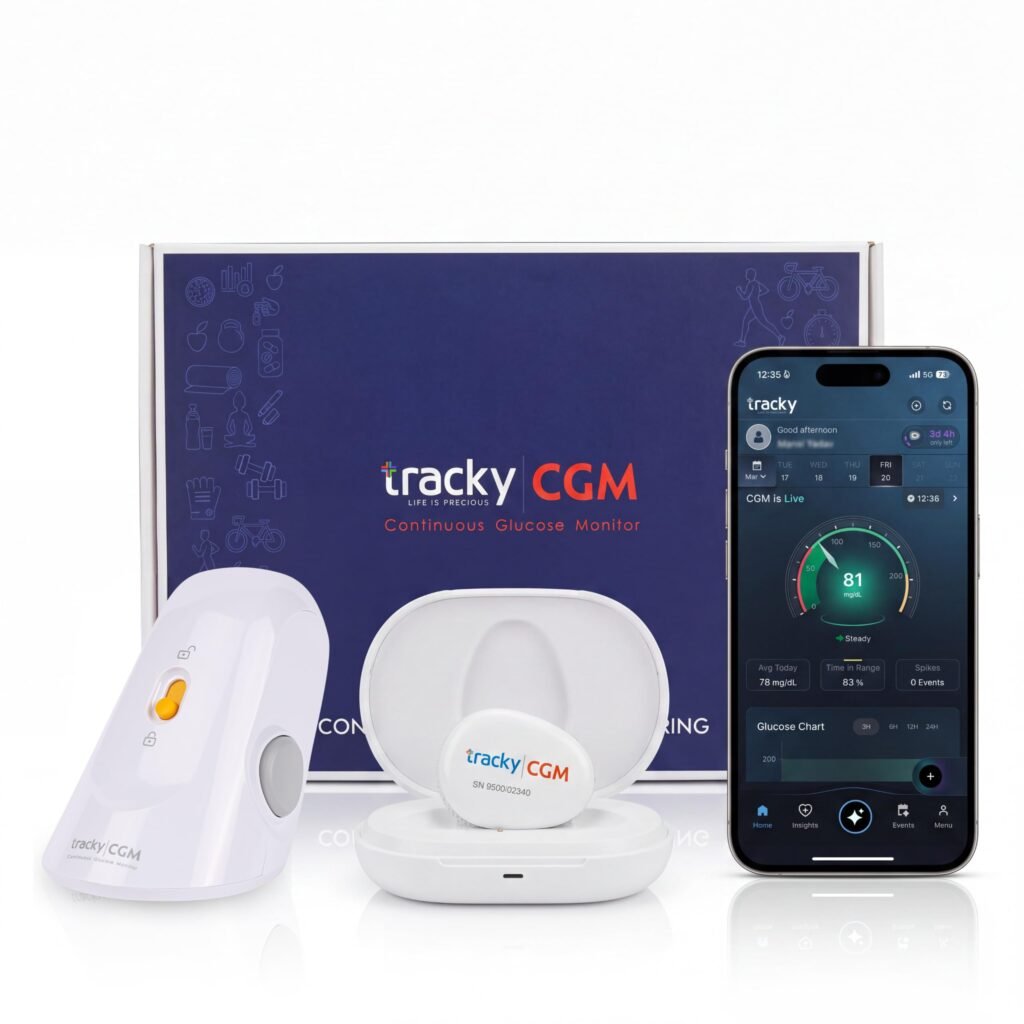

Drstore Healthcare Services has entered a new phase of India’s connected healthcare market with the launch of Tracky 16D, a continuous glucose monitoring device that can provide glucose readings for up to 16 days. The company describes the product as India’s first 16-day continuous glucose monitoring system, extending sensor use beyond the 14-day duration offered by many existing CGM devices.
Key takeaways: Tracky
- Tracky 16D is positioned not simply as a glucose sensor, but as part of a broader digital health platform that brings glucose readings together with information on nutrition, physical activity, medication, sleep, blood pressure and body composition.
- One of the central features of Tracky 16D is its 16-day monitoring period.
- Tracky estimates that users could require about 22 patches annually with its 16-day system, compared with approximately 27 to 28 patches when using shorter-duration sensors.
The new wearable is designed to help users observe how their glucose levels change in response to meals, exercise, medication and daily routines. By extending the operating life of the sensor, Tracky is also targeting a practical issue faced by people who depend on continuous monitoring: replacing sensors frequently enough to maintain uninterrupted access to glucose data.
The launch comes as the remote patient monitoring system market continues to move toward connected devices that can collect health information outside traditional clinical settings. Tracky 16D is positioned not simply as a glucose sensor, but as part of a broader digital health platform that brings glucose readings together with information on nutrition, physical activity, medication, sleep, blood pressure and body composition.
Tracky 16D Extends Sensor Life and Links Glucose With Daily Habits
One of the central features of Tracky 16D is its 16-day monitoring period. The longer sensor life could reduce the number of replacements required over the course of a year, particularly for people who need continuous glucose monitoring for extended periods.
Tracky estimates that users could require about 22 patches annually with its 16-day system, compared with approximately 27 to 28 patches when using shorter-duration sensors. Fewer replacements could offer added convenience while potentially lowering the recurring cost associated with continuous monitoring.
The company has also reported a mean absolute relative difference, or MARD, of 8.58%. MARD is commonly used as one measure of glucose sensor accuracy, although healthcare professionals consider multiple factors when evaluating the performance and suitability of a CGM system.
Tracky 16D combines the sensor and transmitter into a compact, lightweight unit. The design is intended to simplify application and support comfortable use over the monitoring period, an important consideration for wearable devices that users may need to keep on their bodies continuously.
The company’s connected Tracky Health platform expands the role of the device beyond glucose measurement. Users can bring together information from several areas of daily health, allowing them to examine glucose patterns alongside food intake, medication, exercise and sleep.
The platform also supports blood pressure and body composition information, creating a broader view of factors that can influence metabolic health. Bluetooth auto-sync is designed to transfer information automatically, while Nightscout integration provides another option for users who rely on connected glucose monitoring tools.
Tracky has also incorporated an AI-powered health assistant into the platform. The feature is intended to help users make sense of their health information, although clinical decisions continue to require appropriate medical guidance.
This wider approach reflects a change in how connected health companies are developing monitoring products. Glucose data can be useful on its own, but its value can increase when it is considered alongside lifestyle and other physiological information. For users and clinicians, trends over time may provide more useful context than individual glucose readings.
Neeraj Katare, founder of Tracky, said the company views Tracky 16D as an entry point into a broader connected cardiometabolic health ecosystem. According to the company, continuous monitoring can help users understand the relationship between everyday habits and glucose levels while providing doctors with additional information about glucose patterns.
Tracky Builds Remote Monitoring Ecosystem Around CGM Data
The launch also forms part of Tracky’s wider strategy to build a connected health ecosystem around its monitoring products. Rather than keeping glucose measurements separate from other health indicators, the company is working toward a system in which different data streams can be viewed together.
This strategy has potential relevance for the growing remote patient monitoring system segment, where connected devices are increasingly being used to collect health information between clinical appointments. Wearable monitoring can allow patients to generate data from their homes and daily environments, while healthcare professionals can use available reports to support consultations and follow-up care.
Tracky is also developing features for family members and caregivers. Remote access to selected information could allow caregivers to stay informed about a user’s health trends without requiring them to be physically present. Such capabilities may be particularly useful when monitoring involves older adults or people who need additional support with ongoing health management.
For physicians, the availability of historical glucose reports can provide another source of information during consultations. Instead of relying entirely on a patient’s recollection of glucose changes, doctors may be able to review recorded patterns and assess them alongside other relevant clinical information.
The business opportunity for Tracky extends beyond the sale of individual sensors. By linking the Tracky 16D device with a broader software platform, the company is seeking to build an ecosystem in which monitoring hardware, health data and digital services work together.
That model is becoming increasingly common across connected healthcare, where companies are looking to create recurring engagement rather than treating medical devices as standalone products. Longer sensor life can also contribute to the user experience by reducing the number of interruptions associated with replacing wearable components.
Tracky 16D will be available from September 11 through the company’s website and multiple online marketplaces. The launch gives consumers in India another option in the expanding CGM market while introducing a longer monitoring cycle and a broader approach to health data management.
For Drstore Healthcare Services, the product represents a move toward integrating continuous glucose monitoring with a wider set of health signals. As connected healthcare develops in India, the ability to combine glucose, activity, sleep, cardiovascular indicators and other measurements could become increasingly important for people seeking a clearer understanding of their day-to-day health.
Tracky’s approach places the 16-day sensor at the centre of that strategy. By combining longer monitoring duration with a connected platform and remote access to health information, the company is positioning Tracky 16D as more than a glucose monitoring device and as part of a broader remote patient monitoring system for ongoing cardiometabolic health management.
Related reading:
- Abbott and Google Health Partner to Advance AI in Healthcare With Glucose Data
- Medtronic Launches Simplera Sync Sensor in South Korea to Advance Continuous Glucose Monitoring for Type 1 Diabetes
- Samsung AI Health Assistant Signals a New Phase for AI in Healthcare Through Unified Personal Health Insights