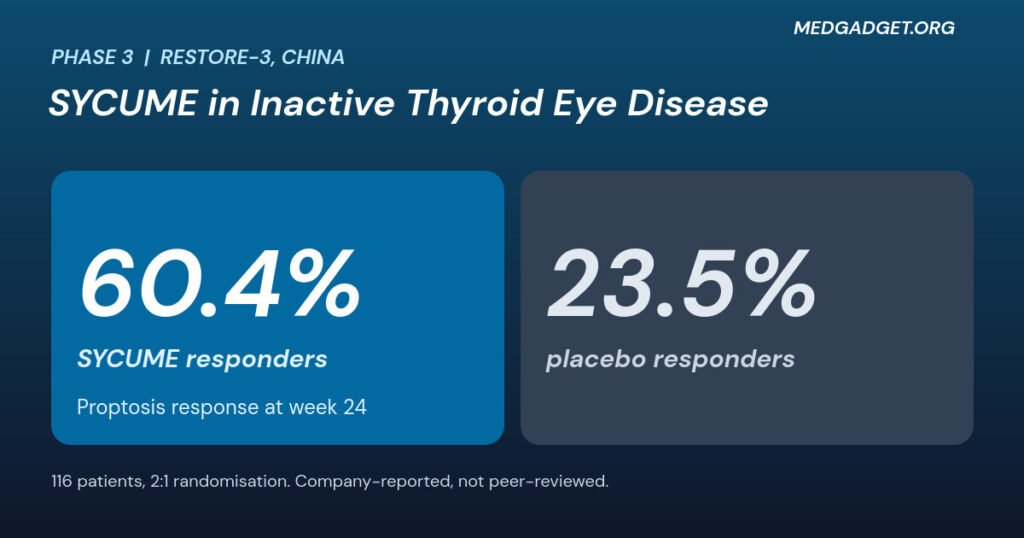

Innovent Biologics says its antibody SYCUME has met the main goal of a Phase 3 trial in people with SYCUME inactive thyroid eye disease, a stage of the disease in which inflammation has settled but bulging of the eyes remains. In the RESTORE-3 study, 60.4% of patients on SYCUME had a meaningful reduction in eye bulging at week 24, compared with 23.5% on placebo.
The result matters because most treatments for thyroid eye disease are aimed at the active, inflamed phase. Patients with long-standing, inactive disease have had fewer non-surgical choices. This article sets out what the trial found, how to read the numbers, and what the company has and has not said.
SYCUME inactive thyroid eye disease: key results
- Trial: RESTORE-3, a multicentre, randomised, double-blind, placebo-controlled Phase 3 study in Chinese patients.
- Patients: 116 people with inactive disease, randomised about 2 to 1 to SYCUME (IBI311) or placebo.
- Primary result: 60.4% responded on study-eye proptosis at week 24, versus 23.5% with placebo, a difference of 36.9 percentage points (P = 0.0003).
- Size of effect: eye bulging fell by 1.88 mm on SYCUME versus 0.88 mm on placebo, a 1.00 mm difference.
- Safety: most adverse events were mild to moderate, with no new safety signals, per the company.
SYCUME inactive thyroid eye disease: why “inactive” matters
Thyroid eye disease is an autoimmune condition in which the tissue behind the eyes becomes inflamed and swollen. It can push the eyes forward (proptosis), cause double vision, dryness, redness and, in severe cases, threaten sight. It is most often linked to Graves’ disease, an overactive thyroid. The American Thyroid Association and the National Eye Institute provide patient-oriented information.
The disease usually has an active phase, with redness and swelling, followed by an inactive phase when inflammation fades. Eye bulging and double vision can persist in the inactive phase, and surgery has often been the main option. A drug that reduces bulging without an operation would fill a gap, which is the idea behind testing SYCUME in this group.
What SYCUME is and where SYCUME inactive thyroid eye disease stands
SYCUME, also called teprotumumab N01 injection or IBI311, is a monoclonal antibody that blocks the insulin-like growth factor 1 receptor (IGF-1R). Innovent says it was independently developed and is the first IGF-1R antibody approved in China and the second approved worldwide for thyroid eye disease. The first is teprotumumab, sold as Tepezza.
The company’s announcement of the new trial does not state which indication SYCUME is currently approved for, and does not mention a submission for inactive disease. Further regulatory steps are therefore unclear. Innovent says follow-up continues and that full results will be presented at a future medical meeting or in a journal.
Inside the RESTORE-3 trial of SYCUME inactive thyroid eye disease
Patients had a Clinical Activity Score of 2 or lower in both eyes, meaning little or no active inflammation. Their average disease duration was 4.3 years, average eye bulging in the study eye was 22.16 mm, and about 74% had a score of 0 or 1. The main outcome was the proportion of patients whose study eye improved on proptosis at week 24.
- Responders: 60.4% on SYCUME versus 23.5% on placebo.
- Change in study-eye proptosis: minus 1.88 mm versus minus 0.88 mm.
- Other eye: response rate of 46.0% versus 19.8%, and change of minus 1.77 mm versus minus 0.91 mm.
By our calculation, the response rate on SYCUME was roughly 2.6 times that on placebo, and with a 2 to 1 split the study had about 77 patients on SYCUME and 39 on placebo. These are our own approximations from the published ratio and total.
How to read the SYCUME inactive thyroid eye disease numbers
About a quarter of the placebo group also counted as responders, because eye bulging can change a little over time and measurement varies, which is why a placebo arm matters. A 1 mm extra reduction is modest in absolute terms, and trials of this kind commonly define a responder as a reduction of 2 mm or more, so the responder analysis carries much of the story. We have not seen how the company defined a responder in this study.
Innovent says the results are generally consistent with those reported for Tepezza in inactive disease, though baseline bulging was lower in RESTORE-3. That is an indirect comparison across separate trials in different populations and does not show that one drug is better than the other.
SYCUME inactive thyroid eye disease: safety questions to watch
The company reports a favourable safety profile and no new signals, but its announcement gives no figures for specific side effects. Drugs in this class have been linked to muscle cramps, hair loss, blood sugar changes and hearing problems, so those will be central when the full data appear. The announcement does not report hearing or blood glucose results, so we cannot comment on them for SYCUME.
Why SYCUME inactive thyroid eye disease results matter for eye care
Eye drug development is expanding on several fronts, as shown by our report on a new ophthalmic formulation database. In thyroid eye disease, the arrival of more antibodies would give doctors more options, particularly in Asia, where local development could widen access. For related clinical-trial news, see our report on a Phase 3 result in Parkinson’s disease.
Our assessment of the SYCUME inactive thyroid eye disease data
In our assessment, the RESTORE-3 headline is strong on the primary endpoint, with a response rate more than double that of placebo and a very low P value. The weaker points are what we cannot see: no figures for safety events, no detail on how a responder was defined, only Chinese patients and a 24-week window. Whether the benefit lasts, and whether it means fewer operations, remains to be shown. The data come from a company announcement from Innovent Biologics and have not been peer-reviewed.
For more drug news, browse our pharmaceutical news section.
What to watch next for SYCUME inactive thyroid eye disease
- Full RESTORE-3 results at a medical meeting or in a journal.
- Hearing and blood sugar safety data.
- Any regulatory filing for inactive disease in China or elsewhere.
- Durability of the benefit after treatment ends.
Frequently asked questions
What did the SYCUME inactive thyroid eye disease trial show?
60.4% of SYCUME patients had a meaningful reduction in eye bulging at week 24, compared with 23.5% on placebo.
What is SYCUME?
An IGF-1R-blocking monoclonal antibody (IBI311) developed by Innovent Biologics.
How many patients were in RESTORE-3?
116, in a randomised, double-blind, placebo-controlled study in China.
Is SYCUME approved for inactive thyroid eye disease treatment?
The announcement does not mention any approval or filing for inactive disease.
Is it better than Tepezza?
No head-to-head study exists. Comparisons across separate trials are indirect.
How we reported this: we based this article on Innovent’s announcement of the RESTORE-3 results (about 9 October 2026) and public patient-information pages. Results are company-reported and not peer-reviewed. Figures labelled as ours are our own calculations. Last updated: 12 October 2026. This article is news reporting and not medical advice.