
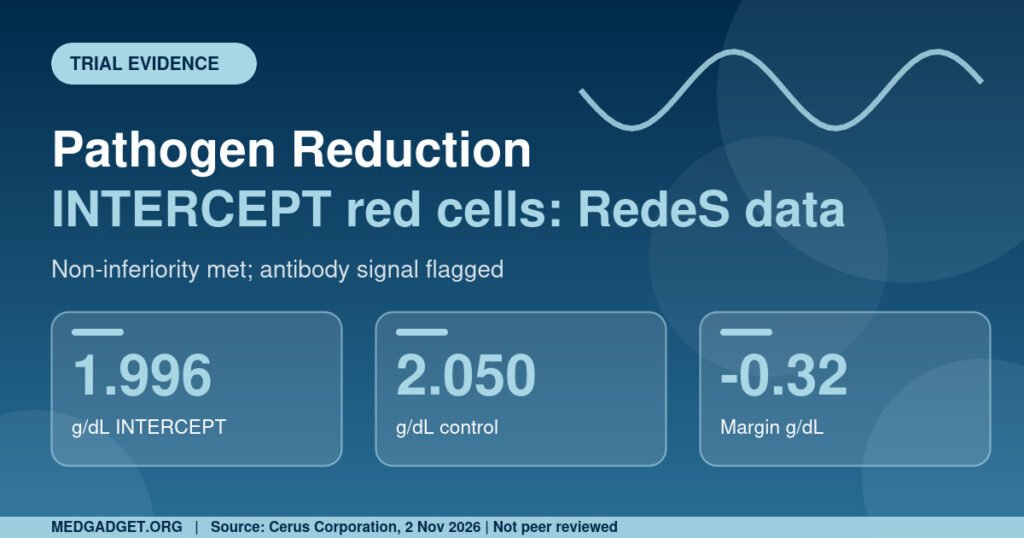

Evidence for pathogen reduction technology in red blood cells took a step forward on 2 November 2026, when Cerus Corporation reported that its Phase 3 RedeS trial met its primary efficacy endpoint. The study compared red cells treated with the INTERCEPT Blood System against conventional red cells in 543 patients. Pathogen reduction for red cells remains investigational in the United States, the FDA has not reviewed the final study report, and the data come from a company release and not a peer-reviewed paper. This article reads the results with a clinical-evidence lens.
Key takeaways from the RedeS evidence
- Design: Phase 3, NCT03037164, with INTERCEPT and control arms; 267 and 276 patients in the safety populations.
- Primary endpoint: adjusted haemoglobin increment, tested for non-inferiority in the modified intent-to-treat group (195 INTERCEPT, 199 control).
- Result: 1.996 g/dL versus 2.050 g/dL, a difference of minus 0.054 g/dL (95% confidence interval minus 0.210 to 0.103) against a margin of minus 0.32 g/dL; p=0.004.
- Safety: related treatment-emergent adverse events 3.4% versus 2.5% (p=0.634).
- Signal to watch: antibodies to INTERCEPT red cells in 2.2% of treated patients versus none in controls.
What pathogen reduction does
Pathogen reduction treats donated components with a photochemical or chemical process designed to inactivate DNA- or RNA-based organisms, so they cannot replicate in the recipient. The goal is a broader safety net than donor screening alone, including against emerging pathogens and bacterial contamination. For platelets and plasma the approach is established. Red cells are harder: they carry oxygen, must survive storage and circulation, and any process that alters the cell surface could in principle provoke an immune response. That is why a dedicated Phase 3 programme was needed.
Reading the primary endpoint
A non-inferiority trial asks whether a new option is not unacceptably worse than the comparator. Here the question was whether treated cells raise haemoglobin by almost as much as standard cells. The observed gap, minus 0.054 g/dL, is small against the pre-specified margin of minus 0.32 g/dL, and the lower bound of the confidence interval, minus 0.210, stays inside it. The company reports a p-value of 0.004 for non-inferiority. A non-inferiority result does not show superiority, and it says nothing about infection rates, which a trial of this size would not be powered to detect.
| Measure | INTERCEPT | Control |
|---|---|---|
| Safety population | 267 | 276 |
| mITT population | 195 | 199 |
| Adjusted haemoglobin increment (g/dL) | 1.996 | 2.050 |
| Related TEAEs | 3.4% (9/267) | 2.5% (7/276) |
| Antibodies to INTERCEPT red cells | 2.2% (6/267) | 0% |
Questions a reader should ask of any transfusion trial
Several general questions help when reading a topline release. Was allocation random and were assessors blinded? Which patients were included, and were those with the greatest transfusion needs represented? How was the haemoglobin increment adjusted, and for which factors? How many patients were excluded from the efficacy analysis, here 72 of 267 INTERCEPT patients and 77 of 276 control patients by our subtraction, and why? These details determine how far the headline generalises, and the release does not supply them.
The antibody signal in context
Six patients developed antibodies specific to INTERCEPT-treated red cells, against none in the control arm; the company reports the difference as statistically significant, with a p-value below 0.013. It describes the antibodies as low-titre and transient, with no haemolysis or clinical impact, similar to what it saw in the earlier ReCePI study. These are company statements, and the release does not provide titres, timing or follow-up duration. For transfusion medicine, antibodies matter because they can complicate cross-matching if the patient is transfused again, so the question for regulators is whether the pattern is manageable in routine practice.
What the trial does not answer
- Whether pathogen-reduced red cells lower transfusion-transmitted infection rates in practice.
- Performance in specific groups such as neonates, patients with sickle cell disease or those needing repeated transfusions.
- How storage age of the cells affects outcomes.
- The long-term significance of antibody formation.
Regulatory position
The company states that INTERCEPT red blood cells are investigational in the US and that the FDA has not reviewed the final report, so the agency’s view of benefit and risk may differ. The system is under regulatory review in Europe, according to company background. Study details are on the ClinicalTrials.gov record, and the FDA blood and blood products pages outline the US framework. Ross Fasano of Emory University, a site investigator, said the findings reinforce the potential to extend this established paradigm to red blood cell transfusions.
Timeline
- Earlier: ReCePI study reports antibody findings.
- 2 November 2026: RedeS topline results and investor call.
- Next: peer-reviewed publication, scientific meetings and further antibody studies.
Market context
Acumen Research And Consulting’s Blood Transfusion Diagnostics Market report gives USD 3,813.1 million in 2020 rising to USD 5,873.9 million by 2028, a compound annual growth rate of 6.7% for 2021 to 2028, with blood banks the largest end use and North America the leading region. It covers diagnostics, not pathogen reduction, so it is adjacent context only. By our calculation the endpoints imply about 5.6%, the FAQ misstates the 2020 value and the page was last updated in 2021.
Our analysis
In our assessment, RedeS supports the view that treated red cells perform acceptably on haemoglobin recovery. The decisive evidence for clinicians will be the peer-reviewed dataset, particularly antibody follow-up and any subgroup information, together with the regulators’ reading. Until then, the finding is promising evidence for an investigational product and not a practice-changing result.
What is not disclosed
- Blinding, randomisation and countries involved.
- Patient populations and transfusion indications.
- Antibody titre and follow-up data.
- US filing plans.
Risks and caveats
- Company-reported topline results, not peer reviewed.
- Investigational in the US; not approved.
- Market statistics are adjacent and inconsistent.
- This article is news reporting and not medical advice.
What to watch next
- Full publication.
- Antibody study outcomes.
- European decision.
- FDA engagement.
General background
Related coverage: a regional blood centre’s work and a point-of-care testing device. More in the Medical Device category.
Questions readers are asking about pathogen reduction technology
Does pathogen reduction remove all infection risk?
No. It aims to reduce risk and works alongside donor screening and testing.
Was non-inferiority met in RedeS?
The company reports yes for the haemoglobin increment.
Is the system approved for red cells in the US?
No. It is investigational.
FAQ
What is the INTERCEPT Blood System?
A pathogen reduction system for blood components, already used for platelets and plasma.
What is a haemoglobin increment?
The rise in haemoglobin after transfusion.
What is a TEAE?
A treatment-emergent adverse event.
How we reported this: details come from the Cerus Corporation release of 2 November 2026; market figures are attributed to Acumen Research And Consulting; calculations marked as ours are our own. Last updated 4 November 2026. This is news reporting and not medical advice.