
The Microsoft AI diagnostic tool works by asking questions and ordering tests one step at a time, the way a clinician narrows a diagnosis, rather than judging a fixed bundle of symptoms in one go. A study published in Science, reported on 22 and 23 October 2026, says that approach made the system more than twice as accurate as general physicians across more than 300 unusual medical cases. This article explains how the method works and what the results can and cannot show.
Key takeaways: how the Microsoft AI diagnostic tool works
- An orchestrator directs the process and uses a simulated panel of clinical experts, according to the report.
- It chooses questions, examination findings and tests, reviews results and updates its working hypotheses, then repeats.
- On more than 300 unusual cases it was more than twice as accurate as general physicians using textbooks and the internet, per the report.
- It also outperformed physicians on emergency-room scenarios, with no figures given, and a Beth Israel Deaconess Medical Center trial of waiting-room triage is planned.
- The Microsoft AI diagnostic tool is a research result, not a deployed product or a replacement for clinicians.
Diagnosis as a sequence, step by step
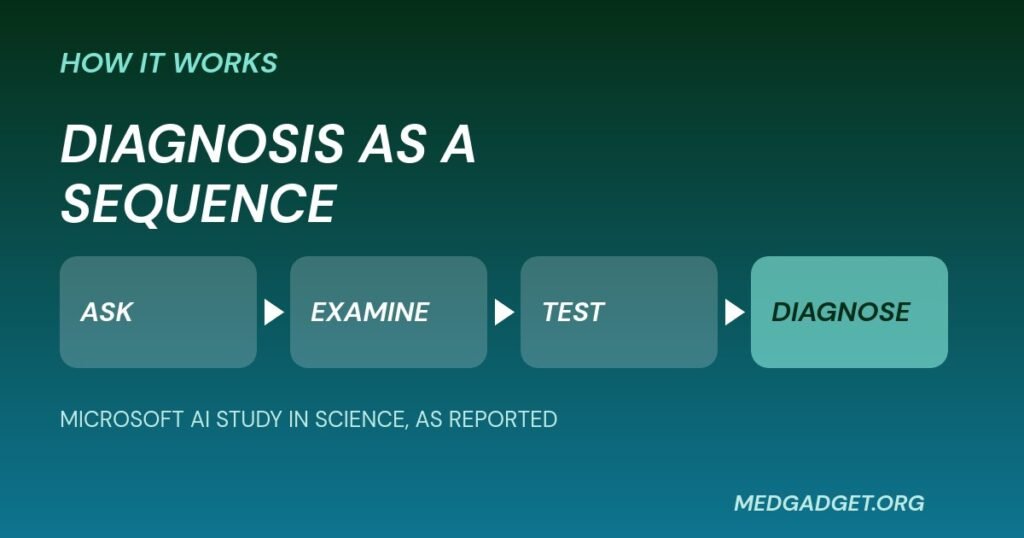
In practice, a doctor rarely has all the information at the start. They take a history, form a short list of possibilities, decide what to examine or test, and revise the list when results arrive. The report says the Microsoft system imitates that loop. It decides which history questions and examination findings matter, orders tests, reads the results and orders more tests if needed, updating its plan continuously.
- Step 1: receive a brief case description.
- Step 2: ask for history and examination findings judged most informative.
- Step 3: order tests and review the results, with cost in mind, as the report says work-ups cost less when the orchestrator designed them.
- Step 4: revise hypotheses and repeat until it commits to a diagnosis.
The report says most existing medical AI examines all symptoms, laboratory results and imaging together to produce a single diagnosis. A sequential design adds decisions about what to ask next, which is closer to real clinical work and, in principle, easier to audit step by step.
What the Microsoft AI diagnostic tool study found
The system was tested on more than 300 highly unusual and confusing cases and was more than twice as accurate as general physicians, who used textbooks and the internet, according to the report. It also performed better than physicians on scenarios drawn from a large emergency-room admissions database. Exact accuracy percentages, physician numbers and the emergency-room figures are not given, so AI diagnostic accuracy cannot be compared with other published systems on this evidence.
Dominic King of Microsoft AI says AI has become very good at multiple-choice exams but that patients do not arrive with a neat summary. Harsha Nori says the team is also measuring how judiciously the system goes through a work-up. Those statements describe the aims of the research, not additional results.
Why a stepwise design could matter for safety and audit
One practical advantage of a sequential system is that every step leaves a trace: a question asked, a test ordered, a hypothesis revised. A reviewer can read that trail and ask why a test was chosen or why a possibility was dropped. That is harder with a single-shot answer. The Microsoft AI diagnostic tool could therefore, in principle, be examined for unnecessary testing as well as for wrong answers.
That is our reading of the design, not a finding from the study. The report does not say whether the researchers analysed the reasoning trail, and a visible trail is not the same as a correct one. Hospitals would still need to test whether clinicians understand and trust the steps, and whether the system behaves safely when information is missing.
General background: clinical decision support and regulation
Software that helps clinicians decide is called clinical decision support. In the United States the FDA sets out when such software is regulated as a device in its guidance on clinical decision support software. Whether a tool like this would be regulated depends on what it does and how it is used, and Microsoft has not described a regulatory plan in the report. This is general background, not a statement about the tool.
Microsoft Research published an earlier preprint on sequential diagnosis in 2025 under the name MAI-DxO, available on its research page. The wire report on the Science study does not name the tool, so we have not assumed the two are identical.
Our analysis: why the design matters, and what is missing
In our assessment, the Microsoft AI diagnostic tool matters mainly because it measures process as well as the answer: which questions it asks, which tests it orders, and what that costs. That is the information a hospital needs to judge safety and value. The missing piece is independent validation on common conditions and on live patients, where mistakes carry consequences.
We also note that testing on rare, published-style cases favours a system that can recall broad medical literature. Real emergency departments involve incomplete records, noisy data and time pressure. See our healthcare IT coverage for related reporting.
What is not disclosed about the Microsoft AI diagnostic tool
- Accuracy percentages and confidence intervals.
- Number of physicians and how their answers were scored.
- Emergency-room figures and cost numbers.
- Which underlying models power the orchestrator.
Risks and caveats for the Microsoft AI diagnostic tool
The study used cases, not live patients, and the report contains no safety data. Physicians in the comparison used textbooks and the internet, which is not the same as working with colleagues, records and tests at the bedside. A result on difficult cases does not predict performance on everyday ones. This is news reporting and not medical advice.
What to watch next
- The full Science paper, via Science, for the accuracy tables.
- The emergency-department triage evaluation planned with Beth Israel Deaconess Medical Center.
- Independent tests of the Microsoft AI diagnostic tool.
FAQ
Is the Microsoft AI diagnostic tool available to doctors?
No deployment has been announced. The next step described is an emergency-department triage evaluation.
What makes the approach sequential?
It asks questions and orders tests in turn, updating its hypotheses after each result, instead of evaluating everything at once.
How we reported this: we relied on a wire-service report on the study and public Microsoft Research material, attributing each claim. We have not read the Science paper. Last updated 23 October 2026. This is news reporting and not advice.