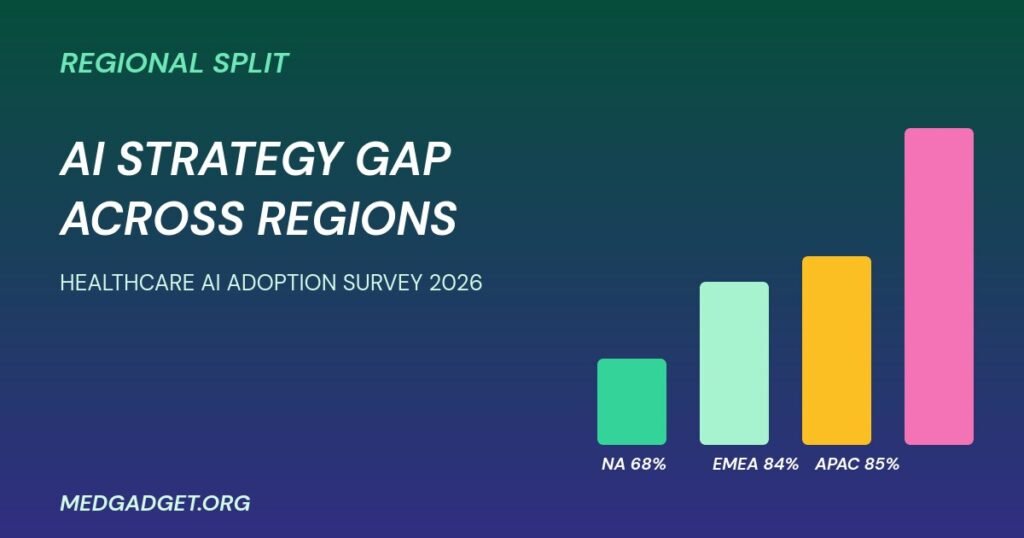

North American health systems are the least likely to say they have a clear clinical AI strategy, according to a healthcare AI adoption survey 2026 from HIMSS. Only 68% of North American respondents agreed they have one, compared with 84% in Europe, the Middle East and Africa and 85% in Asia Pacific, in a poll of 525 clinical leaders reported on 23 October 2026.
Key takeaways: regional gaps in the healthcare AI adoption survey 2026
- A clear clinical AI strategy was reported by 68% of North American respondents, 84% in EMEA and 85% in APAC.
- 91% of all respondents are highly motivated to pursue specialised AI training.
- 32% completely agree and 44% somewhat agree their organisation has clear AI governance.
- At least 70% expect high or transformative impact within two years in documentation, operations, predictive analytics and diagnostics.
- HIMSS described the regional variances as striking.
Timeline of the healthcare AI adoption survey 2026
- February 2026: a separate HIMSS survey of 50 leaders is covered in a Guidehouse trends report. It is a different sample and is not combined with the figures here.
- August 2026: fieldwork for the 525-leader poll.
- 23 October 2026: the findings are reported after presentation at the HIMSS AI in Healthcare Forum.
How the healthcare AI adoption survey 2026 was run
The poll is part of the HIMSS Market Insights report Workforce AI: Impact on Clinical Productivity, Satisfaction and Burnout. Fieldwork was in August 2026, and the sample was 525 clinical leaders from director level to the C-suite who have decision-making power over AI investment. The association describes its work at himss.org. We have read a trade report of the findings, not the report itself, so every figure here is as reported.
The North America strategy gap
The regional gap is the most distinctive result. A difference of 16 to 17 percentage points between North America and the other two regions is large by survey standards, and HIMSS called the variances striking. We calculate those differences ourselves from the reported shares, and the sources do not give regional sample sizes, so we cannot say whether the gap is statistically robust.
The reasons are not explained in the coverage we read. Possible factors, such as fragmented health systems, different regulatory environments or different definitions of strategy, are our speculation and are not findings of the survey.
Questions the regional data raises
Several questions remain open. Do North American leaders hold themselves to a higher standard when asked whether a strategy is clear? Are strategies there spread across many independent systems, so that one leader sees only part of the picture? Does the mix of respondents by organisation size differ by region? The coverage we read answers none of these, and readers should treat the regional comparison as a signal to watch and not a ranking.
What leaders in the healthcare AI adoption survey 2026 want from training
Across all regions, 91% say they are highly motivated to pursue specialised AI training, 89% want robust policies that include structured, ongoing proficiency training, and 83% agree AI will create new career pathways. Leaders also expect early impact in clinical documentation, administration, predictive analytics and diagnostic support, with at least 70% anticipating high or transformative effects in the next two years.
Governance and trust concerns
On oversight, 32% completely agree and 44% somewhat agree their organisation has clear governance for evaluating, monitoring and overseeing AI. The top trust concerns are unclear or missing safety guidelines, patient privacy and data security, along with hallucinations, errors and bias. In the United States, the FDA keeps a public list of authorised AI-enabled medical devices on its AI-enabled devices page, one input leaders can use when judging tools.
Market context by region for the healthcare AI adoption survey 2026
Acumen Research and Consulting’s report AI in Healthcare Market Size, Share, Forecast Report 2026 To 2035 says North America held about 43% of the global AI in healthcare market in 2025, with Europe at about 25%. It projects North America to grow at 37.8% a year, while Asia Pacific is the fastest-growing region at 42.5%. The global market is estimated at USD 41.84 billion in 2025 and USD 1,136.90 billion by 2035.
The contrast is worth noting: the largest market reports the lowest share of leaders with a clear strategy. The two datasets measure different things and come from different sources, so we draw no causal link. See also our Healthcare IT coverage.
General background: what a clinical AI strategy means
A clinical AI strategy generally sets out which use cases an organisation will pursue, how tools are chosen and validated, who owns outcomes and how staff are trained. The survey statement is self-assessed, so one respondent’s clear strategy may be another’s draft. That is a general caveat about surveys, not a finding.
Our analysis of the healthcare AI adoption survey 2026: ambition without alignment
In our assessment, the healthcare AI adoption survey 2026 is best read as a reminder that spending and strategy are different things. North America leads in market share and trails in reported strategic clarity. If the pattern holds in later research, it would suggest that rapid purchasing is not matched by planning. We cannot confirm that from one poll.
The training result is the more encouraging signal for workforce planning. A 91% figure suggests little resistance among leaders to upskilling, though it says nothing about budget or time.
What is not disclosed
- Regional sample sizes and margins of error.
- Definitions used for clear clinical AI strategy.
- Breakdown by organisation size or type.
- Any outcome data, including burnout.
Risks and caveats of the healthcare AI adoption survey 2026
The survey is self-reported and relayed through a trade report. A different HIMSS survey of 50 leaders earlier in 2026 used a smaller sample and is not combined here. Market figures from Acumen are forecasts. This article is news reporting and not professional advice.
What to watch next
- The full HIMSS report and methodology.
- Further regional breakdowns.
- Policy responses on AI oversight in North America.
- Hospital announcements on AI training.
FAQ
Which region lags in the healthcare AI adoption survey 2026?
North America, where 68% report a clear clinical AI strategy versus 84% in EMEA and 85% in APAC.
How many leaders were surveyed?
525 clinical leaders with AI investment decision power, polled in August 2026.
Is the sample representative?
Not necessarily. The sources do not give regional counts or a margin of error.
How we reported this: we relied on a trade report of the HIMSS findings, the HIMSS and FDA sites and the Acumen Research and Consulting report cited above, and attributed every claim. Last updated 24 October 2026. This is news reporting and not advice.