
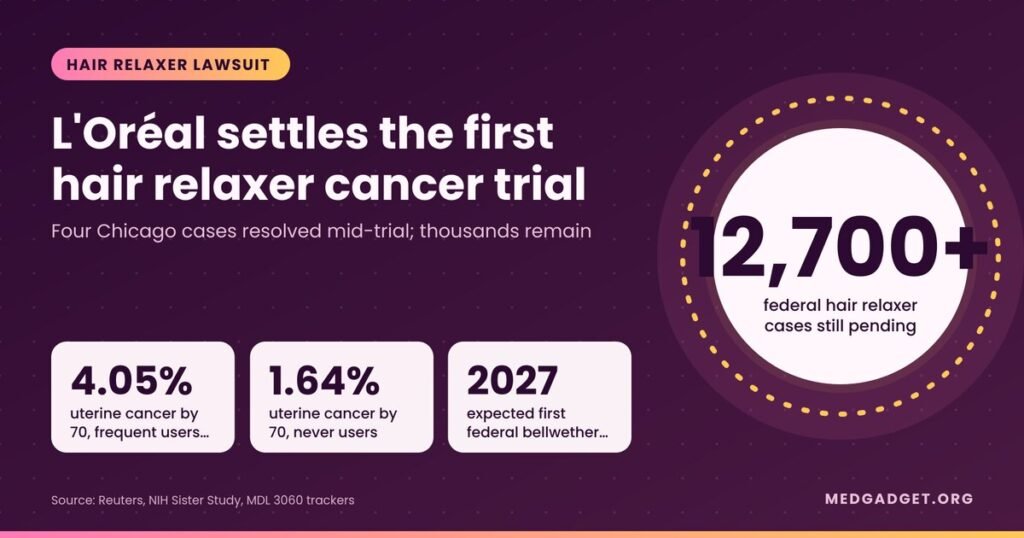

The first hair relaxer lawsuit to reach a jury ended before a verdict: on Monday, 16 November 2026, L’Oréal’s US unit and other manufacturers settled the claims of four women who said years of chemical hair straightener use caused their gynecologic cancers. The trial in Cook County, Illinois, had opened with jury selection on 9 November. Terms are confidential, and more than 12,700 similar cases remain centralized in federal court in Chicago, so the settlement closes one courtroom but leaves the larger fight open.
Key takeaways on the hair relaxer lawsuit
- Four plaintiffs (MaryAnne Lindsey, Surenthia Jenkins, Miranda Lofton and Sandra Simpson) settled with L’Oréal USA and other companies mid-trial; the amount was not disclosed.
- These were the first hair relaxer cancer cases anywhere to go to trial, so no jury has yet ruled on whether the products cause cancer.
- L’Oréal says it remains confident in the safety of its products and that the science has not shown a causal link.
- The federal multidistrict litigation (MDL 3060) holds more than 12,700 cases; a law-firm tracker reports the first federal bellwether trial is expected around September 2027.
- Arizona and Minnesota have separately sued L’Oréal this year, alleging it misled women about product safety.
What happened in the Chicago courtroom
The four women filed in Cook County Circuit Court in 2023 and 2024, part of a wave of suits that followed a 2022 National Institutes of Health analysis linking frequent straightener use to uterine cancer. Their products were sold under brands such as Dark and Lovely and Optimum, which L’Oréal markets through its SoftSheen-Carson division and which have long been marketed heavily to Black women, according to Reuters reporting carried by Claims Journal.
The settlement came one week into proceedings. Plaintiffs’ lawyer Danielle Ward Mason said she hoped it would give her clients a sense of justice. A L’Oréal spokesperson said consumer health is the company’s top priority and that L’Oréal USA follows all regulations in every market where it operates. Neither side disclosed the money involved, and the other defendant companies were not named in the report.
A mid-trial settlement is common in mass torts. It spares a defendant the risk of an adverse verdict that plaintiffs’ firms could cite in thousands of other cases, and it spares plaintiffs the risk of losing outright. The trade-off is that the central scientific question goes untested in front of a jury for now.
The litigation by the numbers
| Item | Figure | Source |
|---|---|---|
| Plaintiffs in the settled Cook County trial | 4 | Reuters |
| Cases centralized in federal court, Chicago | More than 12,700 | Reuters; MDL 3060 trackers |
| Federal judge overseeing MDL 3060 | Mary M. Rowland, N.D. Illinois | Court records via Drugwatch |
| Bellwether pool (narrowed 22 Oct 2026) | 5 cases | Drugwatch tracker |
| Expected first federal bellwether trial | About September 2027 | Drugwatch tracker |
| States suing L’Oréal separately in 2026 | 2 (Arizona, Minnesota) | Reuters |
Other companies named across the federal docket include Revlon, Strength of Nature, Namaste, House of Cheatham, Avlon, Dudley Beauty, John Paul Mitchell Systems and Wella, according to the Drugwatch case tracker. L’Oréal’s French parent was dismissed from the federal case in 2025; the US subsidiary remains a defendant.
What the science shows, and what it does not
The study behind most claims came from the NIH’s Sister Study, which followed more than 33,000 US women for about 11 years. Researchers estimated that 4.05% of women who used straighteners more than four times in the previous year would develop uterine cancer by age 70, compared with 1.64% of women who never used them. By our calculation that is roughly 2.5 times the risk, or about 24 extra cases per 1,000 frequent users over a lifetime. The NIH summary noted the association was stronger among Black women, who reported more frequent use.
Two caveats matter. First, the study is observational: it shows an association, not proof that relaxers cause uterine cancer, which is exactly the gap L’Oréal points to. Second, the researchers did not have product-level ingredient data, so it is not clear which chemicals, if any, drive the signal. Formaldehyde and formaldehyde-releasing agents, parabens, phthalates and other endocrine-active compounds are the leading suspects in the scientific literature.
On regulation, the FDA said in 2023 it planned to propose a ban on formaldehyde and related chemicals in hair-smoothing and straightening products, then missed several target dates. Public reporting through early 2026 indicated the rule had still not been finalized. The agency recently moved against other cancer-linked chemicals in food, as covered in our report on the FDA methylene chloride ban, but no comparable final action on relaxers has been announced.
Market context: the chemistry behind beauty products
The case lands in a large and growing ingredients business. According to Acumen Research and Consulting, the global cosmetic chemicals market was worth USD 22.7 billion in 2022 and is projected to reach USD 45.9 billion by 2032, a compound annual growth rate of 7.5%. Litigation and pending ingredient restrictions put pressure on formulators to document safety and reformulate, which is one reason product liability outcomes in the relaxer cases are watched closely across the sector.
What this means if you used chemical straighteners
The settlement does not change medical advice. A higher relative risk still means most frequent users will never develop uterine cancer. What matters clinically is recognizing symptoms early: abnormal bleeding after menopause, bleeding between periods, or new pelvic pain should be checked by a doctor promptly, regardless of hair-product history. People who want to reduce exposure can talk to a stylist about non-chemical options or reduce how often they relax their hair.
On the legal side, filing deadlines (statutes of limitations) vary by state and usually start from diagnosis or from when a person reasonably learned of a possible link. Anyone considering a claim should get advice from a licensed attorney rather than relying on news coverage.
What to watch next
- Whether other state-court trials on the calendar also settle, which would hint at a broader resolution strategy.
- Progress of the five federal bellwether cases before Judge Rowland and any change to the 2027 trial timing.
- The Arizona and Minnesota consumer-protection suits, which focus on marketing rather than individual injuries.
- Any FDA movement on the long-delayed formaldehyde rule for straightening products.
FAQ
Did L’Oréal admit hair relaxers cause cancer?
No. The settlement was confidential and L’Oréal said it remains confident in its products’ safety and that the NIH study did not establish causation.
How much was the hair relaxer settlement?
The amount was not disclosed. It covers only the four women in the Cook County trial, not the thousands of other pending cases.
Which cancers are linked to hair relaxers?
Most lawsuits involve uterine (endometrial) cancer, and some involve ovarian cancer. The strongest published evidence, from the NIH Sister Study, concerns uterine cancer and shows an association rather than proven cause.
When is the next hair relaxer trial?
The first federal bellwether trial in MDL 3060 is expected around September 2027, according to case trackers. Additional state-court trials could come earlier. Read more in our healthcare services coverage.
Sources: Reuters (via Claims Journal), NIH, Drugwatch MDL 3060 tracker. Market data: Acumen Research and Consulting, Cosmetic Chemicals Market report. This article is for information only and is not medical or legal advice. Last updated: 17 November 2026.

