
The cancer drug price cap India announced on 17 October 2026 limits trade margins at 30% for 137 non-scheduled anti-cancer medicines, and revised maximum retail prices apply from 9 November 2026. The order comes from the National Pharmaceutical Pricing Authority (NPPA) and relies on Paragraph 19 of the Drugs (Prices Control) Order, 2013, a power the regulator describes as exceptional. This article looks at the mechanics: the legal basis, the formula, who is covered, the duties that follow, and how the order compares with the 2019 pilot.
Cancer drug price cap India: key takeaways
- Instrument: a gazette order issued on Saturday, 17 October 2026, under Paragraph 19 of the pricing order.
- Cap: trade margin limited to 30% of the pre-GST retail price.
- Scope: 137 non-scheduled anti-cancer drugs; the list is not closed.
- Start: 9 November 2026, until further orders.
- Size: the Ministry expects retail prices to fall by up to 70%, depending on each product.
Legal basis of the cancer drug price cap India
Under the pricing order, drugs on the national essential-medicines schedule have ceiling prices, while non-scheduled medicines can see only limited annual increases. Paragraph 19 lets the government intervene in extraordinary circumstances in the public interest, and the NPPA used it in 2019 to cap trade margins on 42 anti-cancer drugs. The 2026 order follows that precedent, according to summaries of the order. One analysis notes that patented drugs are generally outside the pricing order except where an exemption applies, yet reports say this order includes patented medicines. We could not check the gazette wording and flag that point as unresolved.
How the cancer drug price cap India formula works
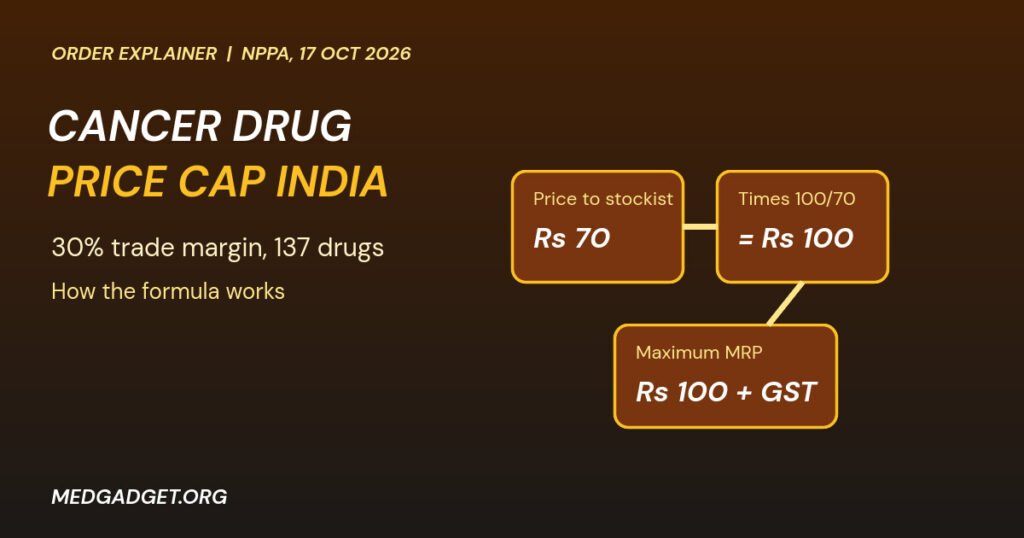
Reports of the order give the maximum MRP as the price to stockist multiplied by 100/70, plus GST. That structure makes the margin equal to 30% of the pre-GST retail price rather than 30% on top of the purchase price. In the illustration reported from the order, a product with a price to stockist of ₹70 and a current MRP of ₹300 would have a maximum MRP of ₹100 plus GST. By our arithmetic, ₹30 is 30% of ₹100 and about 43% of ₹70, so the cap is looser than it may sound as a markup. The reference price is the March 2026 price to stockists, with April 2025 to March 2026 used where there were no March sales, according to the summaries.
Scope of the cancer drug price cap India
Reports say the order covers any non-scheduled formulation containing a listed drug, alone or in combination, whatever the strength, dosage form or route of administration, and even where it is used for another condition. It reportedly reaches direct hospital supplies and patented products. It excludes government sales and, subject to conditions, medicines supplied free under a company’s patient assistance programme. The statement says the list was drawn up on an expert committee’s recommendation and will be updated periodically, so the perimeter may widen.
Compliance duties under the cancer drug price cap India
Manufacturers are reported to have seven days from publication to report revised prices to the NPPA and state drug controllers and to circulate new price lists. They must keep production at existing levels, seek permission before cutting it, and give six months’ notice before discontinuing a listed product, according to summaries. Overcharged amounts are reported to be recoverable with interest. Hospitals must display revised prices, and state drug controllers are directed to enforce the order. Consumers can check rates on NPPA’s website and the Pharma Sahi Daam app, per the Ministry’s statement.
How 2026 compares with the 2019 pilot
- 2019 scope: 42 drugs, described in the official notice of 28 February 2019 as a proof of concept; margin capped at 30% of MRP.
- 2019 results: a release of 8 March 2019 reported 390 brands with cuts of up to 87%.
- Later figure: a later government release cited cuts of up to 90% across 526 brands.
- 2026 scope: 137 drugs, with up to 70% expected, a different list and a different market.
The earlier figures show that the same tool produced large cuts on some brands, but they are not a forecast for 2026, and the official releases themselves quote different totals at different dates.
What remains unclear
We have not reviewed the gazette text, the official list of 137 drugs or revised prices, so we name no individual medicines and quote no revised prices. Reports also differ on which body recommended the list, and no source we reviewed gives industry reaction. The up-to-70% figure comes from the Ministry’s statement, and it does not say which products would fall that far. Readers should also note that the printed MRP is a ceiling: pharmacies and hospitals may already sell below it, so the change in what a patient pays can be smaller than the change in the printed price. The reference is each manufacturer’s own price to stockists, so the order works on the distribution margin rather than setting a new price on the manufacturer’s side. We will update this article if the gazette text or the list becomes available.
Risks and caveats on the cancer drug price cap India
- Several details come from summaries of the order, not the gazette text.
- Patients’ actual savings depend on discounts already given.
- Supply continuity is a stated risk the production rule is meant to address.
- This is news reporting, not legal or medical advice.
In our assessment, the cancer drug price cap India is best read as a distribution-margin measure with a track record, and the useful questions are which medicines are on the final list and how the printed prices change on 9 November. See also Grünenthal Widens Asia-Pacific Pain Access Through DKSH and Korea Deals. More in our pharmaceutical coverage.
What to watch next on the cancer drug price cap India
- The official list and revised price lists.
- Manufacturer compliance filings.
- Additions to the list.
- Any legal challenge or industry representation.
Frequently asked questions
What is the cancer drug price cap India order?
An NPPA order capping trade margins at 30% on 137 non-scheduled anti-cancer drugs from 9 November 2026.
What law is it under?
Paragraph 19 of the Drugs (Prices Control) Order, 2013.
Is it the first such cap?
No. The NPPA capped margins on 42 anti-cancer drugs in 2019.
How we reported this: we relied on the Ministry’s statement as reported, summaries of the NPPA order and government releases on the 2019 precedent; we could not open the gazette text. Last updated: 19 October 2026. This article is news reporting and not legal or medical advice.