
The Moderna Merck melanoma vaccine works differently from any vaccine most people know: it is built for one patient at a time from the genetic changes in their own tumour, then given with the immunotherapy Keytruda (pembrolizumab) to help stop melanoma returning after surgery. In a Phase 3 trial of 1,137 patients, the combination lowered the risk of recurrence or death by 42% compared with Keytruda alone, according to the companies. The therapy, intismeran autogene, is investigational and not approved.
Key takeaways on the Moderna Merck melanoma vaccine mechanism and results
- Each dose encodes up to 34 neoantigens, tumour-specific protein changes identified from the patient’s tumour, according to the companies.
- The trial compared intismeran plus Keytruda with placebo plus Keytruda in patients whose melanoma had been fully removed.
- Recurrence-free survival hazard ratio was 0.58 (42% lower risk); distant metastasis-free survival hazard ratio was 0.62 (38% lower risk).
- Two-year recurrence-free survival was 82.2% versus 70.0%.
- The Moderna Merck melanoma vaccine is not approved, and overall survival data are not yet mature.
How the Moderna Merck melanoma vaccine is made
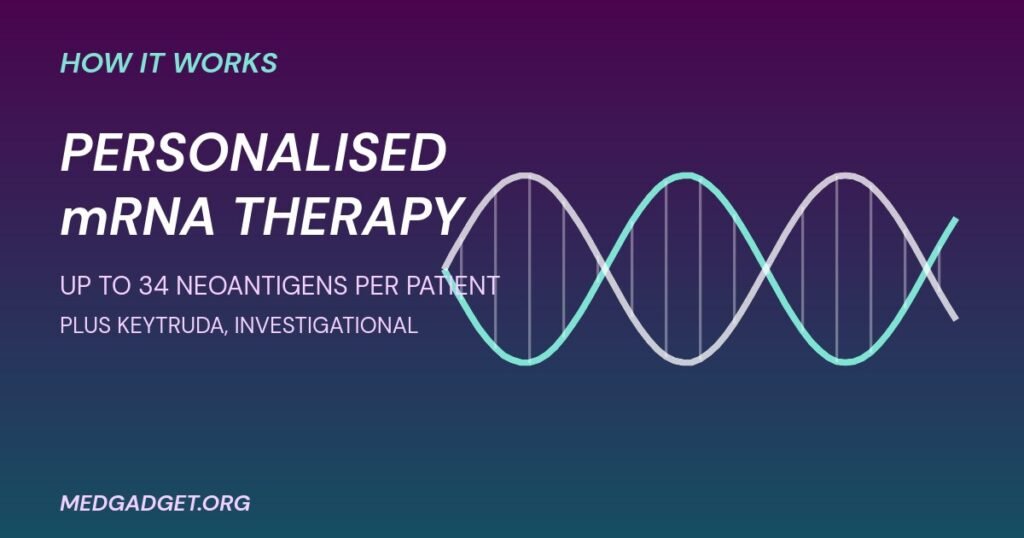
The process starts with the patient’s tumour and a sample of healthy tissue. Sequencing identifies mutations that exist only in the cancer. The companies say that up to 34 of the resulting neoantigens are encoded in a patient-specific mRNA product. After injection, cells translate the mRNA into those proteins and present them to the immune system, which can then generate T-cell responses against cancer cells carrying the same changes.
Keytruda is an anti-PD-1 antibody, which blocks a brake that tumours use to switch off T cells. The idea behind combining the two is that the individualised product trains T cells to recognise the tumour while Keytruda keeps them active. This is the mechanism as the companies describe it, and the trial tests the combination, not the mechanism itself. For Keytruda’s role in melanoma care, see our earlier coverage: Merck Announces Phase 3 Melanoma and Endometrial Cancer Data for ESMO 2026.
What the Phase 3 trial tested
The INTerpath-001 study (NCT05933577) randomised 1,137 patients 2:1 to intismeran plus Keytruda or placebo plus Keytruda. All had completely resected stage IIB to IV cutaneous melanoma. Intismeran was given at 1 mg every three weeks for up to nine doses, and Keytruda at 400 mg every six weeks for up to nine cycles. The comparison group received Keytruda, an existing standard option, so the trial asks whether the addition helps, not whether it beats no treatment.
The primary endpoint was recurrence-free survival, which counts any recurrence or death from any cause. The key secondary endpoint was distant metastasis-free survival, which counts spread to distant sites or death. Median follow-up was 24.6 months, per the Merck release.
Results and comparison group
Against that Keytruda-only comparison, the combination reduced the risk of recurrence or death by 42% (hazard ratio 0.58; 95% CI 0.45–0.75) and the risk of distant metastasis or death by 38% (hazard ratio 0.62; 95% CI 0.45–0.85). Two-year recurrence-free survival was 82.2% versus 70.0%, and two-year distant metastasis-free survival was 88.5% versus 80.2%. By our arithmetic these are absolute differences of 12.2 and 8.3 percentage points.
The companies report that treatment-related adverse events occurred in 95.8% of the combination group and 90.0% of the comparison group, with grade 3 to 5 events at 14.2% and 13.4%. They report no new safety signals. Common events with the combination included fever, injection-site pain and fatigue.
Regulatory status and next steps for the Moderna Merck melanoma vaccine
The investigational therapy has no approval anywhere. The companies say they are engaging with regulatory authorities about filings, and the release says the results have been selected for the ESMO Presidential Symposium and accepted for publication in the New England Journal of Medicine. A potential 2027 launch has been mentioned in press coverage, but the companies’ release does not give a launch date, so we treat that timing as unconfirmed.
A regulator will weigh the relative benefit, the safety profile, the maturity of overall survival data and the practicalities of manufacturing a product for each patient. None of those judgements has been made. For comparison with other melanoma developments, see Cancer Vaccine Momentum Grows as Bristol Myers Squibb Launches Relopduo in India for Advanced Melanoma Treatment and our pharmaceutical coverage.
Our analysis of the Moderna Merck melanoma vaccine data
In our assessment, the Moderna Merck melanoma vaccine data matter because they come from a large, randomised, double-blind Phase 3 trial with a placebo-controlled design on top of a standard drug, which is a demanding test. The effect appears after about six months, according to the sensitivity analyses, which fits the idea that the immune response needs time to build.
The caution is that overall survival is immature, and a relative reduction in recurrence is not the same as a proven survival gain. Also, the logistics of individual manufacture could shape who has access. We treat all of this as analysis rather than as a statement from the companies.
What is not disclosed about the Moderna Merck melanoma vaccine
- Overall survival results with event counts.
- Manufacturing time, cost and eventual price.
- Filing dates and any launch plan.
- Subgroup and long-term safety data.
Risks and caveats for the Moderna Merck melanoma vaccine
The numbers come from the sponsors, not from the peer-reviewed paper. Hazard ratios are group-level and do not tell an individual patient what to expect. The results apply to resected stage IIB to IV melanoma and not to advanced disease. This is news reporting and not medical advice.
What to watch next for the Moderna Merck melanoma vaccine
- The ESMO presentation and journal publication.
- Overall survival updates.
- Regulatory submission news on the Moderna Merck melanoma vaccine.
- Results from the other trials in the INTerpath programme and from Moderna’s own channel at modernatx.com.
FAQ
Is the Moderna Merck melanoma vaccine a preventive vaccine?
No. It is a treatment given after surgery to reduce the chance that melanoma returns.
Can patients get it now?
It is not approved. Access outside clinical trials has not been announced.
How is it personalised?
It is built from the mutations found in each patient’s tumour, encoding up to 34 neoantigens, according to the companies.
How we reported this: we relied on the sponsors’ release and attributed all figures to Merck and Moderna. Calculations are labelled as ours. Last updated 23 October 2026. This is news reporting and not advice.