
The Merck ESMO 2026 Phase 3 results will be the first full look at two trials whose headline outcomes the company has already announced: a personalised mRNA cancer therapy in melanoma and an antibody-drug conjugate in endometrial cancer. Merck said on 13 October 2026 that it will present these first-time Phase 3 data, along with more than 90 other abstracts, at the European Society for Medical Oncology Congress, which runs from 23 to 27 October in Madrid.
Nothing new about efficacy was released on 13 October. The headline findings were reported earlier, in August for melanoma and in May for endometrial cancer, and the numbers that show how large the benefits are will come only at the meeting. Neither treatment is approved. Here is what is known, what is not, and why the sessions matter.
Key takeaways
- Merck has three Presidential Symposium slots at ESMO 2026, including two for new Phase 3 results.
- INTerpath-001 tests intismeran autogene plus Keytruda in resected melanoma; the company says it met its primary endpoint of recurrence-free survival.
- TroFuse-005 tests sacituzumab tirumotecan (sac-TMT) in advanced endometrial cancer; the company says it improved overall survival and progression-free survival.
- Hazard ratios and median survival times have not been published; they are expected at the meeting.
Merck ESMO 2026 Phase 3 results: the melanoma trial
INTerpath-001 enrolled 1,137 people with completely resected stage IIB to IV cutaneous melanoma, randomised two to one. One arm received intismeran autogene, an individualised mRNA therapy built from a patient’s own tumour mutations, plus Keytruda (pembrolizumab). The other received Keytruda with a placebo. Intismeran is developed with Moderna.
On 19 August 2026 the companies said the combination significantly improved recurrence-free survival, the primary endpoint, and also distant metastasis-free survival, a key secondary endpoint. Overall survival and other measures are still being assessed. The release did not give a hazard ratio for the Phase 3 trial. The only figures cited came from the earlier Phase 2b KEYNOTE-942 study: a hazard ratio of 0.51 for recurrence or death (a 49% reduction in risk) at five years. Those earlier numbers came from a smaller, different trial and should not be read as the Phase 3 result.
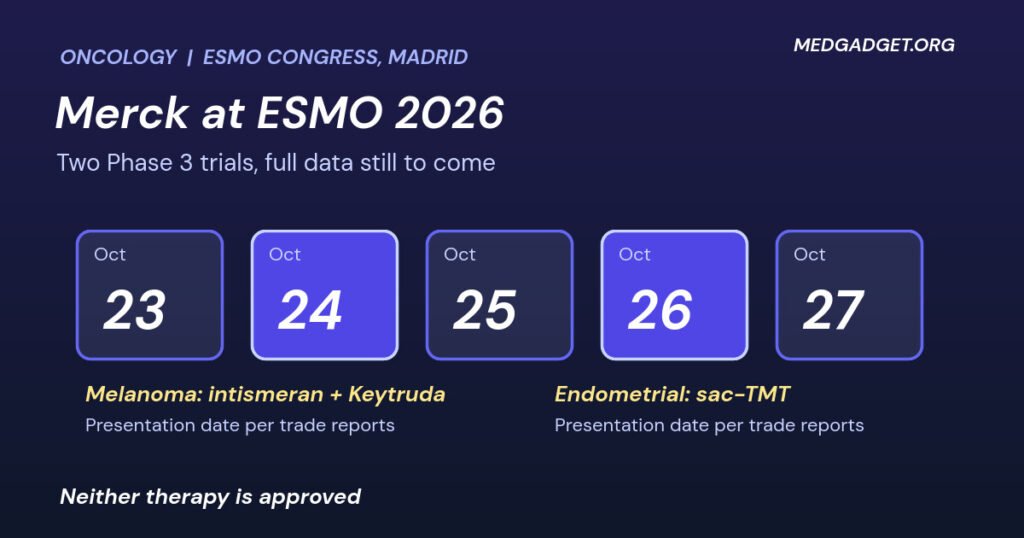
Merck lists the study as presentation LBA1 in Presidential Symposium I, with G. V. Long as presenter. Trade reports put the session on 24 October.
Merck ESMO 2026 Phase 3 results: the endometrial cancer trial
TroFuse-005 randomised 776 patients with advanced or recurrent endometrial cancer that had progressed after platinum chemotherapy and a PD-1 or PD-L1 inhibitor. They received sac-TMT at 4 mg/kg every two weeks or the doctor’s choice of chemotherapy, doxorubicin or paclitaxel. The study was open-label.
On 18 May 2026 Merck said that at a pre-specified interim analysis sac-TMT produced statistically significant and clinically meaningful improvements in overall survival and progression-free survival, and met the key secondary endpoint of objective response rate. The safety profile was described as consistent with earlier studies, with no new safety signals. Sac-TMT was developed by Kelun-Biotech, and Merck holds rights outside Greater China. The company has described the result as the first antibody-drug conjugate to improve both survival measures in a global Phase 3 trial in this setting; that is the company’s claim.
The data are listed as LBA11 in Presidential Symposium III, presented by D. Lorusso. Trade reports place that session on 26 October.
Other data alongside the Merck ESMO 2026 Phase 3 results
The third Presidential slot, LBA12, is KEYNOTE-C93, which compares first-line Keytruda alone with carboplatin plus paclitaxel in mismatch repair-deficient endometrial cancer. Merck will also present sac-TMT lung cancer studies (OptiTROP-Lung06 and Lung04), the LITESPARK-011 trial of belzutifan plus lenvatinib in kidney cancer, and further Keytruda analyses in bladder and breast cancer. An investor event is scheduled for 26 October. For other recent oncology news, see our report on new cancer chemotherapy approvals in China and our report on the European PULSE trial of OncoSil implants.
What the Merck ESMO 2026 Phase 3 results do not yet tell us
- How large the benefit is. Without hazard ratios and median times, “significant” only means the result did not occur by chance.
- How long patients live. Overall survival in melanoma is still being assessed.
- Side effects in detail. Both companies say no new safety signals appeared, but rates have not been published.
- Regulatory plans. Merck says it will discuss the data with regulators, with no filing dates given.
Our assessment of the Merck ESMO 2026 Phase 3 results
In our assessment, the Merck ESMO 2026 Phase 3 results are important, but the real news has mostly been told already. The notable point is scale: two positive Phase 3 trials from newer platforms, an individualised mRNA therapy and a TROP2 antibody-drug conjugate, are being shown at the same meeting, with Keytruda in the background. The meeting will show whether the benefits are large enough to change practice and whether the cost in toxicity is acceptable. Until the numbers appear, we would treat the announcements as promising and unquantified.
What to watch after the Merck ESMO 2026 Phase 3 results
- The recurrence-free survival hazard ratio for intismeran plus Keytruda.
- Overall survival maturity in both trials.
- Treatment-related adverse events and discontinuation rates.
- Filing announcements for intismeran and sac-TMT.
Frequently asked questions about the Merck ESMO 2026 Phase 3 results
When will Merck present its Phase 3 data at ESMO 2026?
The congress runs from 23 to 27 October in Madrid. Trade reports place INTerpath-001 on 24 October and TroFuse-005 on 26 October.
Are the drugs in the Merck ESMO 2026 Phase 3 results approved?
No. Both are investigational and have not been approved by any regulator.
What is intismeran autogene?
An individualised mRNA cancer therapy made for each patient from their tumour mutations, developed by Merck and Moderna and given with Keytruda.
What is sac-TMT?
An antibody-drug conjugate that targets TROP2, developed by Kelun-Biotech and licensed to Merck outside Greater China.
Were the Merck ESMO 2026 Phase 3 results already announced?
The headline outcomes were announced earlier in 2026. The detailed figures will be presented at ESMO.
How we reported this: we relied on Merck’s 13 October 2026 announcement and its earlier results releases. Session dates marked as trade reports were not stated in Merck’s release. Last updated: 14 October 2026. This article is news reporting and not medical advice.