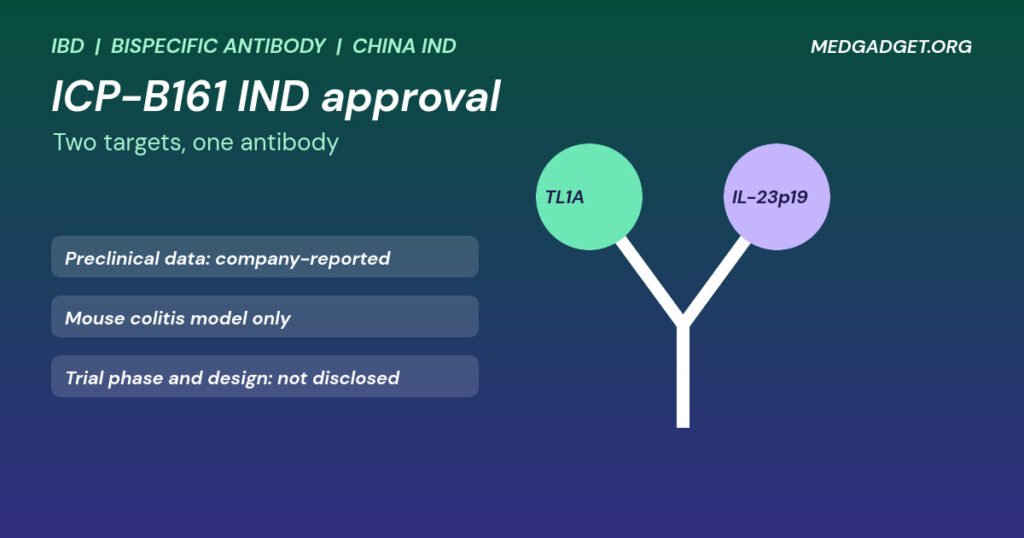

The ICP-B161 IND approval gives InnoCare permission to begin human trials of a bispecific antibody that blocks two inflammation targets at once. On 11 October 2026, the company said China’s Center for Drug Evaluation, part of the National Medical Products Administration, approved the investigational new drug application for ICP-B161, which targets TL1A and IL-23p19 and is aimed at autoimmune diseases including inflammatory bowel disease (IBD).
This is permission to start a clinical programme, and the supporting data are preclinical. Here is what the company said, what the mechanism is meant to achieve, how far the evidence goes, and what has not been disclosed.
Key facts about the ICP-B161 IND approval
- Drug: ICP-B161, a bispecific antibody against TL1A and IL-23p19.
- Approval: an IND clearance from China’s drug regulator, which allows clinical trials to begin. It is not marketing approval.
- Target diseases: autoimmune diseases, including IBD.
- Company claim: ICP-B161 is InnoCare’s fifth novel candidate to enter clinical development in 2026.
- Evidence so far: animal data only, reported by the company.
- Not disclosed: trial phase, design, sites, patient population, endpoints and timelines.
What the ICP-B161 IND approval means
An IND approval lets a sponsor administer an experimental drug to people under a defined protocol. The investigational new drug process in the US works on the same principle. For InnoCare, the Chinese clearance moves ICP-B161 from the laboratory into the clinic, though the company has not said when the first patient will be dosed or what the first study will look like. In our assessment, that is the main gap for readers hoping to gauge how quickly the drug could progress.
How ICP-B161 works behind the ICP-B161 IND approval: TL1A and IL-23p19
TL1A and IL-23p19 are both signalling proteins linked to the inflammation seen in IBD, which includes Crohn’s disease and ulcerative colitis. The National Institute of Diabetes and Digestive and Kidney Diseases gives background on these conditions. Drugs against each target have been developed separately. A bispecific antibody is built to bind two targets at once, and InnoCare argues that blocking both pathways may suppress cytokine release and inflammation more than blocking either alone. That is the company’s hypothesis. It has not been tested in patients.
The company also says the molecule has a novel design with an extended half-life, which it says should allow less frequent dosing and subcutaneous administration. It gave no half-life figure, dosing interval or formulation details.
The preclinical evidence behind the ICP-B161 IND approval
According to InnoCare, ICP-B161 showed dose-dependent activity in animal models, with significant inhibition of colitis-related symptoms. In a mouse model of colitis induced by the chemical TNBS, the company reports that at equivalent doses ICP-B161 had better efficacy than a TL1A antibody, an IL-23p19 antibody and peer bispecific antibodies, with favourable tolerability. The company also states that no TL1A and IL-23p19 bispecific antibody is approved for marketing anywhere.
These claims cannot be checked from the announcement. It does not give the doses, the study design, the size of the effect or the names of the comparator bispecifics, and it does not say whether the data have been published or peer reviewed. The comparison comes from a single mouse model. Mouse colitis models are useful for screening but often do not predict results in people, so the data should be read as a rationale for trials, not as evidence of benefit.
Where the ICP-B161 IND approval sits in the IBD field
As general background, IBD treatment already includes several classes of biologic medicines, and drugs aimed at IL-23 are established in this area. TL1A is a newer target that several drug developers have pursued with single-target antibodies. A drug hitting both is therefore a bet that combining mechanisms adds benefit without adding unacceptable risk. Whether that is true can only be shown in clinical trials, and combination approaches also raise questions about safety, particularly infection risk, that early studies will need to address. The announcement does not discuss those questions, and we have not seen any clinical data to speak to them.
Why the ICP-B161 IND approval matters for InnoCare
InnoCare is best known for orelabrutinib, tafasitamab and zurletrectinib, its three approved products, and says it has more than ten innovative candidates in clinical development. Recent news includes trial approval for ICP-B381, a PSMA and STEAP1 bispecific antibody-drug conjugate, in September 2026, and a research collaboration and licence agreement with Lilly signed on 24 September 2026 worth up to $100 million in upfront and near-term payments and up to about $3.25 billion in milestones, according to the company. The Lilly agreement is separate from ICP-B161, and the announcement does not link them.
Chief executive Dr Jasmine Cui said the company will accelerate development of ICP-B161 to deliver innovative therapies to IBD patients as soon as possible. She described IBD as a progressive, lifelong disease with significant unmet need. The release cites an estimated 6.8 million people affected worldwide, based on a 2017 Global Burden of Disease study. Those are company statements, and the prevalence figure is from an older study.
What the ICP-B161 IND approval leaves unanswered
- The phase, size and design of the first human study, and whether it will recruit patients or healthy volunteers.
- Dose, route and schedule.
- Any clinical safety or efficacy data. None exist in the public record.
- Whether the company plans trials outside China.
- Intellectual property and any partnering plans for this molecule.
For another recent China-based drug development story, see our report on Innovent’s Phase 3 result for SYCUME in thyroid eye disease, or browse more pharmaceutical news.
Frequently asked questions
What is the ICP-B161 IND approval?
China’s drug regulator has cleared InnoCare to start clinical trials of ICP-B161, a bispecific antibody against TL1A and IL-23p19.
What is ICP-B161 designed to treat after the ICP-B161 IND approval?
Autoimmune diseases, including inflammatory bowel disease, according to the company.
Does the ICP-B161 IND approval mean the drug works?
No. It permits human trials. The evidence so far is from animal models reported by the company.
When will trials start after the ICP-B161 IND approval?
The announcement does not say.
Is a TL1A and IL-23p19 bispecific antibody approved anywhere?
The company says none is approved. That is its own statement.
How we reported this: we relied on InnoCare’s announcement of 11 October 2026. Preclinical results and comparisons are the company’s and have not been independently verified. Last updated: 13 October 2026. This article is news reporting and not medical advice.