
Antibody-drug conjugates are only as secure as the supply chain behind their toxic payloads, and for one of the most important payload ingredients that chain has mostly run through a few places outside Europe. Axplora, a global maker of small-molecule APIs and ADC components, now says it is working on an European exatecan supply route. The company has completed its first R&D batches of exatecan, the starting material for a widely used class of ADC payloads, with the aim of giving developers an independent European source. The work was reported in late September 2026.
The plan in brief
- Milestone reached: first R&D batches of exatecan completed, at gram scale.
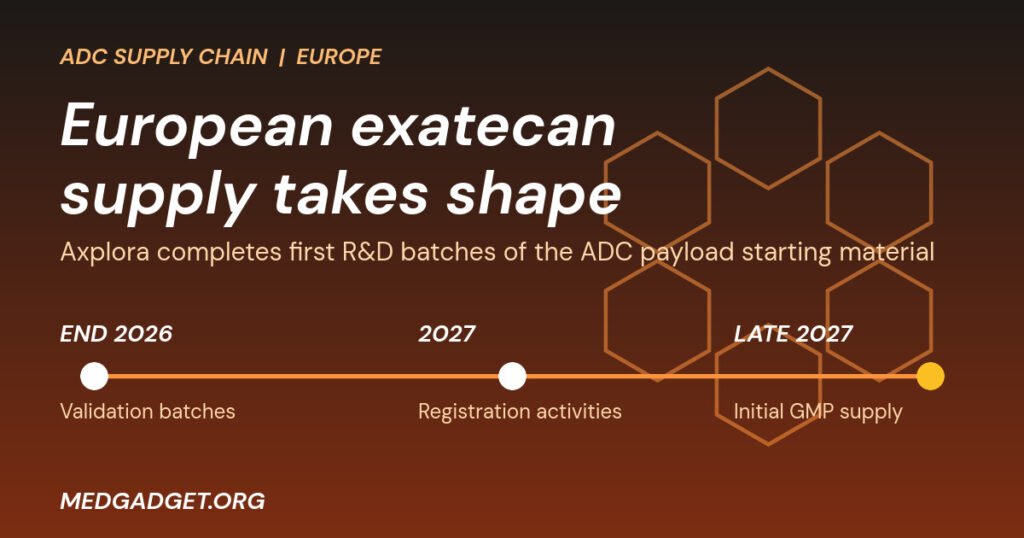
- By end of 2026: validation batches planned.
- 2027: registration activities targeted.
- Late 2027: initial GMP supply planned, subject to technical, quality and regulatory milestones.
Why exatecan matters to ADC developers
Exatecan is a highly potent topoisomerase I inhibitor. Derivatives of it are used as cytotoxic payloads in antibody-drug conjugates, which deliver a toxic drug directly to cancer cells via a targeting antibody. Because the payload is potent, it must be made under strict containment, and because it sits at the very start of the ADC chain, any constraint on exatecan supply can ripple through to clinical programmes.
Axplora’s argument is that developers want a second, independent source in Europe, with production linked to payload-linker and ADC capabilities so that fewer hand-offs are needed between making the starting material and building the finished conjugate. The programme appears under the name Axotecan in some company material, while the reporting we reviewed refers to the compound as exatecan.
Two sites, one chain
The programme draws on two locations. Farmabios in Gropello Cairoli, Italy, supports high-potency development, containment and manufacturing; the company says it has five independent lines under OEB 5 containment, with batch sizes from 0.5 to 300 kg. Novasep CDMO in Le Mans, France, provides payload-linker development and manufacturing, plus bioconjugation.
The idea is to connect these steps. Axplora says linking them reduces technical handoffs and supports technology transfer and scale-up, from payload starting material through to ADC drug substance manufacturing. For a sponsor, that could mean one technology transfer rather than several.
How an ADC is built, and where this fits
An ADC has three parts: an antibody that finds the tumour target, a linker that holds the drug on the antibody, and a cytotoxic payload that does the killing. Each part is made separately, often by different specialists, and then joined in a bioconjugation step before the finished product is purified and filled into vials. Exatecan sits at the front of the payload branch, which makes it a bottleneck if only a few suppliers can make it.
Making that payload ingredient in Europe, and connecting it to the linker and conjugation steps the same group already offers, is the logic behind the programme. A developer would still need to qualify the new source, compare it with existing material and file the change with regulators, which is why the timeline runs through 2027.
How far along is it really?
It is early. Gram-scale R&D batches show a route works at laboratory scale; they do not prove that it can be made reproducibly at GMP scale, with the purity, impurity profile and documentation regulators expect. The planned sequence, validation batches, registration activities and then initial GMP supply in late 2027, is a sensible path, but the company itself notes it depends on technical, quality and regulatory milestones.
In our assessment, the late-2027 target is the date to watch. Plans of this kind in specialty chemistry frequently shift, and a developer deciding whether to qualify a second source will want to see validation data before committing. That judgement is ours, not a statement from Axplora.
Why a European source is attractive
- Supply resilience: a second source reduces dependence on a single region or supplier.
- Regulatory familiarity: European manufacturing sits within a framework regulated by authorities such as the European Medicines Agency and national inspectorates.
- Speed: shorter transport and fewer organisational hand-offs can shorten timelines.
- Integration: payload, linker and conjugation under one network simplifies project management.
None of these benefits is guaranteed. They depend on price, capacity, quality and whether customers choose to dual-source.
What the announcement does not say
- Customers and volumes: no customers were named and no commercial volumes or prices were given.
- Intellectual property: the reporting we reviewed does not describe the route chemistry or patent position.
- Capacity: the scale planned for commercial supply was not specified.
What to watch next
- Whether validation batches are completed by the end of 2026 and what purity and yield data are shared.
- Any named customers or supply agreements for exatecan or related payloads.
- Regulatory filings referencing the new source during 2027.
- Competing announcements from other European or global suppliers of ADC payload starting materials.
The wider ADC manufacturing picture
ADCs are among the busiest areas of oncology development, and the specialised manufacturing behind them, potent payloads, linkers, bioconjugation and fill-finish, has become a competitive niche for contract manufacturers. Companies are investing to add capacity and secure starting materials so that clinical programmes do not stall on supply. For related oncology and manufacturing coverage, see our reports on Beactica’s BEA-28 preclinical candidate for solid tumours and the Italfarmaco and VeriSIM Life partnership, and browse more pharmaceutical news.
Frequently asked questions
What is exatecan used for?
It is a potent topoisomerase I inhibitor used as a starting material for ADC payloads that kill cancer cells once delivered by an antibody.
What has Axplora achieved?
It has completed first R&D batches of exatecan, producing gram quantities, with the aim of an independent European source.
When will GMP supply be available?
Initial GMP supply is planned for late 2027, subject to technical, quality and regulatory milestones.
Which sites are involved?
Farmabios in Gropello Cairoli, Italy, for high-potency work, and Novasep CDMO in Le Mans, France, for payload-linker development, manufacturing and bioconjugation.
Is this commercial supply today?
No. The work is at R&D stage, with validation batches planned by the end of 2026.
How we reported this: we used Axplora’s programme update reported on 29 September 2026. Timelines and benefits are company statements and are subject to change. Last updated: 8 October 2026. This article is news reporting, not investment advice.