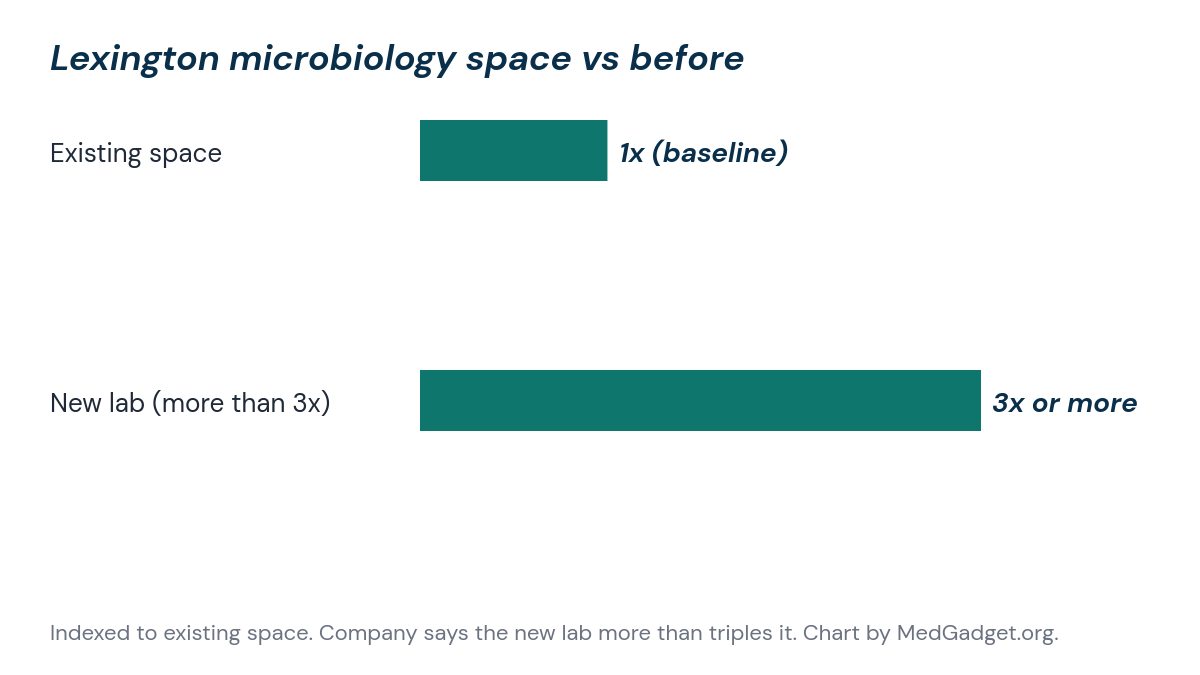
Before a sterile injectable reaches a patient, someone has to prove it is free of living microbes, and that proof often decides how fast a batch can ship. Piramal Pharma Solutions has just added capacity for exactly that step. The contract development and manufacturing organisation (CDMO) has launched a new microbiology laboratory at its sterile injectables facility in Lexington, Kentucky, which it says more than triples the site’s microbiology testing space and could cut testing times by up to 50 percent.
Key Takeaways
- What opened: a new microbiology laboratory at Piramal’s Lexington, Kentucky sterile injectables site, released for GMP use on 11 September 2026.
- Size: it more than triples existing microbiology testing space, according to the company.
- Speed: Piramal expects testing times to fall by up to 50 percent. This is a company projection.
- Equipment: a dedicated Grade A sterility testing isolator that doubles site capacity, plus three new biosafety cabinets for environmental monitoring.
- Bigger picture: the lab is part of an $85 million expansion at Lexington, with the manufacturing build-out expected online in late 2027.
What does the new laboratory contain?
The headline feature is a dedicated Grade A sterility testing isolator. An isolator is a sealed, tightly controlled enclosure in which samples can be handled without exposure to the surrounding room, which lowers the risk of a false positive caused by contamination during the test itself. Piramal says the isolator doubles the site’s sterility testing capacity and supports both open and closed filtration methods.
Around the isolator sits a Grade C background environment for the sterility suite, which is the cleanliness level of the room the isolator operates in. Three new biosafety cabinets allow environmental monitoring tests to run at the same time, and all incubators have been consolidated within the new lab. The company also built pass-throughs that move samples from the manufacturing floor straight into the lab, which shortens handling and reduces the chance of mix-ups.
| Feature | What the company says |
|---|---|
| Testing space | More than triples existing microbiology space |
| Sterility isolator | Dedicated Grade A isolator; doubles site sterility testing capacity |
| Environmental monitoring | Three new biosafety cabinets for concurrent testing |
| Workflow | Pass-throughs from manufacturing floor to lab; incubators consolidated |
| Speed | Testing times expected to fall by up to 50% |
| Status | Released for GMP use on 11 September 2026; sterility suite conditionally approved shortly after |
Why does sterility testing matter so much?
Injectables bypass the body’s natural defences, so any contamination can be dangerous. Regulators therefore expect manufacturers to demonstrate sterility and control the manufacturing environment in line with good manufacturing practice. The US Food and Drug Administration sets out its expectations in its guidance on sterile drug products produced by aseptic processing.
Testing is also a scheduling problem. Many sterility tests need days of incubation, and lab capacity can become the bottleneck that holds finished vials in quarantine. In our assessment, adding an isolator and more cabinets addresses that bottleneck directly: more parallel tests mean shorter queues, and shorter queues mean customers get released batches sooner. The claimed 50 percent reduction should be read as the best case the company expects, not a guaranteed result for every product.
Who is the lab for?
The Lexington site serves clients developing small molecules, bioconjugates and peptides, all of which are commonly delivered as injections. Piramal says it is one of 17 global development and manufacturing facilities operated by its parent, Piramal Pharma Limited. You can read more about the site on the Piramal Lexington facility page.
Nathan Richardson, Vice President and Site Head at Piramal Pharma Solutions Lexington, said that by enhancing sterility testing and microbiological quality capabilities, the company is further strengthening its ability to support clients.
How does this fit the Lexington expansion?
The laboratory is one piece of a larger investment programme. In its latest announcement Piramal describes an $85 million expansion at Lexington. Earlier public statements about the programme cited an $80 million plan, so the figure appears to have grown or been restated; the company has not explained the difference in the material we reviewed. The wider manufacturing expansion is expected to be online in late 2027.
Testing capacity usually has to expand before, or alongside, production capacity. Bringing the lab online first means that when new filling capacity arrives, quality testing is less likely to throttle output. That logic is shared across the sector, as seen in other recent moves such as our report on GE HealthCare’s radiopharma expansion, where injectable products also depend on fast, reliable release testing.
What this means for the CDMO market
Contract manufacturers compete on reliability, speed and regulatory track record. Sterile injectable capacity is a particularly tight segment because of the specialist facilities and skills needed, so investments in quality infrastructure are a way to stand out. For Piramal, whose parent company is based in India, building US capacity also helps serve customers who prefer domestic supply. For related coverage, see our pharmaceutical news section.
What we do not know
- Customer wins: no new contracts were announced with the lab.
- Throughput: the release did not give absolute test volumes per week.
- Final approval: the sterility suite was described as conditionally approved, so full approval details were not provided.
Frequently asked questions
Where is the new microbiology laboratory?
It is at Piramal Pharma Solutions’ sterile injectables facility in Lexington, Kentucky.
When did it open?
The company says the lab was released for GMP use on 11 September 2026, and announced it on 6 October 2026.
What is a Grade A isolator?
It is a sealed, highly clean enclosure where sterility tests are carried out, designed to protect samples from contamination.
How much faster will testing be?
Piramal expects testing times to fall by up to 50 percent, which is a company projection.
How big is the Lexington investment?
The company cites an $85 million expansion, with the manufacturing build-out expected in late 2027.
How we reported this: this article is based on the company’s announcement dated 6 October 2026 and the regulatory and facility pages linked above. Performance figures are company projections. Statements marked as our assessment are opinion. Last updated 7 October 2026. This is general information only.