
A new Dutch biotech has launched with one goal: to give people with a rare bleeding disorder their first approved option. RougeTx has raised $58 million in Series A financing to take RTX-001, an oral HHT therapy for hereditary hemorrhagic telangiectasia, toward its first trials in people. The company announced the round on 6 October 2026. RTX-001 is still preclinical, so the story is about promise and funding rather than proven benefit.
Key Takeaways
- Funding: $58 million Series A, led by BioGeneration Ventures, Angelini Ventures and Kurma Partners.
- The drug: RTX-001 is an oral small molecule, with potential for once-daily dosing, designed to stabilise fragile blood vessels.
- The stage: preclinical. The money is meant to carry RTX-001 toward first-in-human development.
- The need: the company says there are no approved therapies for HHT, so patients rely on supportive care and off-label treatments.
- The base: a spin-off from Leiden University Medical Center, headquartered in Naarden, the Netherlands.
What is hereditary hemorrhagic telangiectasia?
Hereditary hemorrhagic telangiectasia, or HHT, is a genetic condition in which abnormal connections called arteriovenous malformations (AVMs) form between arteries and veins. These vessels are fragile and bleed easily. Patients commonly suffer recurrent nosebleeds and gastrointestinal bleeding, which in turn lead to iron deficiency and chronic anaemia. RougeTx describes HHT as the second most common inherited bleeding disorder. You can read patient-focused background at Cure HHT and in the MedlinePlus genetics entry.
The practical burden is hard to overstate. A nosebleed that arrives without warning can disrupt work, school and sleep, while repeated iron loss may require infusions or transfusions. According to the company, patients today depend on supportive care and off-label treatments, because nothing is approved specifically for the disease.
How is RTX-001 meant to work?
RougeTx says RTX-001 is a small-molecule oral treatment designed to stabilise fragile blood vessels by restoring pericyte attachment. Pericytes are supporting cells that wrap around small blood vessels and help keep them stable. In the company’s view, a loss of that attachment is part of what makes HHT vessels leak and bleed. The approach differs from therapies that aim to starve abnormal vessels of growth signals; it is meant to reinforce the vessel wall itself.
The idea draws on more than two decades of work by co-founder Franck Lebrin, who began the research at Inserm and continued it for the past decade at Leiden University Medical Center, according to the company. RougeTx also mentions a platform called periSCOPE that it will use to explore other vascular diseases. As is typical for a launch announcement, the preclinical evidence behind RTX-001 was not detailed, so the mechanism should be seen as a hypothesis under development.
Who is funding RougeTx?
| Role | Investors named by the company |
|---|---|
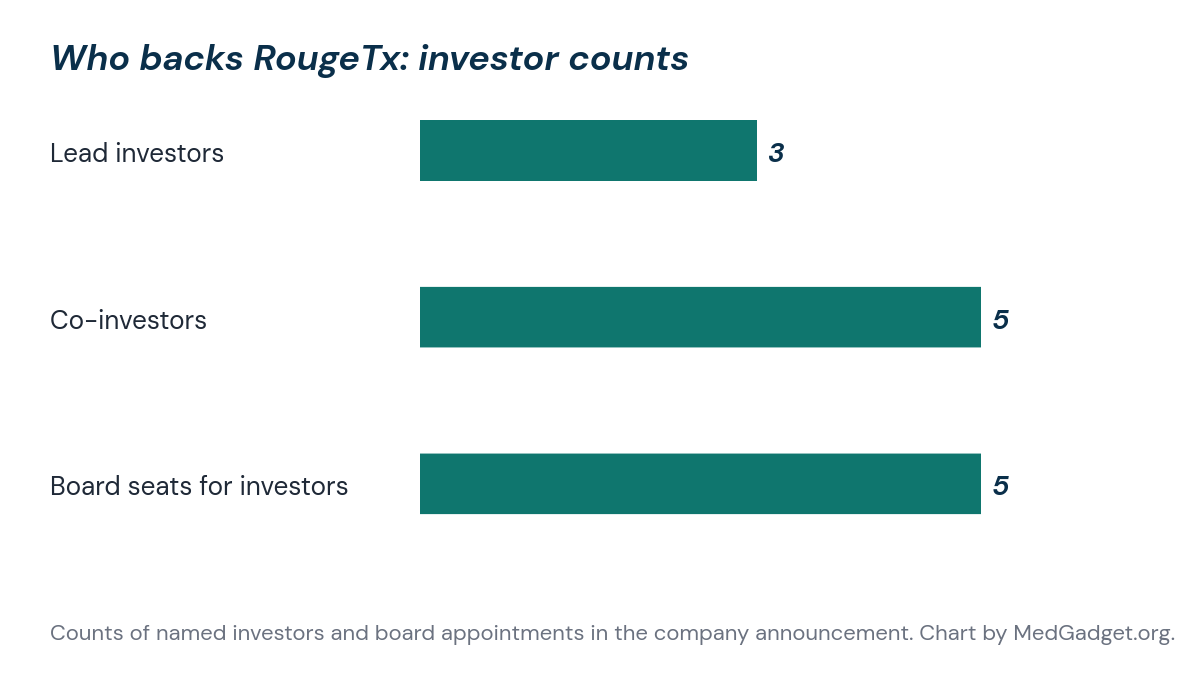
| Lead investors | BioGeneration Ventures (BGV), Angelini Ventures, Kurma Partners |
| Co-investors | Epidarex Capital, Vesalius Biocapital Partners, ROM Utrecht Region, p53 Invest, Kerna Ventures |
| European public support | EIB involvement through the Aurea co-investment facility |
Representatives of five of these investors have joined the board: Edward van Wezel (BGV), Regina Hodits (Angelini Ventures), Hadrien Bouchez (Kurma Partners), Elizabeth Roper (Epidarex Capital) and Stephane Verdood (Vesalius Biocapital Partners). The company is led by chief executive Andrew Lightfoot, with Sandra Glucksmann as executive chair. Glucksmann said that for too long people living with HHT have faced a serious, lifelong disease with no approved treatment options.
Why would an oral option matter in HHT?
Because HHT is lifelong, any future medicine would be taken for years. A daily tablet that reduces bleeding would be easier to live with than repeated procedures to cauterise vessels, regular iron infusions or hospital visits, which are the supportive measures patients commonly rely on today. Convenience, however, only counts if the drug is shown to work and to be safe over the long term, and that evidence does not yet exist for RTX-001.
What happens next?
The financing is intended to advance RTX-001 toward first-in-human clinical development and to explore expansion of the pipeline across vascular diseases. The announcement did not give a date for the first clinical trial, and we do not speculate on one. In general, a preclinical programme must complete safety studies and regulatory preparation before it can dose a first patient, which usually takes well over a year.
Why does this matter for investors and patients?
Rare disease start-ups with a clear unmet need and a mechanism-based story continue to attract money, even when programmes are early. A $58 million Series A is a sizeable round for a preclinical company, and the syndicate mixes specialist life science funds with a European public lender. In our assessment, that mix signals confidence in both the science and the regional ecosystem around Leiden, though it is not a guarantee of clinical success. Early-stage drugs fail often, and an oral small molecule must show it can safely hold vessels together in humans.
For patients, the more immediate message is that HHT is attracting attention from more than one developer. Other companies are also pursuing treatments for the condition using different approaches, which is encouraging for a disease with few options. Readers who follow rare disease finance may also like our report on the Happy Health funding round, or our wider pharmaceutical news.
What we do not know yet
- Preclinical data: the release did not publish efficacy or safety results for RTX-001.
- Timeline: no first-in-human date was given.
- Dose and regimen: once-daily dosing is described as a potential feature, not a confirmed one.
- Valuation and terms: not disclosed.
Frequently asked questions
What is RTX-001?
It is RougeTx’s lead candidate: an oral small molecule designed to stabilise fragile blood vessels in HHT by restoring pericyte attachment.
How much did RougeTx raise?
The company announced a $58 million Series A financing on 6 October 2026.
Is there an approved treatment for HHT?
The company says there is no approved therapy. Patients rely on supportive care and off-label treatments.
Is RTX-001 in clinical trials?
Not yet. It is preclinical, and the financing is meant to carry it toward first-in-human development.
Where is RougeTx based?
The company is based in Naarden, the Netherlands, and spun out of Leiden University Medical Center. See the RougeTx website and the company announcement.
How we reported this: this article is based on the company’s announcement of 6 October 2026 and the reference pages linked above. Claims about the mechanism and the lack of approved therapies are company-reported. Statements marked as our assessment are opinion. Last updated 7 October 2026. This is general information, not medical advice.