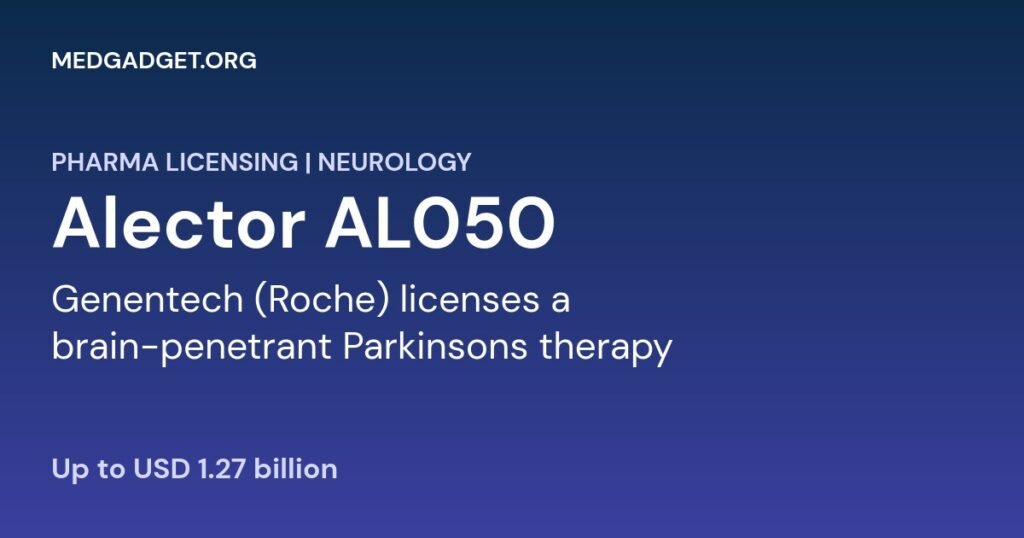

A drug that works in a dish is worthless in Parkinson’s disease if it cannot get into the brain. That is the problem at the centre of a new licensing deal announced on 5 October 2026: Genentech, a member of the Roche Group, has taken exclusive global rights to Alector AL050, an investigational enzyme therapy engineered to cross the blood-brain barrier. The deal is worth up to US$1.27 billion, according to the company announcement filed with the US SEC by Alector.
Key Takeaways
- Alector receives US$100 million upfront and is eligible for up to US$1.17 billion in development, regulatory and commercial milestones, plus tiered royalties on net sales, for a total of up to US$1.27 billion.
- Genentech takes responsibility for development, regulatory work, manufacturing and commercialisation of AL050 across all indications.
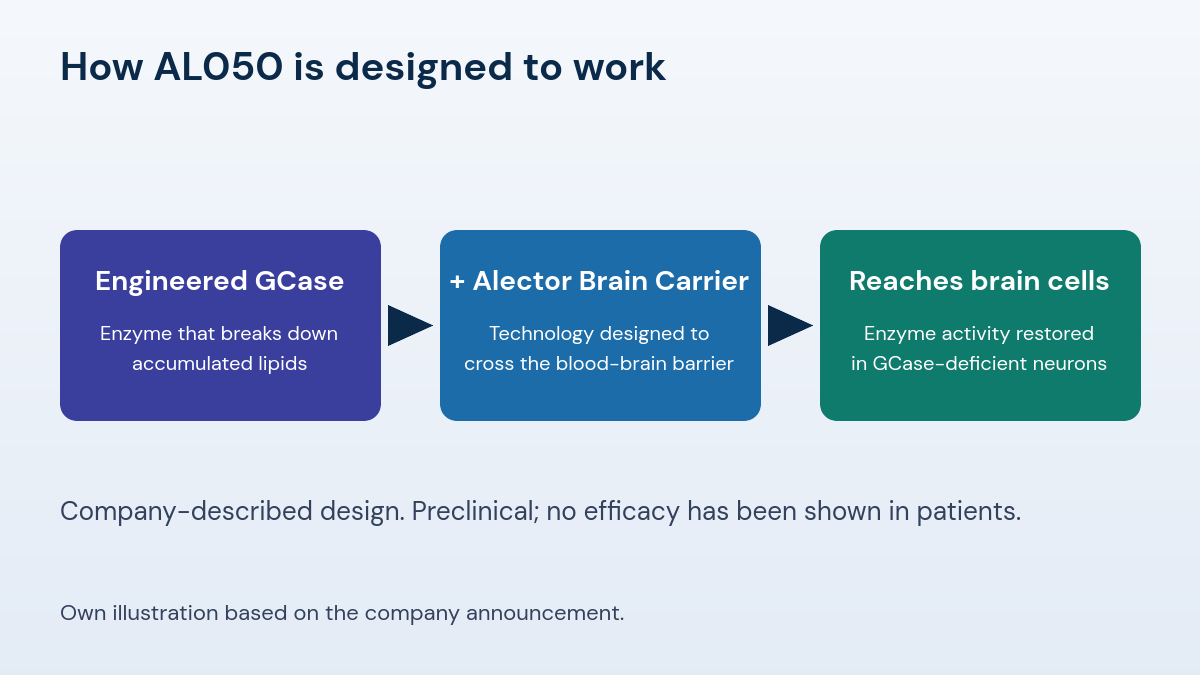
- AL050 pairs an engineered glucocerebrosidase (GCase) enzyme with Alector’s own brain-delivery technology, called Alector Brain Carrier (ABC).
- Alector keeps ownership of the ABC platform and the right to use it across its own pipeline. The company says the deal extends its cash runway into 2029.
- AL050 is an early-stage programme, described in reports as preclinical. It has not been tested in patients for this purpose, and no efficacy claim can be made.
Why Does Brain Delivery Decide Everything?
The blood-brain barrier is a tightly controlled lining of blood vessels that keeps most large molecules, including enzymes and antibodies, out of the brain. That is useful for protecting the brain and a nightmare for anyone trying to treat it with biologic drugs. Enzyme replacement therapies for some inherited metabolic disorders work well in the body but do little for the nervous system because the enzyme never arrives.
Alector’s chief executive, Arnon Rosenthal, framed the challenge in the announcement as twofold: engineering an enzyme with the right activity and durability, and then delivering it to the brain. AL050 is built to address both, by attaching an engineered GCase to the ABC carrier, which the company designed to cross the barrier.
What Is GCase, and Why Parkinson’s?
GCase is an enzyme encoded by the GBA1 gene. It works inside lysosomes, the cell’s recycling compartments, where it breaks down certain fats. Variants in GBA1 are among the better-known genetic risk factors for Parkinson’s disease, and the Parkinson’s Foundation describes how reduced GCase activity is linked to the disease. The scientific idea behind AL050 is that restoring GCase activity in the brain could help clear accumulated lipids and slow the damage to neurons in people whose GCase function is low. That is the company’s rationale, not a proven benefit.
The Deal in Numbers
| Term | Detail |
|---|---|
| Licensor | Alector |
| Licensee | Genentech (Roche Group) |
| Announced | 5 October 2026 |
| Programme | AL050, engineered GCase with Alector Brain Carrier |
| Upfront payment | US$100 million |
| Milestones | Up to US$1.17 billion (development, regulatory, commercial) |
| Headline value | Up to US$1.27 billion, plus tiered royalties |
| Rights | Exclusive global; Alector retains ABC platform and own pipeline |
| Stage | Preclinical (as described in reports) |
By our own calculation, the upfront payment is about 8% of the headline value (100 divided by 1,270). Roughly 92% of the figure depends on milestones that may never be paid, which is normal for deals at this stage but worth remembering before treating “up to US$1.27 billion” as committed money.
Roche, Genentech or Both?
Several headlines name Roche, while the legal licensee is Genentech, which is part of the Roche Group. The announcement quotes Boris Zaïtra, head of Roche Corporate Business Development, who said that by partnering with companies such as Alector the group aims to delay or halt the progression of Parkinson’s. For readers, the two names refer to the same corporate family, and we use them accordingly.
What Alector Gets Beyond the Cheque
The runway statement matters as much as the upfront cash. Alector reported cash, equivalents and investments of about US$172.8 million as of 30 June, according to company reporting, and says the partnership extends its runway into 2029. The company also keeps the ABC platform, which it intends to use on its own programmes; it has scheduled an R&D webinar for 13 October 2026 to discuss its wholly owned pipeline. Validation by a large partner is useful for a platform company because it suggests the delivery technology is credible, though only clinical data can confirm that.
What Is Not Yet Known
- Whether AL050 can deliver enough active enzyme into the human brain, and at what dose.
- When the first human studies will start; no timeline was given.
- The milestone triggers and the royalty rates.
- Whether the programme will focus first on people carrying GBA1 variants or on a broader Parkinson’s population.
- The safety profile of repeated dosing of an engineered enzyme carried across the barrier.
Related Coverage
For more on pharma deals and early-stage science, see our reports on Samfara’s API acquisition, the Datroway and ivonescimab combination and Replimune’s Tudriqev launch.
Our Assessment
In our assessment, this is a deal about a delivery technology as much as a drug. Many neurodegeneration programmes have failed because the molecule never reached the target tissue, so a partner willing to pay US$100 million upfront for a preclinical programme is making a statement about the carrier. But the risk is high. The path from a preclinical enzyme to a medicine that changes the course of Parkinson’s runs through years of studies, and the milestone structure reflects that. We would treat the headline as a sign of interest, not of success.
Frequently Asked Questions
What is AL050?
An investigational brain-penetrant enzyme therapy that combines an engineered glucocerebrosidase with Alector’s Alector Brain Carrier technology.
How much is the Alector deal worth?
Up to US$1.27 billion: US$100 million upfront plus up to US$1.17 billion in milestones, plus tiered royalties.
Who is the partner?
Genentech, a member of the Roche Group, which holds exclusive global rights to AL050.
Is AL050 in clinical trials?
Not according to the information available. It has been described as a preclinical programme.
Does it treat Parkinson’s disease now?
No. It is an investigational programme and is not available to patients.
How we reported this: details come from the company announcement of 5 October 2026 filed with the US SEC. Deal terms, scientific rationale and cash statements are company-reported. This is not medical or investment advice. Last updated 6 October 2026.