
AstraZeneca, Daiichi Sankyo and Summit Therapeutics plan to test an antibody-drug conjugate together with a PD-1/VEGF bispecific antibody in cancer, and the science behind pairing the two drugs is the real story. The companies announced on 2 October 2026 that they will evaluate Datroway (datopotamab deruxtecan) with ivonescimab across multiple solid tumours, starting with a Phase III trial in first-line triple-negative breast cancer (TNBC). Here is what Datroway plus ivonescimab aims to do, what the existing TNBC data show and what remains unproven.
Key Takeaways
- Datroway is a TROP2-directed antibody-drug conjugate (ADC). Ivonescimab is an investigational bispecific antibody that targets PD-1 and VEGF.
- The first planned study is a Phase III trial in first-line TNBC, with lung cancer and other solid tumours also named as settings.
- In the company-reported TROPION-Breast02 trial, Datroway alone improved survival and response versus chemotherapy in first-line TNBC for patients not suited to immunotherapy.
- Nothing is yet known about whether the combination is safe or better than either drug, and the trial design, endpoints and start date have not been disclosed.
- The combination is experimental and available only through clinical trials once they open.
What Do Datroway and Ivonescimab Do?
Datroway links an antibody that recognises TROP2, a protein found on the surface of many tumour cells, to a chemotherapy payload that blocks topoisomerase I, an enzyme cells need to copy DNA. The antibody acts as a delivery vehicle, bringing the payload into cells that carry TROP2. It is developed and sold jointly by AstraZeneca and Daiichi Sankyo.
Ivonescimab is a single antibody built to bind two targets: PD-1, an immune checkpoint that tumours exploit to switch off T cells, and VEGF, a growth factor that drives new blood vessel formation. Summit licensed it from Akeso for the United States, Canada, Europe and Japan. Reports say it was first approved in China in May 2024. It is investigational in the United States and Europe.
Datroway and Ivonescimab at a Glance
| Item | Datroway | Ivonescimab |
|---|---|---|
| Type | TROP2-directed antibody-drug conjugate | PD-1/VEGF bispecific antibody |
| Developers | AstraZeneca and Daiichi Sankyo | Summit Therapeutics (licensed from Akeso for US, Canada, Europe, Japan) |
| Mechanism | Delivers a topoisomerase I inhibitor payload to TROP2-bearing cells | Blocks PD-1 immune checkpoint and VEGF signalling |
| Status | Approved for certain TNBC patients in 30+ countries and regions, per the companies | Approved in China (reported); investigational in the US and Europe |
| First planned study together | Phase III, first-line TNBC | Phase III, first-line TNBC |
Why Combine an ADC With a PD-1/VEGF Antibody?
The rationale is a hypothesis, not a result. In our assessment, the logic runs as follows. An ADC kills tumour cells directly and may release tumour material that the immune system can recognise. A PD-1 blocker removes a brake on T cells. Blocking VEGF can change tumour blood vessels and, in some settings, reduce the immunosuppressive environment around a tumour. Putting these together could in theory produce a deeper or more durable response than any one drug.
That theory still has to survive a clinical trial. Combinations can add side effects as well as benefit, and what works in the lab does not always translate into longer survival. The companies have not published data on the combination in patients.
What the TNBC Data Show So Far
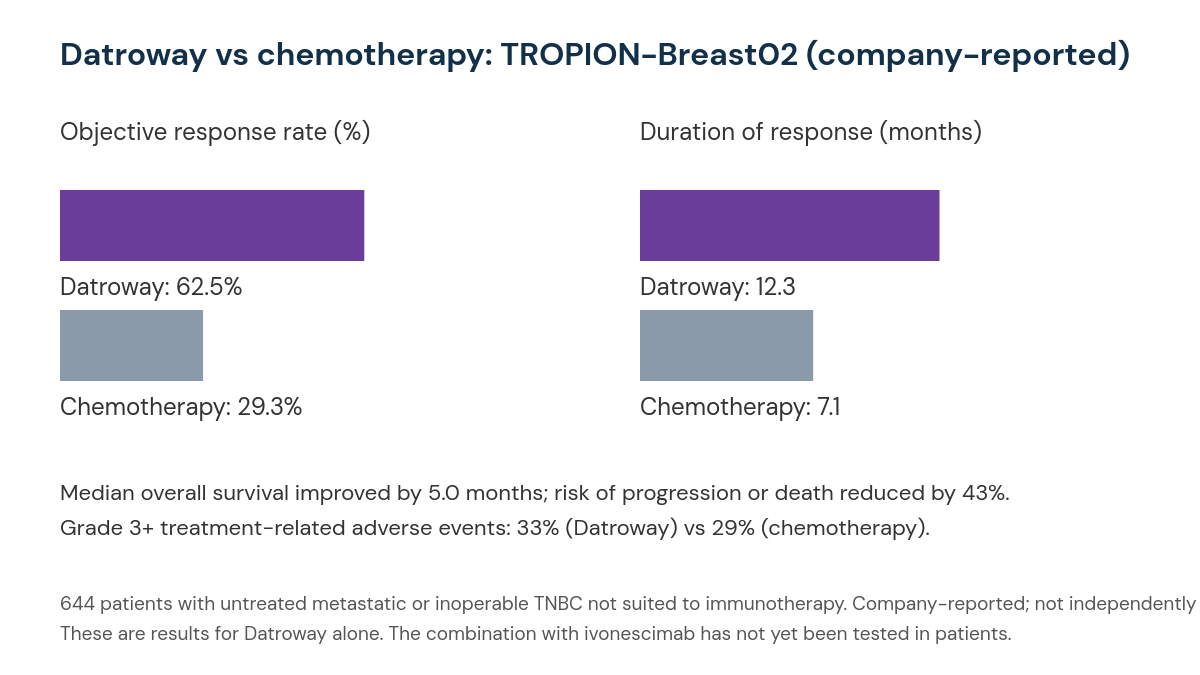
TNBC lacks the hormone and HER2 receptors that many breast cancer drugs target, so options are limited. The Datroway evidence in first-line TNBC comes from TROPION-Breast02, a global Phase III trial of 644 patients with previously untreated, inoperable or metastatic disease who were not candidates for immunotherapy. It compared Datroway with investigator-chosen chemotherapy, according to the companies.
Reported results are strong: median overall survival improved by 5.0 months, the risk of disease progression or death fell by 43%, the objective response rate was 62.5% versus 29.3% and the duration of response was 12.3 months versus 7.1 months. Grade 3 or higher treatment-related adverse events occurred in 33% of Datroway patients versus 29% on chemotherapy, with interstitial lung disease (including one fatal case) and stomatitis among the concerns. These figures are company-reported and were not independently verified by us. The companies say Datroway is approved in more than 30 countries and regions for adults with unresectable or metastatic TNBC who are not candidates for PD-1 or PD-L1 inhibitors.
Safety Questions the Combination Must Answer
Datroway can cause interstitial lung disease and mouth sores, according to the TROPION-Breast02 report. Drugs that block VEGF are generally associated with effects on blood pressure and bleeding, and PD-1 blockade can trigger immune-related inflammation. Whether these risks add up when the drugs are given together is exactly what a Phase III trial, with careful monitoring, will have to show. The companies have not disclosed any safety data for the pair.
What Is Still Unknown
- Enrolment target, primary endpoint, comparator and first-patient date for the TNBC study. Reports say either AstraZeneca or Daiichi Sankyo will sponsor it.
- Which lung cancer settings will be studied and when.
- Whether the trial will include patients who are eligible for existing PD-1 or PD-L1 treatments.
- Dose, schedule and how toxicities will be managed.
What This Means for Patients
The combination is not available outside trials. People with TNBC or lung cancer who are interested can ask their oncologist about eligibility and watch ClinicalTrials.gov for new listings. General information on breast cancer treatment is available from the National Cancer Institute, and regulatory decisions on cancer drugs are published by the US Food and Drug Administration.
Related Coverage
For more on cancer drug development, see our reports on Summit’s bladder cancer Phase II/III ivonescimab trial, the end of the Foghorn FHD-909 program, China’s oncology approvals and Exelixis oncology strategy.
Our Assessment
In our assessment, the combination is scientifically plausible and builds on a genuinely strong first-line TNBC result for Datroway, but it is still an unproven idea in humans. The decisive questions are whether adding ivonescimab improves survival beyond Datroway alone, and whether it does so without unacceptable toxicity. Until Phase III data arrive, the announcement should be read as a plan, not a finding.
Frequently Asked Questions
What is Datroway plus ivonescimab?
It is a planned combination of a TROP2-directed antibody-drug conjugate and a PD-1/VEGF bispecific antibody, to be tested in solid tumours starting with first-line TNBC.
Who is testing the combination?
AstraZeneca, Daiichi Sankyo and Summit Therapeutics announced the collaboration on 2 October 2026.
Why start with triple-negative breast cancer?
TNBC has few targeted options, and Datroway has shown survival and response benefit in first-line patients not suited to immunotherapy, according to the companies.
Is the combination approved?
No. It is experimental, and ivonescimab is investigational in the United States and Europe.
How can patients take part?
Through clinical trials once they open. Ask your oncologist and check ClinicalTrials.gov.
How we reported this: this article draws on company announcements and press releases about the collaboration and about the TROPION-Breast02 trial. Efficacy and safety figures are company-reported. Design details of the new trials have not been disclosed. Last updated 5 October 2026. This article is for information only and is not medical advice.