
The Sanofi Regeneron alliance just got bigger. On October 1, 2026 the two companies announced an expanded antibody collaboration in which Sanofi will pay Regeneron $1 billion upfront and up to $7 billion more in development, regulatory and commercial milestones, for a potential total of up to $8 billion. The deal adds four next-generation, long-acting immunology antibodies to the partnership behind the blockbuster drug Dupixent.
Sanofi’s shares rose about 2% in early trading, Reuters reported. The agreement also settles earlier litigation between the partners and addresses investor concerns about Dupixent, which is set to lose patent protection in 2031.
Key Takeaways: Sanofi Regeneron Alliance Expansion
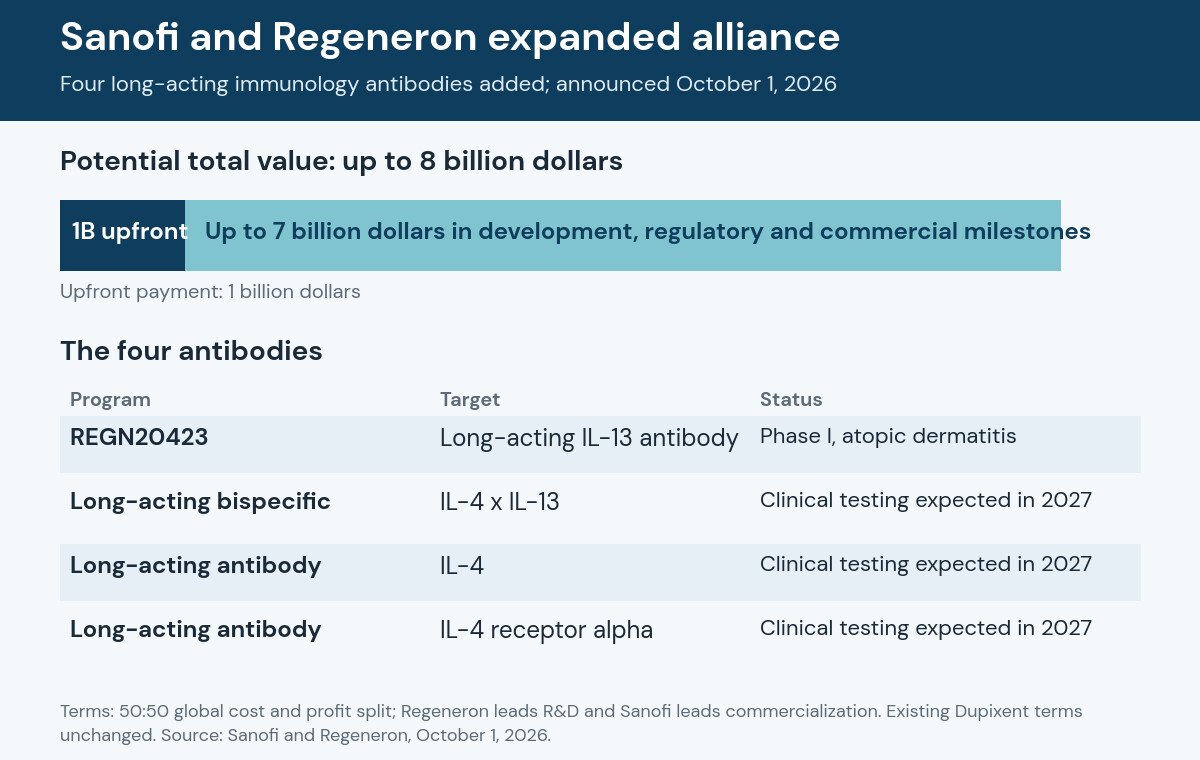
- Sanofi pays $1 billion upfront, with up to $7 billion in further milestone payments, so the deal could reach $8 billion.
- Four long-acting, Regeneron-invented antibodies join the alliance, targeting IL-13, IL-4xIL-13, IL-4 and IL-4 receptor alpha.
- Costs and any future profits are split 50:50 globally. Regeneron leads research and development, and Sanofi leads global commercialization.
- Only one candidate, REGN20423, is in clinical testing. The other three are expected to begin clinical studies in 2027.
- Existing Dupixent profit-sharing terms do not change, and the companies have settled their prior collaboration-related litigation.
What Is the Expanded Sanofi Regeneron Alliance?
The expanded Sanofi Regeneron alliance is a license and collaboration agreement that adds four long-acting antibodies to the companies’ 20-year-plus antibody partnership. The new medicines target the same type 2 inflammation pathways as Dupixent, which is used by more than 1.5 million people across nine indications, but are designed to last longer in the body.
Sanofi Regeneron Alliance Deal at a Glance
| Term | Detail |
|---|---|
| Upfront payment | $1 billion from Sanofi to Regeneron |
| Potential milestones | Up to $7 billion in development, regulatory and commercial payments |
| Combined potential value | Up to $8 billion |
| Cost and profit split | 50:50 globally for the new medicines |
| Research and development lead | Regeneron |
| Commercial lead | Sanofi |
| Existing Dupixent terms | Unchanged |
| Litigation | Prior collaboration-related litigation settled |
The $8 billion figure is the sum of the upfront payment and the maximum milestones, a total derived from the companies’ disclosed terms rather than a single amount stated in their release. Milestones are contingent, so Regeneron receives them only if the programs hit development, regulatory and commercial targets.
The Four New Antibodies in the Sanofi Regeneron Alliance
The lead asset is REGN20423, a long-acting IL-13 monoclonal antibody that is in a Phase I study in atopic dermatitis, according to Regeneron’s announcement. It is joined by a long-acting IL-4xIL-13 bispecific antibody and two further long-acting antibodies aimed at IL-4 and IL-4 receptor alpha. Reuters reported that the other three treatments are expected to begin clinical testing in 2027.
Regeneron will also have the option to add Sanofi’s lunsekimig, an investigational bispecific Nanobody therapy targeting TSLP and IL-13, once its Phase 3 trials in chronic obstructive pulmonary disease are complete.
How the Sanofi Regeneron Alliance Deal Is Structured
Regeneron will hold final decision-making authority on development, while Sanofi keeps final commercial decision rights, including pricing and market access, according to Sanofi’s CEO Belen Garijo as reported by Yahoo Finance. The companies will share development and commercialization costs equally, as well as any profits from the new products.
The agreement also resolves a dispute. Pharmaceutical Executive reported that the settled litigation followed allegations of restricted access to pharmacy benefit manager contracts and constraints on auditing Dupixent-related books and records.
Why Sanofi and Regeneron Struck the Deal
Dupixent is the engine of the alliance. It generated about 5.2 billion euros in global sales in the second quarter of 2026, and its patent protection is due to end in 2031, which makes a next generation of antibodies strategically important. Reuters reported that Sanofi called the deal a first step in rebuilding its pipeline before that loss of exclusivity.
Analysts framed the agreement as a win for Garijo, Sanofi’s new chief executive. Jefferies analyst Michael Leuchten said it signals a proactive focus on the key uncertainties investors face, and Barclays analysts noted that Garijo’s predecessor, Paul Hudson, had tried and failed to expand the partnership, Reuters reported. Regeneron’s chief scientific officer, George Yancopoulos, said combining Regeneron’s antibody discovery with Sanofi’s global reach could deliver the next wave of immunology innovation.
Risks and Open Questions for the Sanofi Regeneron Alliance
In our assessment, the headline value overstates near-term certainty. Most of the $8 billion is contingent on milestones, only one of the four antibodies is in the clinic, and none has yet shown efficacy data in patients. The new medicines will also need to show clear advantages over Dupixent and other treatments in type 2 inflammatory diseases before they can drive meaningful sales.
The companies have not disclosed dosing schedules, target indications beyond atopic dermatitis for the lead asset, or the timing and size of individual milestone payments. Those details will shape how much of the potential value is realized.
What the Sanofi Regeneron Alliance Means for Patients
Patients currently using Dupixent are not affected, because its terms are unchanged. The four new antibodies are experimental and are not available outside clinical trials. If they succeed, longer-lasting antibodies could reduce how often patients need injections, although dosing schedules for these candidates have not been disclosed. For related coverage of pharmaceutical partnerships and pipelines, read our reports on Sentynl’s alvelestat license deal with Mereo, Novo Nordisk’s pipeline sales target and the H1 and Novo Nordisk AI collaboration, or browse our pharmaceutical news.
Frequently Asked Questions About the Sanofi Regeneron Alliance
How much is the Sanofi Regeneron deal worth?
Sanofi will pay Regeneron $1 billion upfront and up to $7 billion in milestone payments, so the deal could be worth up to $8 billion.
Which antibodies are included in the expanded alliance?
REGN20423, a long-acting IL-13 antibody in Phase I for atopic dermatitis, plus a long-acting IL-4xIL-13 bispecific and long-acting antibodies targeting IL-4 and IL-4 receptor alpha.
How will costs and profits be shared?
Development and commercialization costs and any future profits from the new medicines will be split 50:50 globally. Regeneron leads research and development, and Sanofi leads global commercialization.
Does the deal change the Dupixent partnership?
No. The companies said the existing Dupixent profit-sharing terms remain unchanged.
Did Sanofi and Regeneron settle their litigation?
Yes. The companies said they have settled their prior collaboration-related litigation as part of the agreement.
How we reported this: this article is based on the Sanofi and Regeneron announcements, Reuters coverage and trade reports linked above. The $8 billion total is a sum of disclosed upfront and maximum milestone amounts. Last updated October 2, 2026. It is for information only and is not investment or medical advice.