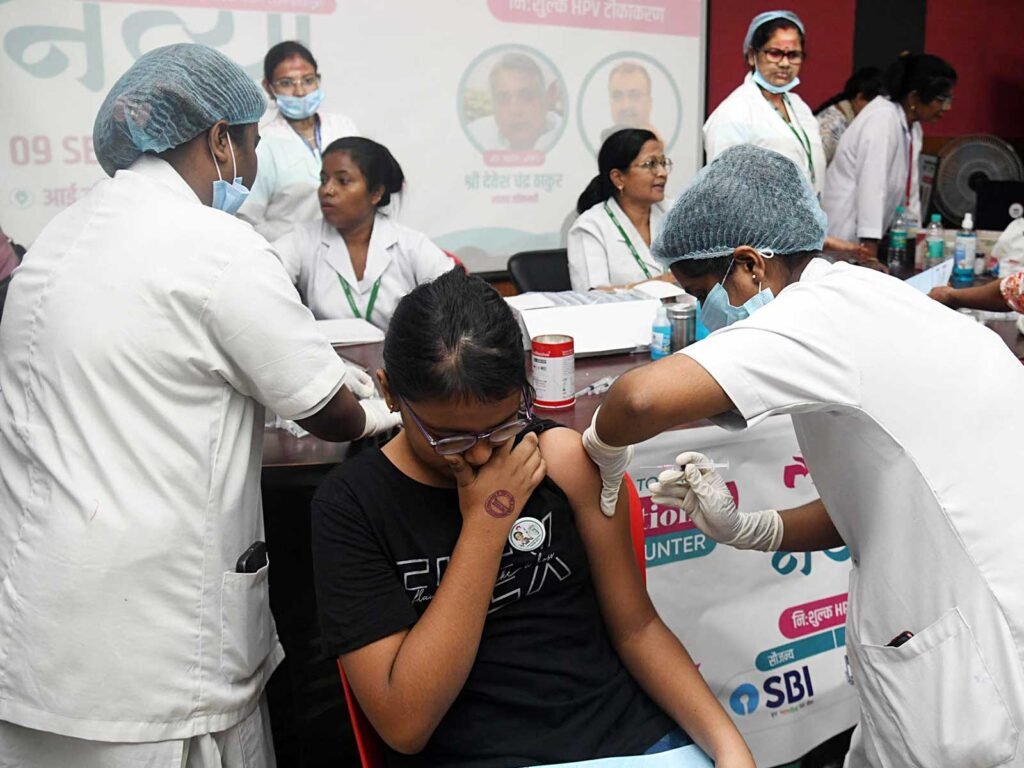

India has administered more than 80 lakh, or 8 million, doses of the Human Papillomavirus vaccine since the launch of its National HPV Vaccination Campaign in February 2026, marking a major step in the country’s efforts to strengthen prevention against cervical cancer. The programme is being delivered through the public health system and targets adolescent girls across states and Union Territories.
Key takeaways: HPV Vaccine
- The national campaign was launched by Prime Minister Narendra Modi in February 2026, with the government offering voluntary, single-dose HPV vaccination free of charge to 14-year-old girls at government health facilities.
- According to 2021 estimates from the Registrar General of India, around 1.2 crore girls form the annual cohort of 14-year-olds eligible to benefit from the programme.
- Gujarat, Uttar Pradesh, Madhya Pradesh and Mizoram have reported 100% coverage of their identified target populations, while Bihar, Andhra Pradesh and Assam have crossed 90%.
The national campaign was launched by Prime Minister Narendra Modi in February 2026, with the government offering voluntary, single-dose HPV vaccination free of charge to 14-year-old girls at government health facilities. Vaccination is provided with parental consent, giving families access to preventive care without the cost barrier associated with privately delivered immunisation.
The progress comes as governments and healthcare systems increasingly place prevention alongside cervical cancer treatment in efforts to reduce the burden of the disease. According to 2021 estimates from the Registrar General of India, around 1.2 crore girls form the annual cohort of 14-year-olds eligible to benefit from the programme. Reaching this population through routine public health infrastructure could have long-term implications for cancer prevention in India.
States Expand HPV Vaccination Through Public Health Networks
The national vaccination figures have been supported by strong implementation across several states. Gujarat, Uttar Pradesh, Madhya Pradesh and Mizoram have reported 100% coverage of their identified target populations, while Bihar, Andhra Pradesh and Assam have crossed 90%. Karnataka has exceeded 85% coverage, and Chhattisgarh, Sikkim, Kerala, Telangana and Odisha have moved beyond 60%.
Uttar Pradesh has recorded the largest number of vaccinations among individual states, with more than 22 lakh adolescent girls receiving the HPV vaccine under the campaign. The scale of the state’s programme highlights the importance of state-level health systems in translating a national vaccination policy into large-scale delivery.
Madhya Pradesh and Gujarat have also reached full coverage of their identified cohorts, supported by sustained mobilisation and coordination between health authorities and field teams. Progress in Assam and other northeastern states demonstrates how local health networks can be used to extend vaccination services across areas with different geographic and logistical conditions.
The implementation has relied on more than simply making vaccines available at government facilities. District health teams have worked with communities to identify eligible girls and encourage participation, including in rural, urban, remote and geographically difficult locations.
Community communication has become another important part of the campaign. Parents, teachers, healthcare professionals and frontline health workers have been involved in providing information about HPV vaccination and responding to concerns. Paediatricians, gynaecologists and specialists associated with institutions including AIIMS have supported awareness activities, while ASHAs and ANMs have played a role in reaching families at the community level.
This approach is particularly relevant for adolescent vaccination, where parental understanding and consent can influence uptake. Providing information through trusted local healthcare and education networks can help address questions surrounding vaccine safety and effectiveness while reducing the impact of misinformation.
The campaign’s progress also has implications for the broader cancer prevention ecosystem. Cervical cancer places a significant burden on healthcare systems, requiring diagnosis, treatment and long-term patient care. Preventing HPV infection in the first place can reduce future demand for cervical cancer treatment and other medical interventions associated with advanced disease.
Digital Monitoring Supports India’s National Vaccination Drive
Technology is playing a supporting role in the programme through U-WIN, India’s digital platform for vaccination management. The system enables programme managers to monitor coverage at the district level and identify areas where eligible beneficiaries may have been missed.
For a programme operating across a population as large and geographically diverse as India, timely information on vaccination performance can help health authorities identify gaps and direct resources where they are most needed. Digital monitoring can also support more structured planning as states continue efforts to reach their respective target populations.
The national programme builds on a substantial body of international experience with HPV vaccination. More than 800 million HPV vaccine doses have been distributed globally, providing extensive real-world experience regarding their use and safety.
Adoption has also expanded well beyond high-income countries, where HPV vaccination programmes were initially concentrated. According to the figures cited by the government, 87% of upper-middle-income countries, 78% of lower-middle-income countries and 54% of low-income countries have now incorporated HPV vaccines into their national immunisation programmes.
India’s programme therefore represents part of a wider international shift toward HPV vaccination as a public health measure for preventing cervical cancer. The country’s large adolescent population gives the initiative considerable potential scale, while its public healthcare network provides an established channel for reaching eligible beneficiaries.
From a healthcare industry perspective, the campaign also illustrates the growing emphasis on preventive interventions in cancer care. While screening, diagnosis and cervical cancer treatment remain essential for individuals who develop the disease, vaccination offers an opportunity to reduce risk before cancer becomes a clinical concern.
Maintaining high coverage will remain important as India moves beyond the initial momentum of the programme. Continued community engagement, reliable vaccine availability, accurate digital tracking and cooperation among health workers, schools, parents and healthcare professionals will determine how effectively the campaign reaches successive cohorts of eligible girls.
The administration of more than 8 million doses represents a significant early milestone. With around 1.2 crore girls entering the target age group each year, the programme has a continuing opportunity to establish HPV vaccination as a routine component of India’s cancer prevention strategy and potentially reduce the future burden placed on cervical cancer treatment services.
Ref: https://www.pib.gov.in/PressReleasePage.aspx?PRID=2309109®=48&lang=2
Related reading: