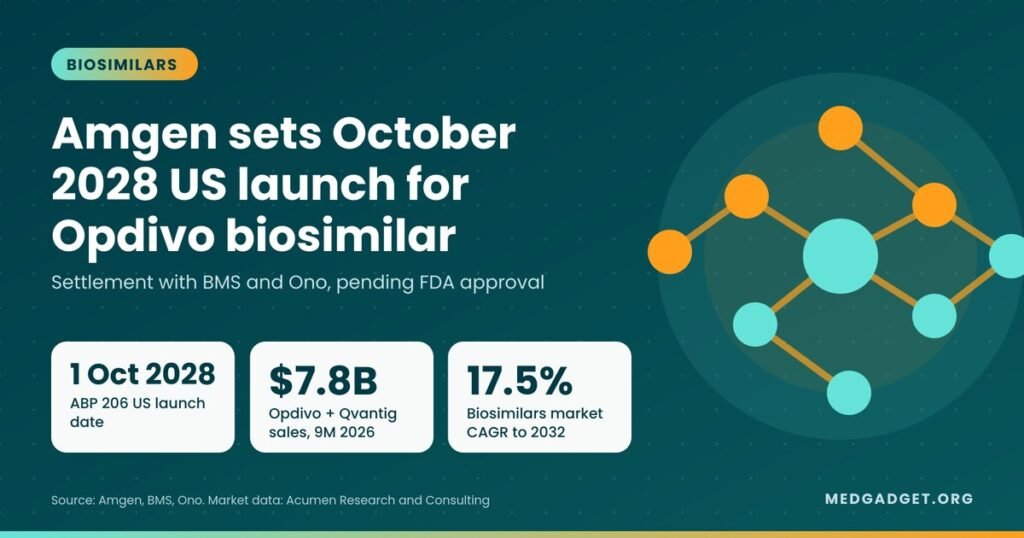

The first Opdivo biosimilar now has a US launch date: Amgen said on 24 November 2026 that it settled patent litigation with Bristol Myers Squibb (BMS) and Ono Pharmaceutical, clearing its nivolumab copy, ABP 206, to reach American patients on 1 October 2028, provided the FDA approves it first. The agency is expected to act on Amgen’s application before the end of 2026. Settlement terms are confidential.
Opdivo is one of the most widely used cancer immunotherapies in the world, prescribed for lung, skin, kidney, bladder, oesophageal and other cancers. A fixed date for cheaper competition matters to hospitals, insurers and patients who pay a share of infusion costs, and it sets the clock for one of the largest biologic patent cliffs of the decade.
Key takeaways on Opdivo biosimilar
- Amgen’s ABP 206 can launch in the US on 1 October 2028, subject to FDA approval.
- The FDA is due to decide on the ABP 206 biologics license application by the end of 2026.
- Ono says it will keep collecting US Opdivo royalties from BMS until at least 2036, at 2% to 4% depending on how much biosimilars take.
- The biosimilar copies the intravenous drip; BMS is moving patients to Opdivo Qvantig, an under-the-skin version with separate patent protection.
- Sandoz, Celltrion, mAbxience and Intas/Xbrane also have Opdivo biosimilars in late-stage testing, so more competitors may follow.
What the settlement actually decides
Amgen had been fighting BMS and Ono in US court over patents that could have kept ABP 206 off the market for longer. The Amgen announcement filed with the SEC says the deal lets it launch before patents that could otherwise have been asserted expire. In exchange, Amgen accepts a fixed entry date rather than risking a court loss or an at-risk launch.
Two points are easy to misread. First, the date is permission, not approval: ABP 206 still needs FDA sign-off. Second, the date applies to Amgen. Other developers are not covered and would need their own route through the patents or their own settlements.
How much money is at stake
Opdivo remains a blockbuster even after a decade on the market. Figures reported by pharmaphorum for the first nine months of 2026 show the scale:
| Product (Jan to Sep 2026) | Global sales | US sales |
|---|---|---|
| Opdivo (intravenous) | About $7.0 billion | Almost $4.0 billion |
| Opdivo Qvantig (subcutaneous) | $758 million | $587 million |
| Combined, by our calculation | About $7.8 billion | About $4.6 billion |
| Share of BMS total revenue | Around 21% | |
The intravenous version, the one ABP 206 copies, still accounts for the overwhelming majority of sales. That is why the October 2028 date is so important for BMS planning, and why the company is pushing hard to convert prescribers to Qvantig before then.
Will patients actually pay less?
Probably, but not overnight. Biosimilars of oncology antibodies such as trastuzumab (Herceptin) and bevacizumab (Avastin) took market share steadily once launched in the US, and list prices for the originals came down as competition grew. For an infused cancer drug, the savings usually show up first for hospitals and insurers, then for patients with coinsurance tied to the drug’s price.
There is a catch. If many patients have already switched to the subcutaneous Opdivo Qvantig by late 2028, the pool of intravenous use that a biosimilar can directly replace will be smaller. Biosimilar uptake will depend on how hospitals, oncologists and payers weigh the convenience of a shorter injection against the lower price of a drip.
Medicare pricing is a separate track. Readers following US drug costs can see how negotiated prices are reshaping other brands in our report on Medicare negotiated drug prices for 2028.
Ono’s royalty stream and the Japanese angle
Ono co-discovered nivolumab and earns royalties on Opdivo sales outside Japan, South Korea and Taiwan. In its own statement, summarised by Tokyo Brief, Ono said it will keep receiving royalties from BMS on US sales through at least 2036, including after biosimilars arrive, at a rate between 2% and 4% depending on biosimilar penetration. Ono said the settlement does not change its forecast for the year ending March 2027.
Keytruda is next in line
Amgen has also filed a biosimilar of Merck’s Keytruda (pembrolizumab), the world’s top-selling medicine, which is expected to lose key US patent protection in 2028 as well. Keytruda and its subcutaneous form Keytruda Qlex brought in about $25 billion in the first nine months of 2026, by our calculation from reported figures. Formycon with Zydus and Samsung Bioepis are among the rivals racing Amgen to the first FDA approval. Together, the two PD-1 antibodies make 2028 a turning point for cancer drug spending.
Market context: biosimilars growth
According to Acumen Research and Consulting, the global biosimilars market was worth about USD 26.7 billion in 2023 and is projected to reach USD 113.2 billion by 2032, a compound annual growth rate of 17.5%. Acumen says North America held the largest share, while Asia-Pacific is growing fastest. The figures use a 2023 base year and should be read as indicative; they predate the PD-1 settlements, which could add a large new category to the market.
What to watch next
- FDA decision on ABP 206 by the end of 2026, including whether it is labelled interchangeable.
- Other settlements from Sandoz, Celltrion and others that could set their own entry dates.
- Qvantig conversion rates reported in BMS quarterly results.
- Keytruda biosimilar approvals and Merck’s own patent fights over Keytruda Qlex.
Opdivo biosimilar FAQ
When will an Opdivo biosimilar be available in the US?
Amgen’s ABP 206 can launch on 1 October 2028 under the settlement, but only if the FDA approves it. Approval is expected to be decided by the end of 2026.
Is a biosimilar the same as a generic?
Not exactly. Biologics like nivolumab are made in living cells, so copies cannot be identical. A biosimilar must show no clinically meaningful differences in safety, purity and potency from the original.
Will the biosimilar replace Opdivo Qvantig?
No. ABP 206 copies the intravenous infusion. Opdivo Qvantig, the under-the-skin version, has separate patents and is not affected by this settlement.
Should patients switch now?
No biosimilar is available yet. Any future switch is a decision for the treating oncologist and the patient’s insurer.
Sources: Amgen news release (24 November 2026, SEC Form 8-K exhibit), Ono Pharmaceutical statement via Tokyo Brief, sales figures via pharmaphorum. Market data: Acumen Research and Consulting. More in our Pharmaceutical section and our report on Teva and Samsung Bioepis biosimilars. This article is not medical or investment advice. Last updated 26 November 2026.