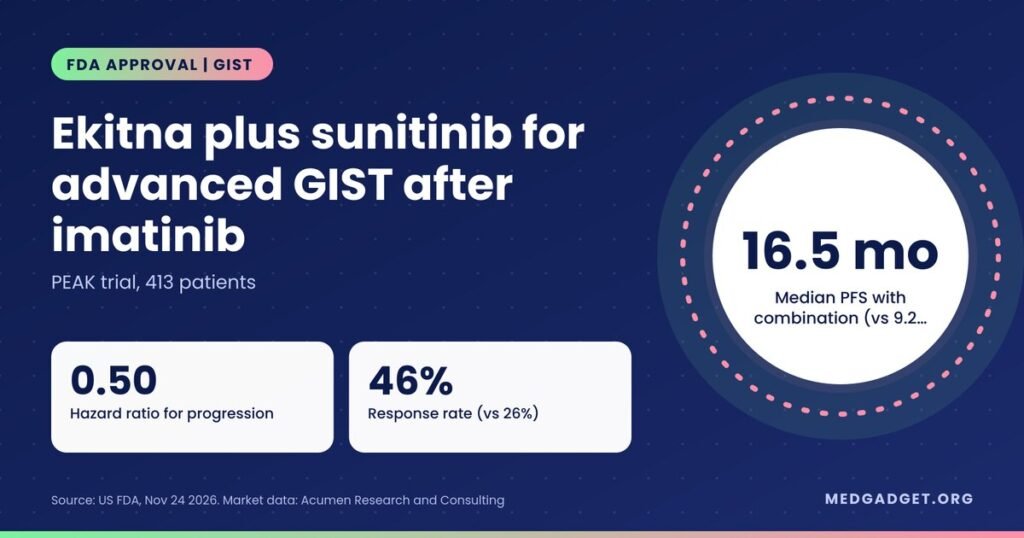

The Ekitna GIST approval came on November 24, 2026, when the US Food and Drug Administration cleared Cogent Biosciences’ bezuclastinib, taken with sunitinib, for adults with advanced gastrointestinal stromal tumors (GIST) who have already been treated with imatinib. In the 413-patient PEAK trial, the combination kept the disease in check for a median of 16.5 months, against 9.2 months for sunitinib alone, according to the FDA announcement.
Key takeaways on the Ekitna GIST approval
- Ekitna (bezuclastinib) is approved only in combination with sunitinib, for adults with advanced GIST after prior imatinib.
- Median progression-free survival rose from 9.2 to 16.5 months, a hazard ratio of 0.50 (half the risk of progression or death).
- Tumors shrank meaningfully in 46% of patients on the combination versus 26% on sunitinib alone.
- The label carries a boxed warning for liver toxicity; overall survival data were not yet mature.
- The FDA used priority review, breakthrough therapy and orphan drug designations, and its Real-Time Oncology Review pilot.
Why second-line GIST needed a better option
GIST is a rare sarcoma that usually starts in the stomach or small intestine and is driven, in most patients, by mutations in the KIT gene. Imatinib transformed treatment two decades ago, but tumors typically find a way around it by picking up new KIT mutations. Sunitinib has long been the standard next step, yet it covers only part of that mutational landscape, and most patients progress within the first year.
Bezuclastinib is a selective KIT inhibitor designed to hit the resistance mutations sunitinib tends to miss, particularly in the activation loop of the protein. Pairing the two drugs aims to cover both major classes of escape mutation at once, rather than switching drugs one at a time as resistance appears.
PEAK trial results at a glance
PEAK was a randomized, open-label, international study. Patients took either bezuclastinib plus sunitinib or sunitinib alone, once daily, until their disease progressed. Those on sunitinib alone could cross over to the combination after progression. The primary endpoint was progression-free survival (PFS) judged by blinded independent central review.
| Measure | Bezuclastinib + sunitinib | Sunitinib alone |
|---|---|---|
| Patients randomized (total) | 413 | |
| Median PFS | 16.5 months (95% CI 13.8 to 19.2) | 9.2 months (95% CI 7.2 to 11.0) |
| Hazard ratio for PFS | 0.50 (95% CI 0.39 to 0.65), p<0.0001 | |
| Objective response rate | 46% | 26% |
| Overall survival | Not mature at the PFS analysis | |
By our calculation, the combination added a median 7.3 months without progression, a gain of roughly 79% over sunitinib alone, and lifted the response rate by 20 percentage points. That size of benefit is notable in a pretreated, resistant population where incremental gains of a few months are more typical.
Safety: the liver warning patients should know about
Adding a second kinase inhibitor brings extra side effects. The label carries a boxed warning for hepatotoxicity, so liver tests will be a routine part of treatment, and it also warns about harm to an unborn baby. The most common side effects, seen in at least 20% of patients, included diarrhea, raised liver enzymes, high blood pressure, taste changes, nausea, hair colour changes, fatigue, abdominal pain, vomiting, reduced appetite, mouth sores, reflux, rash, indigestion and fever.
The most frequent severe (grade 3 or 4) laboratory abnormalities were raised ALT, a liver enzyme, and falls in white blood cells, neutrophils, lymphocytes and haemoglobin. Many of these overlap with sunitinib’s own profile, which oncologists already manage, but the liver signal is the one to watch most closely. Dosing decisions belong with the treating oncologist and the prescribing information.
What remains unknown
- Survival. Overall survival was immature, and crossover from the control arm may make any survival difference harder to show.
- Which mutations benefit most. Subgroup results by KIT mutation type will help doctors decide who gains the most from adding bezuclastinib.
- Price and access. Cogent has not disclosed a list price in the materials we reviewed, and patients will pay for two oral cancer drugs rather than one.
- Outside the US. No European or Indian regulatory decisions have been announced.
Market context for sarcoma therapies
GIST is classed among the soft tissue sarcomas. In its sarcoma market report, Acumen Research and Consulting notes that current care relies heavily on cytotoxic drugs with significant side effects and poor tolerance, and expects North America and hospitals to account for the largest revenue shares. That report was last updated in 2021, so its view is dated and indicative, but the unmet need it describes is the gap targeted therapies such as Ekitna are trying to close.
What comes next for bezuclastinib
GIST is the first of three potential FDA decisions for the drug. Trade press citing Cogent’s third-quarter update reports target action dates of December 30, 2026 for non-advanced systemic mastocytosis and June 29, 2027 for advanced systemic mastocytosis, both driven by the KIT D816V mutation. Cogent chief executive Andrew Robbins said the company’s commercial team is in place to launch in GIST. Readers following other recent cancer approvals can also see our coverage of Roche’s Wilserdly in early breast cancer, and more news in our Pharmaceutical section.
FAQ
What is Ekitna approved for?
Ekitna (bezuclastinib) is approved in the US with sunitinib for adults with advanced gastrointestinal stromal tumors who have previously received imatinib.
How much longer does bezuclastinib plus sunitinib control GIST?
In the PEAK trial, median progression-free survival was 16.5 months with the combination versus 9.2 months with sunitinib alone.
What are the main side effects of Ekitna?
The label has a boxed warning for liver toxicity. Common side effects include diarrhea, raised liver enzymes, high blood pressure, taste changes, nausea and fatigue.
Does Ekitna help people with GIST live longer?
That is not yet known. Overall survival data were not mature when the FDA reviewed the progression-free survival results.
Sources: US FDA; Cogent Biosciences statements as reported by PharmExec and Reuters. Market context: Acumen Research and Consulting sarcoma market report. This article is for information only and is not medical or investment advice. Last updated November 24, 2026.