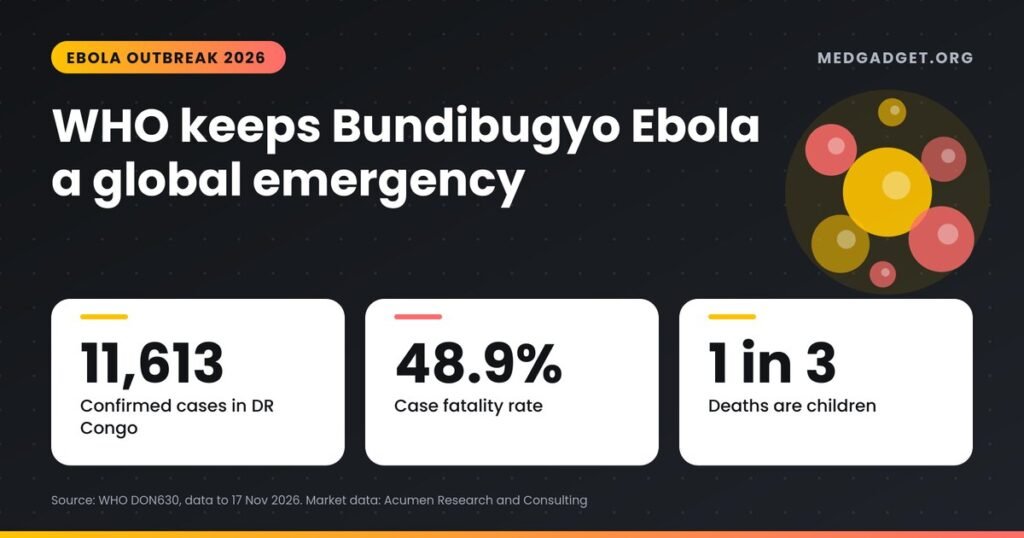

The Ebola outbreak 2026 remains a public health emergency of international concern, the World Health Organization confirmed on 20 November, after its emergency committee met for a third time on 17 November and Director-General Tedros Adhanom Ghebreyesus ruled the next day that the declaration should stay. The Bundibugyo virus epidemic in the Democratic Republic of the Congo (DRC) had reached 11,613 confirmed cases and 5,678 deaths by 17 November, and US CDC figures dated 20 November put the multi-country total at 11,793 cases and 5,779 deaths. WHO now describes it as the largest Ebola outbreak ever recorded in the DRC, and children are carrying a disproportionate share of the deaths.
Key takeaways on the Ebola outbreak 2026
- WHO kept the global emergency (PHEIC) in place on 18 November, six months after the outbreak was declared in May.
- Confirmed cases in the DRC rose by 945 and deaths by 480 between WHO’s 6 and 17 November updates, roughly 86 cases and 44 deaths a day by our calculation.
- Children make up more than a quarter of confirmed cases and a third of deaths; seven in ten confirmed cases in children under five have died, according to WHO.
- Kenya (9 cases, 2 deaths) and Nigeria (1 imported case) are in 42-day countdowns with no new cases; WHO rates their risk as high but contained.
- There is still no approved vaccine or specific drug for Bundibugyo virus. Ervebo and two Bundibugyo-specific candidates are being tested in the DRC, with vaccine results expected in early 2027.
Why WHO kept the emergency declaration
An emergency declaration under the International Health Regulations is not a ranking of how frightening a disease is. It is a signal that an event threatens other countries and needs a coordinated international response. In Disease Outbreak News 630, WHO set out why that test is still met: between 400 and 500 new cases are confirmed each week, 48 of 68 affected health zones reported at least one case in the past 21 days, and contact follow-up averaged 81% against a 95% target.
Insecurity is the single largest obstacle, the agency says. In his opening remarks to the committee, Tedros described an armed attack in Ituri that killed 66 civilians, including three health workers, and caused more than 1,000 contacts to be lost to follow-up. Two-thirds of confirmed deaths still happen in the community rather than in treatment centres, which means many patients are not reaching care and their funerals and households remain transmission points.
Where the virus is spreading now
The epidemic is concentrated in two eastern provinces, but the momentum has shifted. Ituri still holds most of the cumulative burden, yet its three-week case count fell 13%, while Nord-Kivu rose 8% over 21 days and 40% in the latest week alone. The newest affected health zone is Watsa in Haut-Uele.
| Province (DRC) | Confirmed cases | Deaths | Fatality rate | Cases in last 21 days |
|---|---|---|---|---|
| Ituri | 7,946 | 3,751 | 47% | 668 (down 13%) |
| Nord-Kivu | 2,996 | 1,654 | 55% | 635 (up 8%) |
| Haut-Uele | 534 | 231 | 43%* | 90 (up 13%) |
| Tshopo | 109 | 35 | 32%* | 20 (down 47%) |
| DRC total | 11,613 | 5,678 | 48.9% | 1,417 |
Outside the DRC, the picture is more reassuring. Kenya’s nine cases all trace back to one imported patient and include four health workers; its last patient was discharged on 11 November and all 135 contacts finished monitoring. Nigeria’s single case in Abuja was evacuated to Geneva and has recovered. Uganda and France controlled their clusters months ago. Our earlier report on the Abuja case and contact tracing explains how those countdowns work.
Why children are dying at such high rates
“Children are paying a terrible price,” Tedros told the committee. The numbers behind that line are stark: more than one in four confirmed cases are children, and they account for one in three deaths. Young children dehydrate quickly, are often cared for at home by relatives who are themselves infected, and depend on routine services such as vaccination and malaria care that collapse when clinics close or staff are redeployed. WHO is urging governments and donors to protect those primary services alongside the Ebola response, because deaths from measles, malaria and malnutrition tend to climb during long outbreaks.
Vaccines and treatments: what is being tested
Bundibugyo is a different species from the Zaire ebolavirus that caused the 2014 West Africa epidemic, so the tools built for that strain are not proven here. Merck’s Ervebo is licensed only for Zaire ebolavirus, and the monoclonal antibody treatments approved in 2020 also target Zaire. That is why this response is running as a series of trials:
- Tumaini ring-vaccination trial: led by the DRC’s INRB and funded by CEPI, it is evaluating Ervebo and will add two Bundibugyo-specific candidates, ChAdOx1 (University of Oxford with Serum Institute of India) and Moderna’s mRNA-1469, once national approvals are in place, according to WHO.
- PARTNERS treatment trial: tests the antibody MBP134, remdesivir, or both, with maftivimab to be added. More than 900 patients have been enrolled.
- Post-exposure prophylaxis: a study of Gilead’s oral antiviral obeldesivir in contacts is under way; see our report on Gilead’s generic licences for obeldesivir.
WHO expects early treatment findings in the coming months and vaccine results in early 2027. Until then, care relies on supportive treatment, early isolation and safe burials.
Travel rules and risk outside Africa
WHO advises against travel and trade bans and rates the risk to countries with strong response capacity as low. The United States has gone further than WHO advice: according to the CDC, people who have been in the DRC within the past 21 days cannot board commercial flights to the US, and since 3 November all international passengers must attest that they have not been there. CDC says no US cases have been confirmed and the risk to the American public is low. It advises against all travel to Ituri and Nord-Kivu.
Market context: infectious disease spending
Outbreaks like this one push governments and funders toward faster diagnostics, stockpiles and platform vaccines. Acumen Research and Consulting sizes the global infectious disease market at USD 26.4 billion in 2022, rising to USD 50.7 billion by 2032 at a 6.9% compound annual growth rate, with Asia-Pacific the fastest-growing region. Those figures cover the wider sector rather than Ebola specifically, and the report was last updated in January 2024.
What to watch next
WHO says updated temporary recommendations will follow shortly. The key markers are whether Nord-Kivu’s weekly rise slows, whether contact follow-up reaches 95%, whether Kenya completes its 42-day countdown (around 23 December by our calculation) and when the Bundibugyo-specific vaccines start dosing. More coverage is in our healthcare services section and our earlier piece on the outbreak passing 11,000 cases.
FAQ
Is the Ebola outbreak still a global health emergency?
Yes. WHO’s Director-General decided on 18 November 2026, after the third emergency committee meeting, that the Bundibugyo virus epidemic remains a public health emergency of international concern.
How many people have died in the 2026 Ebola outbreak?
WHO counted 5,678 deaths among 11,613 confirmed cases in the DRC as of 17 November. CDC’s 20 November tally across all countries was 5,779 deaths and 11,793 cases.
Is there a vaccine for Bundibugyo Ebola?
Not an approved one. Ervebo protects against Zaire ebolavirus and is being trialled against Bundibugyo, and two strain-specific candidates are joining the Tumaini trial. Results are expected in early 2027.
Has Ebola reached the United States?
No US case has been confirmed, according to CDC, which rates the risk to the public as low while keeping entry restrictions for travellers from the DRC.
Sources: WHO Disease Outbreak News DON630 (20 Nov 2026), WHO Director-General remarks (17 Nov 2026), WHO vaccine trial update (4 Nov 2026), US CDC situation summary (updated 23 Nov 2026). Market data: Acumen Research and Consulting. This article is for information only and is not medical advice. Last updated 24 November 2026.