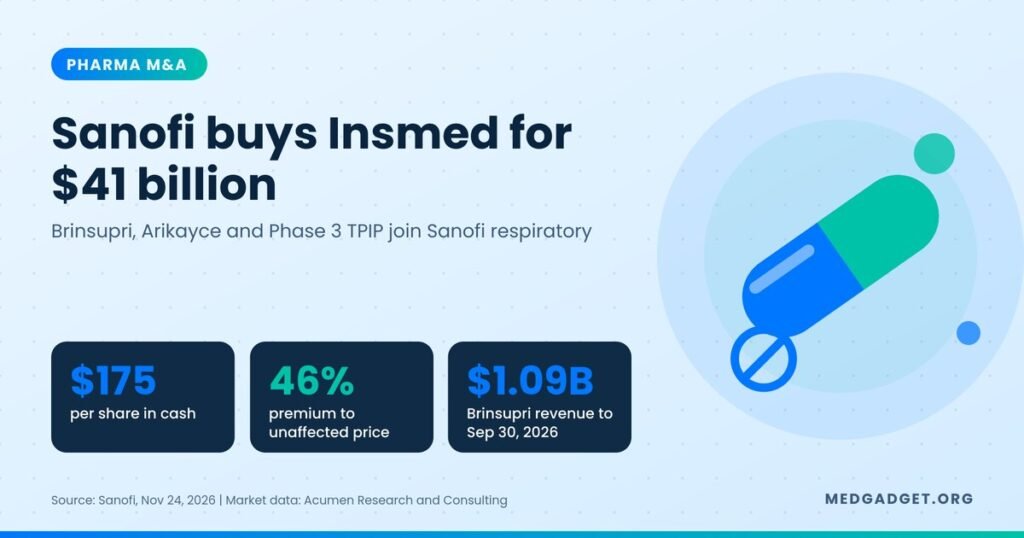

The Sanofi Insmed acquisition is now official: on November 24, 2026, Sanofi agreed to buy Insmed for $175 per share in cash, a total equity value of about $41.0 billion (€37.6 billion). The deal hands Sanofi Brinsupri (brensocatib), the first approved pill for non-cystic fibrosis bronchiectasis, plus the inhaled antibiotic Arikayce and a Phase 3 inhaled treprostinil program, and is expected to close in the first half of 2027.
Key takeaways on the Sanofi Insmed acquisition
- Price: $175 per Insmed share in cash, roughly 46% above the unaffected close on November 18, 2026, the day before media reports of talks.
- Main prize: Brinsupri, a once-daily oral DPP1 inhibitor that has generated $1.09 billion in revenue through September 30, 2026, after its US launch in August 2025.
- Also included: Arikayce for refractory MAC lung disease ($433.8 million in 2025 sales) and TPIP, a once-daily inhaled prostanoid in Phase 3 for pulmonary hypertension and lung fibrosis.
- Financing: debt plus cash on hand, with committed financing secured; Sanofi expects the deal to add to business EPS by the end of 2028.
- Timing: needs Insmed shareholder and antitrust approvals; closing targeted for the first half of 2027, with no change to Sanofi’s 2026 guidance.
The deal in numbers
| Item | Detail |
|---|---|
| Offer price | $175.00 per share, all cash |
| Equity value | About $41.0 billion (€37.6 billion) |
| Premium | About 46% to the November 18, 2026 close |
| Implied unaffected price | About $120 per share (by our calculation) |
| Brinsupri revenue | $1.09 billion through September 30, 2026 |
| Arikayce revenue | $433.8 million in 2025, up 19% |
| Expected close | First half of 2027 |
| Advisers | J.P. Morgan and Cravath for Sanofi; Goldman Sachs and Freshfields for Insmed |
Why Brinsupri is the centre of the deal
Bronchiectasis is a chronic lung disease in which the airways become permanently widened, trapping mucus and causing daily cough and repeated flare-ups. Before Brinsupri, patients without cystic fibrosis had no approved drug aimed at the disease itself, only airway clearance, antibiotics and anti-inflammatory workarounds. Brinsupri blocks dipeptidyl peptidase 1, an enzyme that switches on neutrophil serine proteases, the destructive enzymes released by white blood cells in inflamed airways.
The drug is approved in the US, EU, UK and Japan, though labels differ: in the US and Japan it covers adults and children aged 12 and older, while Europe and the UK limit it to patients aged 12 and older with at least two exacerbations in the past year. Insmed estimates about 500,000 diagnosed patients in the US, 600,000 across the five largest European markets and 150,000 in Japan. Reaching blockbuster revenue in a little over a year is unusual for a respiratory launch, and that early trajectory is what Sanofi is paying for. The label also carries warnings on skin reactions and gum and periodontal problems, so patients are advised to have regular dental care.
What Sanofi gets beyond its lead drug
Arikayce is a once-daily liposomal amikacin inhaled through a nebuliser and is the only inhaled therapy specifically approved for treatment-refractory MAC lung disease in the US, EU and Japan. Its US approval is accelerated, based on sputum culture conversion, and carries a boxed warning for respiratory reactions, so its broader future depends partly on an FDA review, accepted under priority review in September, for use earlier in a combination regimen.
TPIP, a dry-powder prodrug of treprostinil, is the long-dated bet. It is in Phase 3 in pulmonary arterial hypertension (PALM-PAH), pulmonary hypertension tied to interstitial lung disease (PALM-ILD) and progressive pulmonary fibrosis (PALM-PPF), with an idiopathic pulmonary fibrosis study planned for the first half of 2027. It is not approved anywhere, and Sanofi frames it as a growth driver beyond 2030.
Our analysis: a big cheque with a clear logic
The price is more than four times the up to $9.5 billion Sanofi agreed to pay for Blueprint Medicines in 2025, and it signals a shift from bolt-on deals to a transformative bet. The logic is portfolio fit. Sanofi already sells Dupixent in COPD and asthma, so it has respiratory sales teams calling on the same pulmonologists who treat bronchiectasis. CEO Belen Garijo described the deal as “a major strategic step” for mid- and long-term growth. The main risks are concentration and competition: much of the value rests on one young product, and other DPP1 inhibitors are in development. Investors will also watch how quickly Sanofi can pay down the new debt while keeping its progressive dividend and credit rating, both of which it says it will protect. Readers following Sanofi’s dealmaking can compare this with its expanded Regeneron immunology alliance.
Market context for inhaled respiratory medicines
Two of the three assets are inhaled. According to Acumen Research and Consulting, the global inhalable drugs market was projected to grow at about 6.4% a year from 2019 to 2026, with respiratory diseases the largest application, dry powder formulations the leading type and North America the biggest region. That report was last updated in January 2020, so treat its figures as indicative; the finding that dry powders dominate is still relevant to TPIP, which uses that format.
What to watch next
- The Insmed shareholder vote and US antitrust review, which set the path to a first-half 2027 close.
- The FDA decision on the expanded Arikayce application under priority review.
- Brinsupri quarterly sales and any new label expansions outside bronchiectasis.
- Phase 3 readouts for TPIP, the asset that has to carry growth into the 2030s.
Read the full Sanofi announcement, or browse more pharmaceutical news.
FAQ
How much is Sanofi paying for Insmed?
Sanofi is paying $175 per share in cash, about $41.0 billion in total equity value, a premium of roughly 46% to Insmed’s unaffected share price.
What is Brinsupri used for?
Brinsupri (brensocatib) is a once-daily pill for non-cystic fibrosis bronchiectasis. It is the first approved treatment for the condition and works by blocking the DPP1 enzyme that drives neutrophil-led airway inflammation.
When will the Sanofi Insmed deal close?
Sanofi expects closing in the first half of 2027, subject to Insmed shareholder approval and US and other regulatory clearances.
Will patients notice any change?
Not immediately. Insmed keeps selling its medicines until the deal closes. Both companies say the combination should widen global access over time, but no pricing or availability changes have been announced.
Sources: Sanofi and Insmed announcement (November 24, 2026). Market data: Acumen Research and Consulting, Inhalable Drugs Market report (dated, indicative). This article is not medical or investment advice. Last updated: November 24, 2026.