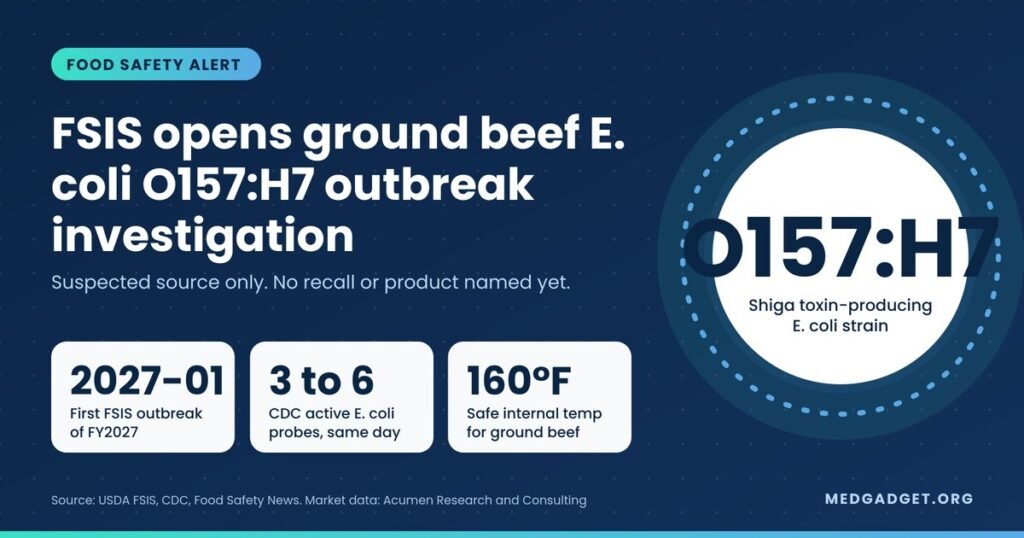

A new ground beef E. coli outbreak investigation has been opened by the USDA’s Food Safety and Inspection Service (FSIS), which listed ground beef as the suspected source of an E. coli O157:H7 outbreak on its public investigations table, as reported on 20 November 2026. The entry, numbered 2027-01, is the first of FSIS’s 2027 fiscal year and the first ground beef O157 outbreak the agency has listed since late 2024. So far FSIS has published no case count, no affected states, no brand and no recall.
Key takeaways on the ground beef E. coli outbreak
- FSIS lists the outbreak as active, with illnesses beginning in October 2026 and ground beef marked as “suspect”, meaning the link is not yet confirmed.
- No recall or public health alert has been issued, and no product, store or lot has been named.
- On the same morning, CDC’s multistate outbreak count rose from 26 to 27 and its E. coli investigations from three to six, though no notice ties those changes to this file.
- The last comparable case, in November 2024, ended in a recall of 167,277 pounds of ground beef after 15 illnesses in Minnesota.
- Cooking ground beef to 160°F (71°C), checked with a thermometer, kills E. coli O157:H7.
What FSIS has confirmed, and what it has not
FSIS posts an outbreak to its investigations table when it is working with CDC and state health departments on illnesses that may be tied to meat, poultry or egg products it regulates. Listing a product as “suspect” means investigators have a working hypothesis, usually from patient interviews, but traceback has not yet tied illnesses to a specific producer or lot. That is why no recall exists: FSIS normally needs product evidence before asking a company to pull food from shelves.
| Detail | Status as of 20 Nov 2026 |
|---|---|
| Pathogen | E. coli O157:H7 |
| Suspected food | Ground beef (suspect, not confirmed) |
| FSIS investigation number | 2027-01 |
| Outbreak month | October 2026 |
| Illnesses, hospitalisations, deaths | Not published |
| States affected | Not published |
| Brand, retailer or lot | Not named |
| Recall or public health alert | None issued |
The thin disclosure has drawn criticism. Seattle food safety attorney Bill Marler told Food Safety News that if traceback has not reached a lot, FSIS should “say that, so the word suspect carries its honest meaning.” Consumers, in other words, currently have an outbreak to be aware of but no specific product to check in their freezer.
How this compares with recent beef outbreaks
The previous ground beef O157:H7 entry on the FSIS table dates to November 2024, when Minnesota linked 15 illnesses to ground beef and Wolverine Packing Co. recalled 167,277 pounds. Earlier this year, FSIS took a faster public route in the Kebab Shop outbreak, where it found O157:H7 in beef kofta, matched patients through whole genome sequencing and issued a public health alert naming the restaurants and producer. The difference shows how much depends on whether investigators have product in hand: genome matches plus a positive sample bring names; patient interviews alone usually do not.
Why E. coli O157:H7 is taken seriously
E. coli O157:H7 produces Shiga toxin. According to CDC, symptoms typically begin three to four days after eating contaminated food and include severe stomach cramps, diarrhoea that is often bloody, and vomiting, sometimes with a low fever. Most people recover within a week. A minority, especially young children and older adults, develop haemolytic uremic syndrome (HUS), a form of kidney failure; CDC estimates this happens in roughly 5% to 10% of people diagnosed with O157 infection. Anyone with bloody diarrhoea, diarrhoea lasting more than three days, or signs of dehydration should contact a doctor, and antibiotics are generally avoided unless a clinician advises otherwise.
What to do in your kitchen now
Ground beef carries more risk than whole cuts because grinding spreads surface bacteria throughout the meat. Until FSIS names a product, standard handling is the best protection:
- Cook burgers, meatballs and meat sauce to an internal 160°F (71°C), measured with a food thermometer. Colour is not a reliable guide.
- Keep raw beef apart from ready-to-eat food, and wash hands, boards and knives after handling it.
- Refrigerate or freeze ground beef promptly and use refrigerated product within one to two days.
- Watch the FSIS recalls page and our healthcare services coverage for any named product.
The outbreak arrives during a busy recall season. See our reports on the breakfast sandwich Listeria recall and the Whole Foods ashwagandha Salmonella recall.
Market context: the testing behind outbreak detection
Outbreaks like this are found and solved through pathogen testing and genome sequencing, an industry that keeps growing. Acumen Research and Consulting’s food safety testing market report valued the global market at USD 19.1 billion in 2021 and projects USD 35.6 billion by 2030, a 7.4% compound annual growth rate. Pathogen testing is the largest contaminant segment, and Asia-Pacific is forecast to grow fastest. The base year is 2021, so treat the figures as indicative.
FAQ
Is there a ground beef recall for E. coli right now?
Not for this outbreak. As of 20 November 2026, FSIS lists ground beef only as a suspected source and has issued no recall or public health alert.
Which states are affected by the E. coli outbreak?
FSIS has not said. No states, case counts or hospitalisations have been published yet.
Is it safe to eat ground beef?
Ground beef cooked to 160°F (71°C) is considered safe because that temperature kills E. coli O157:H7. Rare or undercooked burgers carry the most risk.
What are the symptoms of E. coli O157 infection?
Severe stomach cramps, often bloody diarrhoea and vomiting, usually three to four days after exposure. Seek care for bloody diarrhoea or reduced urination.
Sources: FSIS outbreak investigations, Food Safety News, CDC outbreak list. Market data: Acumen Research and Consulting. Not medical advice. Last updated 20 November 2026.