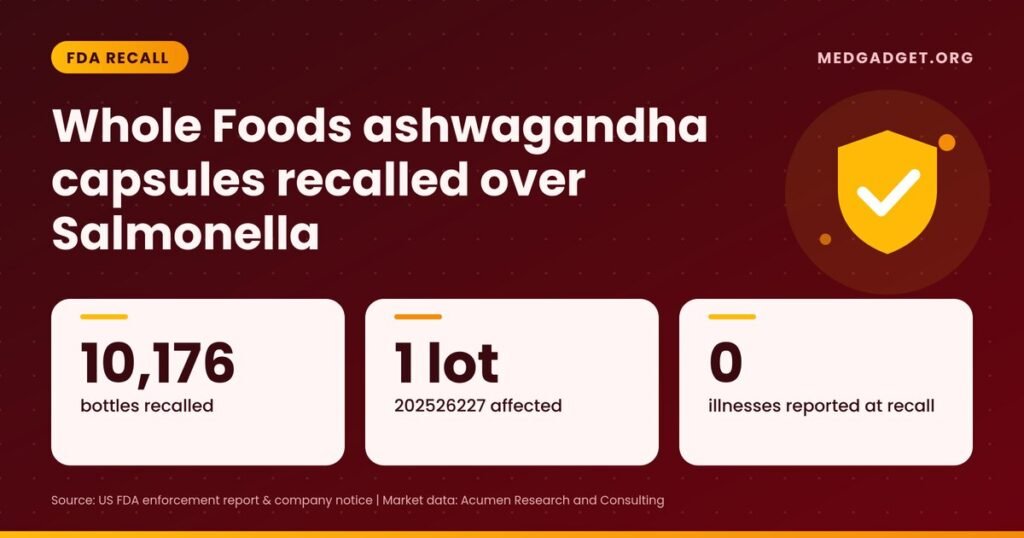

The Whole Foods ashwagandha recall covers 10,176 bottles of 365 Whole Foods Market Standardized + Full Spectrum Blend Ashwagandha Capsules (120 count) that may be contaminated with Salmonella, according to the US Food and Drug Administration’s enforcement report. The maker, Vitality Works Inc. of Albuquerque, New Mexico, started the recall on 23 October 2026 after routine testing of a single retail bottle, widened it to nationwide distribution on 30 October, and the case has now moved into the FDA’s risk classification process. Only one lot is affected, and no illnesses had been reported when the company announced the recall.
Key takeaways on the Whole Foods ashwagandha recall
- One lot, 202526227 (printed by the company as 2025-26227), expiry 13 October 2028, is recalled.
- The FDA enforcement report lists 10,176 bottles distributed nationwide.
- The reason is possible Salmonella contamination found during routine sampling.
- Shoppers should stop using the capsules, discard them and ask any Whole Foods Market store for a refund.
- Consumer press reports say the FDA has given the recall its highest-risk Class I label; the FDA entry we reviewed, dated 11 November, still showed it as not yet classified.
How to check the bottle in your cupboard
The quickest check is the bottom of the bottle, where the lot number and expiry date are printed. The recalled product comes in a white plastic (HDPE) bottle with a white cap and a Whole Foods Market label. Here are the identifiers from the FDA’s company announcement and enforcement report.
| Detail | What to look for |
|---|---|
| Product | 365 Whole Foods Market Standardized + Full Spectrum Blend Ashwagandha Capsules |
| Pack size | 120 capsules, 200 cc white bottle, white cap |
| Lot number | 202526227 (also shown as 2025-26227) |
| Expiry date | 10/13/2028 |
| UPC | 099482520991 |
| Product item number | 3006661 |
| Quantity recalled | 10,176 bottles |
| Distribution | Nationwide (Whole Foods Market stores; online sales also reported) |
| Recall started | 23 October 2026 (firm initiated, voluntary) |
If your bottle carries a different lot number, it is not part of this recall. Other 365 brand supplements and other ashwagandha brands are not named by the FDA.
What happened and how the timeline unfolded
Vitality Works, which manufactures the capsules for the Whole Foods private label, began the recall on 23 October. Its public notice, posted on the FDA recalls page on 30 October, initially referred to selected states before being updated the same day to reflect nationwide distribution. The FDA’s weekly enforcement report (event 100248) added the 10,176-bottle figure on 11 November.
The FDA uses three classes. Class I means a reasonable probability that using the product will cause serious adverse health consequences or death; Class II covers temporary or medically reversible harm; Class III is unlikely to cause harm. Consumer outlets including The Healthy reported on 19 November that the agency assigned Class I on 12 November. That is consistent with how the FDA usually treats Salmonella in ready-to-eat foods and supplements, but readers should treat the class as reported until the FDA database updates. By our calculation, the product sat on shelves for roughly 11 months, as reports put the sale window at 24 November 2025 to 20 October 2026.
Why Salmonella in a capsule matters
Dried botanical powders are not cooked before they are swallowed, so any bacteria that survive drying and encapsulation reach the gut intact. Salmonella can cause fever, diarrhoea (sometimes bloody), nausea, vomiting and stomach pain, usually starting six hours to six days after exposure. Most healthy adults recover within a week, but the infection can spread to the bloodstream and become serious in young children, older adults, pregnant people and anyone with a weakened immune system.
That last group matters here. Ashwagandha (Withania somnifera) is marketed for stress, sleep and energy, and some users take it alongside other medicines or during cancer treatment, when immunity may be lower. Anyone who has taken capsules from the affected lot and develops these symptoms should contact a doctor and mention the recall.
The bigger picture: supplement safety checks
Dietary supplements do not need FDA approval before sale in the US. Manufacturers must follow current good manufacturing practice rules, but the agency mostly acts after a problem surfaces. In this case the problem was caught by routine sampling of one retail unit, not by an illness cluster, which is the system working as intended but also a reminder of how much depends on spot checks. This follows other recent consumer recalls we have tracked, including the ORL toothpaste recall and the ALDI tortelloni botulism recall.
Market context: a fast-growing herbal category
Ashwagandha sits inside one of the busiest corners of the supplement aisle. According to Acumen Research and Consulting, the global herbal supplements market was worth USD 87.5 billion in 2023 and is projected to reach USD 156.3 billion by 2032, a compound annual growth rate of 6.8%. Acumen notes that Asia-Pacific holds the largest share and is also the fastest-growing region, and that adults are the biggest consumer group. As volumes grow, so does the number of lots that need testing, which is why single-lot recalls like this one are likely to keep appearing.
What is still unknown
- Where the contamination entered the supply chain (raw root powder, processing or packing) has not been disclosed.
- The Salmonella serotype has not been published.
- No illnesses had been reported as of 30 October; any later reports would appear in FDA or CDC updates.
FAQ
Which Whole Foods ashwagandha is recalled?
Only 365 Whole Foods Market Standardized + Full Spectrum Blend Ashwagandha Capsules, 120 count, lot 202526227 with expiry 10/13/2028.
How do I get a refund for recalled ashwagandha?
Discard the capsules and ask at any Whole Foods Market store for a full refund. Questions can go to Vitality Works on (505) 268-9950, Monday to Friday, 8 am to 5 pm Mountain Time.
Has anyone got sick from the ashwagandha capsules?
No illnesses had been reported when the recall was announced. The contamination risk was found through routine product testing.
Is ashwagandha itself unsafe?
This recall is about possible bacterial contamination in one lot, not the herb. Separate questions about ashwagandha’s side effects and drug interactions are best discussed with a doctor or pharmacist.
More consumer health safety coverage: Healthcare Services.
Sources: US FDA company announcement (30 Oct 2026) and FDA enforcement report event 100248; The Healthy (19 Nov 2026). Market data: Acumen Research and Consulting, Herbal Supplements Market report (updated July 2024). This article is for information only and is not medical advice. Last updated 20 November 2026.