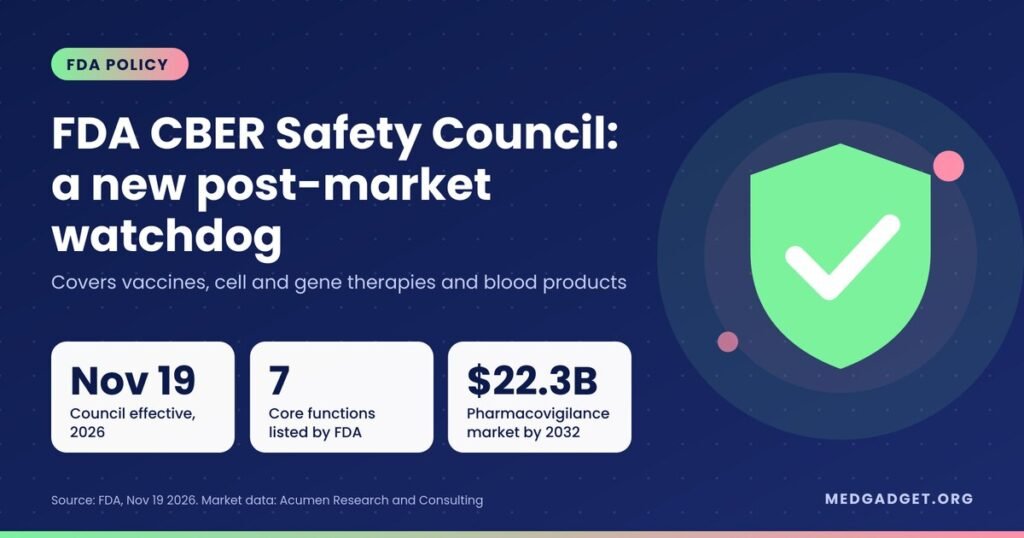

The FDA CBER Safety Council became effective on November 19, 2026, when the US Food and Drug Administration created a new internal body to review the safety of vaccines, cell and gene therapies, and blood products after they reach the market. The council sits inside the Center for Biologics Evaluation and Research (CBER), reports to the CBER Director, and is deliberately kept apart from the product offices that approve those same therapies in the first place.
For patients and families who rely on newer biologics, the change matters because post-approval monitoring is where rare harms tend to surface. Clinical trials for gene therapies often enrol a few dozen people; real-world use can reach thousands. The FDA says the new structure adds a layer of review that is distinct from premarket approval work.
Key takeaways on the FDA CBER Safety Council
- The CBER Safety Council (CSC) took effect on November 19, 2026, and covers all CBER-regulated biologics, including vaccines, cell and gene therapies, and blood products.
- It replaces and builds on CBER’s long-running internal Safety Working Group.
- A Senior Advisor for Postmarketing Safety manages the council and reports directly to the CBER Director, outside the product review offices.
- The council recommends actions such as label changes, risk management programmes (REMS), required post-market studies and market withdrawals. The CBER Director still makes the final call.
- Membership and operating procedures have not yet been published; the FDA says those details will follow.
What the FDA actually announced
In a short notice on its biologics news page, the FDA described the council as a new governance body made up of senior scientific and regulatory experts drawn from across CBER. The agency framed it as an evolution of the Safety Working Group that previously handled cross-product safety questions. Reuters, which reported the move the same day, described the council as superseding that group and formalising independent oversight of post-market safety, though the word “independent” is Reuters’ framing rather than the FDA’s.
The most important structural detail is the reporting line. In the FDA’s words, the council “will be separate from the CBER product offices, reporting directly to the CBER Director.” Put simply, the teams that judge whether a new gene therapy should be approved will no longer be the main voice deciding whether a safety signal after approval warrants action.
The council’s job, function by function
| Function | What it covers | Who decides |
|---|---|---|
| Signal review | Post-market safety signals across every CBER product category | Council assesses |
| Benefit-risk assessment | Structured reviews to support any regulatory recommendation | Council assesses |
| Labeling and REMS | Safety labeling changes, risk evaluation and mitigation strategies, Section 921 safety reviews | CBER Director acts |
| Post-market studies | Safety-related postmarketing requirements; post-approval and Section 522 studies for certain devices | CBER Director acts |
| Withdrawals | Recommendations on safety-related market withdrawals | CBER Director acts |
| Public communication | Safety communications issued promptly after significant determinations, with the evidence documented | FDA publishes |
| Coordination | Work with CDC, NIH and international regulators | Ongoing |
The council will draw on CBER’s Division of Pharmacovigilance, its surveillance programme and its benefit-risk analytics division. It will also use the established surveillance networks: the FDA Sentinel System, the Vaccine Adverse Event Reporting System (VAERS) and the CDC’s Vaccine Safety Datalink. Patients and clinicians should keep reporting problems through VAERS and MedWatch, which do not change.
Why gene therapy safety is under a brighter light
The FDA did not tie the council to any single product. Still, the timing follows a busy year of post-approval safety news for biologics. Earlier this month the agency confirmed that tumours in two children were linked to the spinal muscular atrophy gene therapy Zolgensma, a case we covered in Zolgensma Cancer Risk: FDA Confirms Gene Therapy Tumor Link in Two Children. Vaccine safety has also been politically charged in 2026 as measles cases rose and the US lost its elimination status; see our report on Pennsylvania’s measles death toll.
Reuters noted that regulators face mounting pressure to track cell and gene therapies once they are used in much broader populations than the trials that supported approval. Many of these products are one-time treatments with effects that last years, so late-emerging risks such as insertional cancers or immune reactions may only appear long after a patient leaves a study.
What changes for patients, doctors and drugmakers
For patients, nothing about access to approved vaccines or therapies changes today. The practical effect, if the council works as described, should be clearer and faster public safety communications, since the FDA has committed to publishing them promptly after significant determinations along with the evidence behind them.
For clinicians, the signal is that CBER expects to act on post-market data in a more structured way. That could mean more frequent label updates or new monitoring requirements for high-risk therapies.
For manufacturers, a separate safety body introduces a second set of eyes on products they have already won approval for. Companies with gene therapies, CAR-T products and newer vaccines should expect benefit-risk questions to be raised by people who were not involved in the original approval decision.
Market context: drug safety monitoring is a growth area
Regulators are not the only ones investing in post-market surveillance. According to Acumen Research and Consulting’s pharmacovigilance market report, the global pharmacovigilance market was worth USD 7.9 billion in 2022 and is projected to reach USD 22.3 billion by 2032, a compound annual growth rate of 11.2%. Acumen says North America held the largest share, while Asia-Pacific is expected to grow fastest, at more than 12% a year. By our calculation, the forecast implies the market will roughly triple over the decade (about 2.8 times). These figures come from a report last updated in October 2023 and should be treated as indicative.
Open questions
- Who sits on it? The FDA has not named the Senior Advisor for Postmarketing Safety or any council members.
- How transparent will it be? Operating procedures, including whether meeting summaries are published, are still pending.
- How does it fit existing offices? The announcement does not explain how the council divides work with CBER’s existing biostatistics and pharmacovigilance office.
- Will it affect vaccine policy? The council recommends; it does not set immunisation schedules, which remain with CDC advisers.
FAQ
What is the FDA CBER Safety Council?
It is a new internal FDA body, effective November 19, 2026, that reviews post-market safety signals for vaccines, cell and gene therapies, and blood products, and recommends regulatory action to the head of CBER.
Can the council pull a vaccine or gene therapy off the market?
Not on its own. It can recommend a safety-related withdrawal, but the CBER Director remains responsible for any regulatory action.
Does this change how I report a vaccine side effect?
No. The FDA asks people to keep using VAERS for vaccines and MedWatch for other products.
Why separate safety review from approval?
Keeping post-market review apart from the offices that approved a product is meant to reduce the risk that reviewers are reluctant to revisit their own decisions, and to give safety signals a direct line to center leadership.
Sources: FDA announcement (November 19, 2026); Reuters reporting. Market data: Acumen Research and Consulting. More in our Bio Technology section. This article is for information only and is not medical or investment advice. Last updated November 20, 2026.